


Forget the sun, the biggest push for Canadian immigration to the US is all about freedom and finance. We dive deep with International Lawyer and Investment Strategist Lauren Cohen, Founder of Investing Across Borders. She uncovers the eroding economic freedoms and the heavy shadow of Canada’s ‘deemed disposition’ tax. Lauren then shares her unique program for turning passive real estate investments into an active business. This strategy, often involving high-cap-rate co-living units, helps secure E-2 Visas or a Green Card via EB-5, providing a clear path for investors to build their future in the US. Tune in to learn how to make your strategic leap across the border and unlock massive US market opportunities!
Get in touch with Lauren Cohen:
Website: https://investingacrossborders.net
LinkedIn: https://www.linkedin.com/in/laurenesq
Facebook: https://www.facebook.com/eCouncilInc
Instagram: https://www.instagram.com/investing_across_borders
TikTok: https://www.tiktok.com/@investingacrossborders
YouTube: https://www.youtube.com/channel/UCc6urWxttkC6J6W04qYQSAQ
If you are interested in learning more about passively investing in multifamily and Build-to-Rent properties, click here to schedule a call with the CPI Capital Team or contact us at info@cpicapital.ca. If you like to Co-Syndicate and close on larger deals as a General Partner, click here. You can read more about CPI Capital at https://www.cpicapital.ca.
#avabenesocky #augustbiniaz #cpicapital
—
Watch the episode here
Listen to the podcast here
Important Links
- Capitalism and Freedom
- Investing Across Borders
- Finding Your Silver Lining in the Business Immigration Process
- The 5 Second Rule
- The Let Them Theory
- Investing Across Borders Email
- Lauren Cohen on Instagram
- Lauren Cohen on TikTok
- Lauren Cohen on YouTube
- Lauren Cohen on Facebook
- Lauren Cohen on LinkedIn
About Lauren Cohen
 Lauren Cohen is an International Lawyer, Realtor, and Investment Strategist with over 20 years of experience helping clients access U.S. and global markets through strategic investments, visas, and legal planning.
She founded Investing Across Borders and Elevare Global, offering concierge investment, immigration, and fractional C-suite services.
Known for solving complex problems and creating powerful connections, Lauren helps businesses and investors scale and expand with clarity and confidence.
Why Canadians Are Fleeing To The U.S.: Economic Uncertainty, Political Shifts & Cross-Border Real Estate – With Lauren Cohen, Esq.
We’re in our new studio in Naples, Florida.
We got a little setup here.
We’re upgrading. It’s going to be even nicer than this, but this is what we could put together briefly. When you are a company founder, startup founders, you’re living between Canada and the US, which is going to be a topic of our expert guest, coming on to provide us with her wisdom and experience and knowledge. When you are traveling between two countries and startup founders, investing in the US, partnering with Canadian investors, it ends up for you and your family to move a lot. We’ve been doing that over the last few years. That’s why we get all these different studios.
Milton Friedman: The TRUE Driver For Canadians Moving To The US
Quickly, I want to touch on one very important topic before we get into the show. I’ve started reading the book with Milton Friedman, Capitalism and Freedom. I finished reading chapter one, but there is such wealth of knowledge and information. It’s very intellectually heavy. There’s a lot of content there and a lot of information.
First thing I did when I started reading that first chapter, which is about politic political freedom and economic freedom, I remember right away I thought about Canada and how Canada’s political system is a socialist democracy. It’s interesting what it is and is exactly what Milton Friedman advises against, particularly when it comes to this idea. I want to briefly touch on this. He talks about when you have political oppression, lack of political freedom, it doesn’t always mean you’re going to have lack of economic freedom.

He makes an example of czars of Russia, Nazi Germany, fascist Italy and fascist Spain. He says they did have political oppression, but they had total economic freedom. He makes the reverse. He says, “Anytime you have no economic freedom, it is a case that you do not have political freedom.” Case in point, in the case of Canada, Canada ranks really high when it comes to freedoms as a free country. I think it ranks 97 on a chart out of 100, but we can see some economic freedoms eroding away and they weren’t there in place from the beginning. It goes against what Milton Friedman talks about.
How does that relate to this episode? We have an immigration lawyer who helps Canadians immigrate to the US and we’re going to talk about that. What who are her clients? Why are moving? She’s also very experienced in real estate. It really compliments the show. If you don’t have any comments, give a background of our guest and we can start the show.
Thank you for that, August. That was greatly great. All right, everyone, we’re joined by Lauren Cohen. Lauren is an International Lawyer, a Realtor and Investment Strategist with over twenty years of experience helping clients access US and global markets through strategic investments, visas, and legal planning. She founded Investing Across Borders and Elevare Global, offering concierge investment, immigration, and fractional C-suite services. Known for solving conflicts, problems and creating powerful connections, Lauren helps businesses and investors scale and expand with clarity and confidence. Welcome to the show, Lauren. We’re happy to have you here.
Thank you, guys. It was great. I was like chomping at the bit because Milton Friedman, I’ve read some of his stuff. Also, you’re talking about lack of economic freedom in Canada, and that’s really what’s the biggest driver right now, lack of freedom. Obviously, one of the reasons we both came was the weather, but right now the lack of economic freedom is, is a huge driver.
Especially as an investor.
Let’s touch on this very important point before starting the meat and bones.
We want to get right into it.
From Honeymoon To Deportation: How Lauren Cohen Became An Immigration Lawyer
We want to dive right into it. Lauren, in preparation of our show, I was reading through a bio that you did mention that like a sad, but a very interesting situation. Your husband at the time got deported. Let’s start the show right there. Tell us about what happened.
The funny thing is I think everybody thinks my kid is from that ex-husband, and my child is not his son. It’s very interesting because he’s like, “Mom, people think my dad was deported.” I’m like, “Yeah.” Anyway, so that is what happened. I met my now ex-husband. He was originally from Montreal. I met him here in South Florida. We went on our honeymoon to Thailand. On the way back, at Chicago O’Hare airport, they put him in immigration jail. They expeditiously removed him. They then deported him and sent me back.
It was insane. You don’t expect this return trip from your honeymoon. I ended up getting my green card soon thereafter. I was not a citizen yet. He was denied because he didn’t have status. He wasn’t able to come into the US and he was barred from entry. If not for that happening, though, that’s why my book is called Finding Your Silver Lining in the Business Immigration Process because if not for that happening, I would not do what I do now. I was an in-house lawyer and I probably would still be an in-house lawyer.
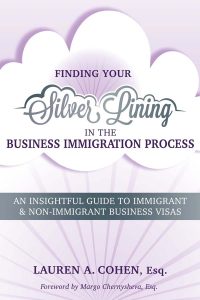
Finding Your Silver Lining in the Business Immigration Process
That was really the start of you wanting to get into immigration law and everything else.
Also, starting your own practice, I’m guessing.
I was just determined that other people shouldn’t suffer this a similar fate. They needed proper guidance. They needed somebody that really has their back. You guys can attest to this, you’ve been through it. It’s not easy. The process is not easy. There are pitfalls no matter how amazing your counsel and your guides are. People try to do it themselves. I was just talking about this with a marketing company and they hit walls and it’s a big deal. Even me, I was not in the immigration space and I didn’t know he was inadmissible. I had no idea. God works in mysterious ways.
The difference between Canada and the us we discussed that, and bringing in Milton Friedman and the way that economic freedom, political freedom and so on. We want to understand as far as your client base and the experience you’ve had with your clients, is your primary business helping Canadians immigrated to the US?
Not exclusively, but about 80% of my clients are Canadian. Just naturally.
The Ideal Client Profile: Why High-Net-Worth Canadians Are Moving South
That’s bulk of your business. You’re Canadian living in the US. It all makes sense. What is the client profile of somebody who comes and sees you? I just want to learn a little bit about their background. Who are they? How old are they? What type of business are they in? What’s the impetus for them wanting to move to the US? You were nodding while I was talking about Milton Freeman, but do they share those issues that we have in Canada, which are getting more and more these days? I can talk about it all day, but talk to us about your client profile. Who is the perfect client for you, for the services you provide?
I will say that that’s a morphine question. I say that because during and after COVID, which is when I think the impetus hit you guys, it was a very different driver than now. It was then about the restrictions and the rules related to COVID and the mask mandate. Just realizing that the world was bigger and that they could move and still go back and forth and have freedom and flexibility.
More recently, things have changed a lot because I developed this program called How to Immigrate Through Real Estate, people come to me because they know I’m going to take them through the concierge journey. There’s no one really that does that to the extent that I do of holding their hand through the process. The people that are just struggling to get ahead and making their first few hundred thousand that maybe don’t own a home, they’re not coming to me because they can’t afford our level of service.
We have a different service that’s available for them. My service is concierge. I’m working with people that have usually younger families. It’s either younger families or empty nesters. I say that because as you know, you’re not in this path, which is good. As with the E-2, which is the most common visa I deal with, a treaty investor visa, there’s no path to a green card. The problem with that is then when the kids hit 21, they’re out. If they don’t have a green card, there’s a problem. People come to me to figure out a strategy so that doesn’t happen. That’s the key. A lot of lawyers just get a visa. “Let’s get you a visa. You’re a number. Here we go. Stamp.” That’s not going to work for me.

Canadian Immigration: It is not one size fits all. Everything is strategic. If you don’t look at the strategy as a whole—family, business, investment, future, goals—then you’re missing the point.
If you have young kids, or if you have teenage kids, I’m dealing with somebody right now as a fifteen-year-old, my son’s age, that’s her biggest concern. It’s making sure that her kid is properly looked after and covered so that when she turns 21, she has a future. We have to look at different strategies. It’s a higher socioeconomic class. I would say 4 out of every 5 times now, somebody that wants to pave the path through real estate investing, which is something that I uniquely created.
Do they become a citizen eventually, or they don’t mind being on E-2?
It really depends, August, because some people don’t want to for tax reasons.
That’s one of our later on questions we’re going to be talking about. Ava wrote this great question. What was it called, Ava?
It’s called Deemed Disposition Tax.
That’s one of the worries of Canadians. We’ll get into that in a moment.
It is a big concern. I actually have a very dear friend, he’s had his green card for 30 years. He’s not moving back to Canada ever but he doesn’t want to become a US taxpayer full-time. There’s a lot of moving parts in the process. People think that it’s like, “I’m in Canada. I can just go there and start a business.” In theory, that’s true, but then what happens when you’re actually here? That’s why I built Elevare Global. How do you actually build your business? As you guys know, I’ve been here 25 years. It is not the same. People are not the same. The culture is not the same. It’s cutthroat, it’s much more capitalist, but there’s also so much more opportunity. If you are a true entrepreneur or a true real estate investor, your future is in the US.
If you are a true entrepreneur or a true real estate investor, your future is in the US. Share on XI think bigger market, 10x bigger market.
I wanted to talk about how you mentioned that the most common visa is E-2. I want to talk about what the end goal is for that specific client that applies for E-2 visa. What’s the end goal for them? They can’t get their green card.
E-2 Visa Vs. Green Card: The Long-Term Strategy For Families
If they go to the E-2 route, they don’t want to be a citizen unless they were misinformed.
What’s their goal? Is it to come to the US for a few years, then go back to Canada?
Sometimes, some people just want a place to get away right now. That was definitely the case during COVID as well. For long-term planning, they could take an E-2 and increase their investment and potentially qualify for green card through E-5. Sometimes they can start with an E-2 and build their Canadian business and then do what you guys did, which is an L-1. It really depends on where they sit in their home country. We’ll say Canada, since most of your audience are Canadian.
What are your end goals? How old are your children? Do you have children? Do you want them to go to school in the US? There is an opportunity at any point. Some of my clients do this, to invest in $800,000 and get a green card. The beauty of that is you get a green card for everybody in your family. If people have, let’s say, 3, 4 or 5 kids that are under 18, this is the best way to go because now, they are all going to go to school as non-foreign students. Suddenly, the rates for post-secondary school drop so significantly that it makes it worthwhile to invest that money because you’re going to save it on these kids
The most important thing that I can convey here, the most important element that I can convey is that it is not one size fits all in everything is strategic. If you don’t look at the strategy as a whole, family business, investment future, what is your goal? If you’re not looking at all of those, and most lawyers, we know this, I can say this, I am one, “They want a visa. Boom, check.” No, I’m looking at the family and the future and the business and the ROI.
It’s a lot of work. We just went through the process of getting an L-1 visa and we got accepted for a year, and then we did an L-1 extension, and then of course, as a spouse, I got the L-2. We had to put together a huge business plan. We had to give them our financials. We had to give them our projections of where the company was going. At the end of the day, we got approved in fifteen minutes because we’re the poster child.
It was a cumbersome and laborious process.
It really was. We did get stamped right away, so we were very excited about that, but I see the importance of sitting with you with the concierge service because it is just so complicated.
There are so many overlaps.
Economic factors, corporate.
This impacts that. You’ve got tax, then you’ve got legal liability, then you’ve got family. One thing that I think is really important that people don’t seem to acknowledge, even with a concierge service, it’s not going to be quick. It is a process. We have a 25-step process that we go through. We share it with our clients. We update them and let them know where they are in the process. That does not mean that they’re not going to hit walls. Here’s a perfect example. I have a client, we’re at the end of the process. We’re about to file. The legal team that I brought on has some health issues. They were MIA. I couldn’t even find them. Client’s freaking out. I’m ultimately responsible.
Lauren, keep in mind that all of your applications are the mercy of the US Homeland Security, US immigration. There are so many different layers on that side as well. There’s a lot of dependence. Let’s get through it because we know that your time is very scarce. I think let’s get through a few more important points.
How To Immigrate Through Real Estate: The Active Investor Secret
I think it’s a perfect time to talk about how you help your clients also make strategic investments in using their visas for pathways. Let’s talk about that.
Before that, it’s important to know because Lauren is also a real estate agent. She understands real estate. She understands the mechanics of real estate.
We should probably do this every week. We could be doing updates every week.
You’re a realtor. You understand real estate, you understand investments. You have a client that comes to you and you say, “Clients, I can help you if you make a $800,000 investment.”
No, that’s only for a green card.
Let’s focus on that.
That’s not going to be in a real estate asset. That’s going to be in a project. The EB-5 is usually a passive investment, and that’s a path to a green card. E-2 cannot be passive. That is why there’s always been a perceived problem with real estate, because real estate, why are you investing in real estate? Is it so you can be out there banging the hammer? No. You’re investing in real estate because it’s passive. We have to turn that on its head for a visa. My superpower is turning a passive real estate investor into an active real estate business owner.
Let’s say you guys came to me and you said, “We want to invest in real estate, or we invest in real estate in the US. How can you turn this into a visa path?” I would find avenues within what you’re doing that are more active to develop a business around your real estate investing. We circle the business around the real estate. Let’s say you are building your reits and your syndications, and you were building them. As the GP, that would be the active business.
My superpower is figuring out where is the active business and what they’re doing. My favorite asset right now is co-living, as I talked with your husband about it. Why? It’s because co-living is super lucrative, creates affordable housing and there’s more bang for the buck within the single unit. $350,000, you’re getting a 6-6 or 7-7 and your returns are really high. The cap rates are like 14%. It’s a nice path to a visa. It just depends. If you have assets already, if they’re not long-term single-family, we can generally work with them outside of that and make them work.
Let’s say somebody heard about CPI Capital, we partner with limited partners as passive investors. They found out about this option that exists that they can somehow invest with CPI and get some visa. What would that look like?
They’re passive. I’m just guessing here, we have a lawyer on the call. If you give them an active role within that partnership, and they’re a general partner to have active duties.
That could potentially work. This is what I’ve done with other syndications. We put the CPI investment as part of their overall investment structures, or part of their overall portfolio. It’s not the core of the business, but their business is developing a real estate investing business with different holdings. One of those investments is in CPI.
What’s the minimum investment for that?
It’s not about a minimum investment, it’s about building a business. Generally speaking, for the business itself, you’re looking at $80,000 to $100,000. That’s for the operations, which could be the hires and the marketing plan and the lease of space and so on. You could invest $5 million or you can invest $150,000 and they might have the same net result, depending on what you’re doing with that investment.

Canadian Immigration: It’s not about a minimum investment, it’s about building a business.
$5 million gets you a gold card.
That is true. Actually, I think the $5 million is the gold card expedited, so yes.
Let’s get going here because we want to get to the other segment as well.
WARNING: The Canadian ‘Deemed Disposition’ Exit Tax Explained
Doing some research, the Canadian government says if you’re planning on giving up your Canadian residency or citizenship, then they require you to pay this exit tax.
As long as you have assets in Canada. If you’re broke and you’re leaving Canada, like, “See you later,” nobody cares.
“Get out of here. Bye-bye. See you later. Have a nice day. Don’t come back and steal our healthcare.”
“Don’t come back.” Exactly. You’re not paying taxes anyway. See you later.
If you got money, let’s charge you something called the deemed disposition tax.
The name is on it, deemed disposition. We are going to just imagine that you already sold it at today’s market price and you lost the tax on it right now.
Why don’t you dive a little bit more into that, Lauren.
Yeah, I’m going to do my best, but I am not a tax advisor or a tax expert. I’m also wanting to say that everything I say in here is not legal advice because I am a lawyer, but I’m not giving legal advice. It’s general information. I have to make that disclaimer. We have tax advisors on our team, tax accountants, tax lawyers that always speak with our clients. The deemed disposition happens when you become a US taxpayer.
That doesn’t only happen based on how many days you spend in the US. It happens based on a variety of factors. I think there’s seven factors. If four of those factors apply to you, you’re considered a US taxpayer, and then you have a deemed disposition. You can elect to have an exit or you can have them tell you to have an exit, or you can speak with tax advisors to figure out what’s the best strategy for you. It is a big deal, especially for high-net-worth people. That is why some people do choose not to become US taxpayers.
What blew my mind was some of your assets, not all of them, you have to pay taxes as what they’re worth, even though you didn’t sell them. That was mind boggling to us. That’s Canadian government for you, I guess. Let’s segue into the next topic. I wanted to talk about tariffs, Lauren.

Tariffs, COVID, And Anti-Semitism: The Political Drivers For Emigration
Before tariffs, one quick thing. You were talking about the flow of clients coming and seeing you. COVID happens, a lot of people don’t like the freedoms that exist in Canada. Limitation. They want to go to places like Florida and Texas. They come see you to get an E-2 to get away from Canada. Later on, after COVID is all settled at this juncture, there are people coming and seeing you want to get an E-2 to move here, to buy a piece of real estate. Talk to us about, since tariffs have come around, has there been a flow of people or actually the lack of people coming and seeing you saying, “There’s tariffs. I don’t want to immigrate at this time.” Talk to us about if it had any effects in that sense.
Absolutely. It has definitely been game changing. It had a game changing impact on my business. I am a dually licensed lawyer, so I now take people to Canada as well as to the US and, for that matter, nine other countries, because I have to, and why not? Why not have a global presence? Why not be able to have access to multiple countries and multiple statuses?
The tariffs, especially for the first six months of 2025, Canadians were, to put it bluntly, pissed, including my own mom, that’s another story, who said, “I’m never coming again.” I’m like, “Your grandson is American. You better show up at some point.” It’s been a very big deal. I live in a country club here in South Florida, and I would say maybe 10% of the homes are Canadian owned by Canadians. A lot of those are snowbirds. I haven’t seen very many Quebec plates, but I’ve seen tons of Ontario plates here.
Florida is a mecca for this, for Ontario and Quebec, more so than the other provinces and they’re just driving down and whatever. I have seen that people are less pissed off with the tariffs and more pissed off with Canada. That is driving things because of what’s going on there. I don’t want to get into religious politics, but that’s another factor as well, because there’s a lot of anti what stuff going on. It’s also a very big driver of people like, “Get me out of this place. Get me away from this. I’m sick and tired of this, and why deal with the winter when I can be in Florida, enjoying my life and not dealing with all the drama?”
We were in the middle of a capital raise while the tariffs were being slapped in our face as well. We did see a significant amount of Canadian investors drop out of the deal. As tariffs were fluctuating, we had investors coming back and saying, “I want to get back into the deal again.” It was such an emotional situation that was happening.
Last question before we get to the next segment of the show, unless you have any other questions, Ava. We see an Israeli flag behind you there, and Cohen is a very prominent Jewish last name. Canada has a large Jewish population because it’s a safe country. Jews can feel safe in Canada. US has the highest Jewish population outside of Israel.
I always wonder because there’s a lot of Jewish people in the East Coast, a lot of people in the private real estate, private equity space because some companies that we know about have done tremendously well in investing in the US. I always wondered why they keep staying in Canada. I think there’s close to 300,000 to 400,000 Jews that live in Canada alone. Why did they decide to stay in Canada?
The obvious reason is because they’ve been there for generations and so on, but the US is so welcoming, biggest market in the world. You touched on this in a very subtle way, but obviously, Canada’s changing a lot, a lot of immigration, a lot of things happening. You have even Canadian politicians. Our prime minister basically said that he will arrest Benjamin Netanyahu if Benjamin Netanyahu came to Canada. That’s a big statement.
Have you had any Jewish Canadians that are thinking about moving these days? Have you seen that? The reason I bring that up is because in 1979, when the revolution happened in Iran, which Iran turned from a constitutional monarchy, a liberal, a very secular country into an Islamic fundamentalist country. It ended up resulting in an eight-year war with Iraq and so on. The country went back to the stone ages. A lot of Iranian Jews at that time left Iran for places like Southern California and so on. Are you seeing such similar analogous to Iranian Jews leaving Iran pre-‘79 to Jewish Canadians possibly making the move to the US?
Absolutely, especially here where I am in South Florida, 100%. There’s so many Canadian Jews that have made the move. The Toronto mayor, who is a big anti-Semite, raised the Palestinian flag at Toronto City Hall. It’s appalling what’s going on. I’m going there to Toronto. I was just on a networking thing with a girl, and she’s an Israeli Canadian.
I mentioned something about Israel and she wrote to me separately in the chat, “Don’t tell people I’m from Israel. I don’t want them to know.” That’s a reality of what’s going on in Canada. It’s very sad. I’m very obviously outspoken about it. My name does give it away. It’s a very big factor. Antisemitism is rampant in Canada.
One very important point on that is that, yes, there is a war between Israel and Palestine. There is a conflict going there for 70, 80 years now, but all Jews around the world shouldn’t be paying for what the Israeli government and Israeli regime and Israeli military is doing there. A lot of them are very secular. They don’t subscribe to certain ideas. Even if you take those very liberal Jews, they’re being bunched up. It’s terrible for Jewish people around the world with the marketing. If you look at it as marketing, it’s very bad marketing for them, what’s happening?
Terrible marketing.
Let’s get to the next segment of the show. We know you have to run and you have a lot of clients.
10 Championship Rounds: Best Investment, Retirement, And Life Advice
August, you’re great keeping us on time, so thank you for that. Lauren, ten championship rounds to financial freedom. Are you ready?
I don’t know, but I’m going to try my best.
Amazing. You’ll do great. First question. Who’s been the most influential person in your life?
My dad.
Briefly tell us what was it?
I lost my dad to ALS and he fought a fight and it was the hardest thing I’ve ever been through. He is watching me all the time. Everything I do, he’s there somehow or other, good, bad or otherwise.
God bless. What did he do for a living quickly, if you don’t mind me asking?
My dad sold cars and sold tires and he had a garbage disposal business. Neither my parents went to college. My mom was a realtor. She should still be, but that’s another story. They were not college educated.
I’m going to break this stereotype. Not all the Jews rule the world. There are ones that sell cars. Alright, let’s go to the next one.
Alright, Lauren, next question is, what is the number one book you would recommend?
That’s a hard one. I think Mel Robbins, The 5 Second Rule. I love that book. I try to practice it, but sometimes I forget.
That’s a good one.
Actually, her other book, which is called The Let Them Theory, have you read that one?
I have not, no.
It’s so great. It’s like, let them. Let them think what they want. Let them do it. Who cares? Just move on, push through it. Let Them is even better.
Start with the five second rule. That’s awesome. Love it. Next question. If you had the opportunity to travel back in time, what advice would you give your younger self?
Spend more time with your dad and do what you want sooner.
Next question. What’s the best investment you’ve ever made?
I think investing in myself is the best investment because that then helps me invest in others and helps me be a better person and be a better service provider. Maybe be a better mom, although not lately because he’s fifteen, but that’s another story.
Yeah, that’s a difficult time. Alright, next question. Lauren, what’s the worst investment you’ve ever made and what lessons did you learn from it?
I don’t know what’s the worst investment I’ve ever made. I think that holding on to some things, maybe relationships, maybe other things for longer than I should and not letting them go for the wrong reasons, that would be the worst investment of time, of effort, of energy, of me.
Of course. Even in a corporate setting. Hire slow, fire fast.
All right, Lauren, next question. How much would you need in the bank to retire now? What’s your number?
There’s no such thing. I’m not retiring. I could have $50 million in the bank and I’m not retiring. What would I do? I’m going to go to the club and play pickleball all day? I don’t think so. No, not happening.
Yeah, exactly. You got to keep your brain working.
It’s just not happening.
Unfortunately, lawyers, when they do retire, they soon after die. Lawyers should never.
That’s hopeful. I’m very optimistic now.
Lauren, next question is, if you could have dinner with someone dead or alive, who would it be?
My dad. Notice a theme. I’m going to start crying. It’s always going to be my dad.
Next question, Lauren. If you weren’t doing what you’re doing today, what would you be doing now?
I would be a buyer at some type of department store. I always wanted to be a buyer for Bloomingdale’s. I love doing marketing and finding designs and all kinds of stuff. That’s probably what I would do. Maybe I would just work at Kernels in the popcorn shop and just eat popcorn all day. Remember Kernels with all the flavored popcorn?
Lauren, my favorite question. Book smarts or street smarts.
Street smarts every day because they’re going to get you further in life. You can always learn, but you can’t get street smarts.
Street smarts are going to get you further in life. You can always learn, but you can't get street smarts. Share on XLast question, Lauren. If you had $1 million in cash and you had to make one investment now, what would it be?
I would buy co-living units very quickly.
Co-living unit means multiple people can live in the same unit?
Yeah, they each have their own. Essentially, it’s like glorified student housing where you take a single-family home and turn it into like a 5-3 or a 6-6 and each person rents individually. It’s like a mini multifamily. It’s like what you’re doing, like scaled back to a small version and you can do multiple levels and then it becomes multifamily. Literally, they share a kitchen. Ideally they share a living room, but everything else is independent.
I didn’t realize the cap rates were that high on that.
Very high. Happy to share that with you, guys.
Expense ratio might be higher too. You never know. We’ve got to look into that.
Lauren, just let all the people reading know what the best way that they can reach you, please.
Everything I do is under the brand Investing Across Borders. I also have Elevare Global, but even that is through Investing Across Borders. You can find me at Hello@InvestingAcrossBorders.net. Instagram, TikTok, YouTube, Facebook, LinkedIn, Investing Across Borders. I’m very big on LinkedIn. Actually, that’s where we reconnected. I’ve known you guys a long time. I think during COVID.
I’ve talked to Lauren before. We had the boys, like way back in the day. Talking about having a son, actually.
It is life changing? Yes.
Thank you so much for being here with us.
It was a pleasure.
Great to catching up with you. I love watching you grow and build and have all these people that go across borders back and forth. Thank you so much for all the knowledge and wisdom. Really appreciate it. Everybody else, you just got an interview with a lawyer without having to pay any money. Like and subscribe.
That’s what you call bringing value. Thank you so much.
Thank you, Lauren.