

Are you a multifamily investor struggling to boost NOI and cash flow in a competitive market? You may be overlooking one of the most powerful, yet underutilized, value-add strategies: solar panels for apartment buildings. In this episode, we sit down with clean-tech entrepreneur Owen Barrett, founder of Shine, who reveals how his company solved the “split incentive problem” that has historically prevented solar adoption in the industry. Learn the simple math that shows how spending $4,200 per unit can generate $11,200 in value—a 3x return on cost—and why this strategy is purely about finance, not environmental feel-good metrics. Discover the secret to transforming rising electricity costs from an expense into a revenue stream, and how you can use this strategy to significantly increase your property’s valuation and returns.
Get in touch with Owen Barrett:
Website: https://www.getshine.com
LinkedIn: https://www.linkedin.com/in/owenmadsenbarrett
➤Newsletter: Join 10K+ investors reading the CPI Capital Newsletter each week: https://cpicapital.cpicapital.ca/newsletter
➤Investors: Access CPI Capital exclusive investment opportunities: https://cpicapital.cpicapital.ca/investor
➤Underwriting: Access to CPI Capital’s proprietary back of the envelope underwriting model: https://share.hsforms.com/14uV3n5iJStO6Soy2RO6tmQ4rx4j
➤Website: https://cpicapital.com/ (https://cpicapital.ca/)
#avabenesocky #augustbiniaz #cpicapital
—
Watch the episode here
Listen to the podcast here
Important Links
About Owen Barrett
 Owen Barrett is a clean tech entrepreneur and founder of Shine, a turnkey solar solution for multifamily real estate.
He previously led $60M in energy projects at a Fortune 100 company, built and scaled an eight-figure energy efficiency company, and later focused on decarbonizing apartment buildings through ZNE Capital.
Today, his mission is focused on scaling real-world climate impact by deploying existing clean technologies faster across real estate.
Solar Panels For Apartment Buildings: How Multifamily Investors Increase NOI & Cash Flow – Owen Barrett
Welcome to Real Estate Investing Demystified, our second show of the day.
That’s right. You’re very transparent. I love your transparency. That’s why you’re very good with investors because we want to make this look like this show took days and weeks to prepare and we planned for it. No, you say we did two shows.
Did a quick outfit change. Here we are again.
You did do an outfit change. What we can’t see is your beautiful hair is covering your outfit. The show is very interesting. I am a very free market capitalist guy, I’m a Milton Friedman type of guy, not everything that he said but mostly that I think free market will prevail about anything. My background, I come from Iran, which is a country that not only don’t you have economic freedom, you don’t have any other types of freedom either, social freedom or political freedom. I love that idea. That’s why after living in Canada for a long time I made my move to the US and I brought my wife with me and I had both of my sons born here in the US because I really believe in that idea in that Jeffersonian libertarian type of idea of the United States and the free market that exists.
Now, I lived in Canada, I lived in the most liberal province of Canada, British Columbia, and then I lived in the second most liberal city within that province which is Vancouver. The most liberal city is Victoria. I saw levels of bureaucracy that existed in different levels of government that screwed things over for business people and everybody else.
One of those items was things related to efficiency and environment when it came to gas pipelines but in the construction industry as well. I’m very familiar with that. Our guest is somewhat in that space in renewable energy I believe it’s called. He’s had an incredible journey, so we’re going to be discussing that. Again, I’m coming this from a lens of somebody who is anti anyone who’s trying to push these ideas about, “We’re doing this because of global warming. Come and invest in this idea,” or, “Put these panels on your house because it’ll save the environment.”
Not that I don’t care about the environment, I just feel that they’ve been taken hostage the way that my country Iran was taken hostage by the mullahs and the Islamic priests. I hate any type of these shows of trying to take control of people’s lives and what have you. Anyways, why don’t we give a background to our audience about our guest and we can start the show?
Introduction Of Owen Barrett & His Mission
All right, we are joined by Owen Barrett. He is a Clean-Tech Entrepreneur and Founder of Shine, a turnkey solar solution for multifamily real estate. He previously led $60 million in energy projects at Fortune 100 companies, built and scaled an eight-figure energy efficiency company and later focused on decarbonizing apartment buildings through ZNE Capital. His mission is focused on scaling real-world climate impact by deploying existing clean technologies faster across real estate. Welcome to the show, Owen. We’re excited to get into things with you.
Thanks for having me on.
One quick thing before that, I got to also mention I also married a woman from the most conservative province in Canada which is Alberta. I had to include that there. Owen, why don’t we start with ZNE Capital? The word capital so it sounds like private equity and investment firm and but you’re not in that space anymore, I don’t believe. Start there, please, and tell us about your journey.
ZNE Capital & The Solar Financial Model For Multifamily
Yes, the whole story with ZNE is what led us to Shine. I had just sold a company, a niche energy services company in California. I had some capital I wanted to invest. I got attracted to multifamily syndications. I noticed that most operators don’t have a clue when it comes to energy, which I thought was really fascinating. Everybody’s obsessed with renovating units and driving rent that way, but nobody was interested in cutting expenses. They are now because the environment’s changed. In 2018, nobody was thinking that way.
I wanted to show that when done correctly, onsite solar was accretive to multifamily syndications. If you had your traditional project level return of 18% and you do solar the right way, you could actually increase that 200, 300 basis points to 20%, 21%. That was the premise with ZNE. If we buy these multifamily properties, if we combine onsite solar with the more traditional value-add strategies, we could squeeze out higher returns for our investors than just a traditional value-add strategy. That’s exactly how it played out for 650 units across the Midwest.
What are those units now? Have you wrapped it up and divested them or you still own them?
We still own them.
Give us a quick overview of how the business model worked. I’m guessing you didn’t go to a third party that you guys would install, you would have a contractor install these solar panels on your properties. Did a selected properties would be accepted that would match having these solars, depending on the roof pitch or other means. Was there a certain criterion of properties that you could put these solar?
We partnered with a multifamily operator to run everything real estate because we recognized we’re not real estate people. We don’t know how to do that. We’re clean technology and finance people. We know how to do that. At the time, we targeted what’s called a master-metered property, so that’s an apartment property that’s built like a hotel. You may have 250 units but you have 1 or 2 electric meters. We did that specifically because that was really easy to install solar on.
It’s a lot easier to install solar on a property with two electric meters than a 250-unit property with 250 electric meters. We self-performed the solar, so we installed it ourselves because again, that’s what we know how to do. Our partners ran the real estate side. Our projects, because of the onsite solar, had higher returns than they would without it.
Could you measure that?
Yeah. That’s a great thing about energy. It’s so easy to quantify. If you’re offsetting common area consumption, you have an electric bill pre-solar and post-solar. If you’re installing solar onto tenant meters, you have no solar income pre-solar and then you have solar income post-solar. Part of the reason that I like energy, the reason that I’ve always been drawn to it is because it’s not a gray area. It’s math. It either makes sense or it doesn’t. It’s easy to quantify in Excel. It’s easy to drive decisions from a quantitative perspective. The big reason that I’ve been so obsessed with energy is because it is so quantifiable.
I did some research before the show and Redfin actually states that homes with solar panels increase the cost, the value of the home by 4%.
Yeah, that’s average too, nationwide. I think it’s higher in places like California and New England and lower in places with cheaper electricity. Again, it all depends if it’s done right. If it’s done right, it’s generally accretive. If it’s done wrong, then you get horror stories.
The reason I asked that is because you guys haven’t divested those 600 units yet, but I’m wondering if you got a higher sale price as a result of having that or maybe higher valuation when you did go to your clients. Now, having this idea of solar panels becoming very common, even Elon Musk getting involved in solar panels and with his tile roof business model. It went down for a while, it picked up again. I’m not sure where he is with that, but it wasn’t as expansive as many of his other initiatives.
When I personally drive through cities and markets in the Sunbelt, if it’s San Antonio, if it was Phoenix earlier on in CPI’s beginnings, if it’s other markets, I rarely see solar panels on apartment communities. Is it just a cost prohibitiveness, is it just because the education is not there? Is there other reasons why isn’t it as common if it’s simple math and you have proved it in those 600 units that you owned?
Solving The “Split Incentive Problem” With Software
The main reason is something called the split incentive problem. If you put yourself in the position of the owner, you, the owner, have to pay for solar onto tenant units. Tenants benefit. No capitalist is going to do that. You’re not going to pay $1 million so that your 100 tenants can each save $100 a month. Doesn’t make any sense. That’s why we had to develop the software that we developed which helps owners monetize the energy that’s going to the tenants.
When you have your average 250-unit apartment building, if you want to install solar, you’re actually installing 250 small solar systems, each one into an apartment unit. You need software to monitor those 250 systems and to bill 250 tenants for how much energy they’re using from the onsite solar. Unless you have an automated way to do that, then you’re stuck in split incentive problem where the owner is expected to pay for solar and the tenants are going to benefit and that’s never going to work.
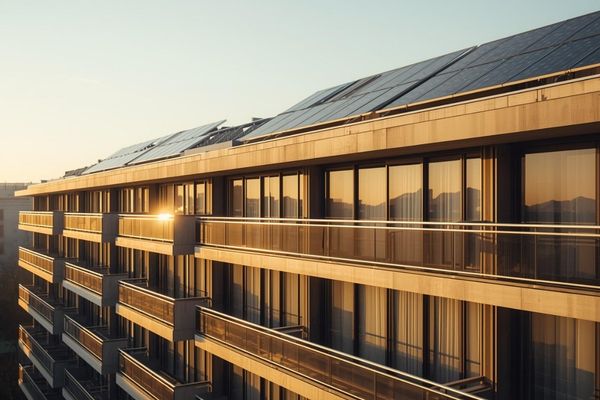
Solar Panels For Apartment: In an average 250-unit apartment building, installing solar means you’re actually installing 250 small solar systems—one for each unit. You need software to monitor all 250 systems and to bill each tenant for the energy they use from the onsite solar.
Let’s visualize that. I think that’s the foundation of your business right there what you just said. You have a 100-unit apartment community on let’s say 5 buildings, 20 units per building. You want to measure how much electricity you’re providing to each unit. Your firm has created a software to do so, but I think there is a hardware functionality as well between the power that panel is producing and the wiring and the software that measures it but there’s got to be another component there that fractionalize it between each unit and sends you the information into your software.
That’s what your company developed. You guys were going after those hotel-like communities where there was one meter and then you’re like, “This isn’t going to work.” you contacted the companies to say, “We need to create some a technology that can individually meter each unit.” And then your company actually had to create it yourself because they wouldn’t offer that?
Exactly, they wouldn’t offer that.
Let’s get into that.
The nice thing about our business model is the way that apartments are built solved a lot of problems for us. The best use case for us is like a two-story garden-style property. In a two-story garden-style property, we offset about 40% of the electricity at every apartment unit. Each unit is going to continue to use electricity from the grid. It’s just going to have its electricity decreased by about 40% thanks to the onsite solar.
What our software does is, let’s you have your resident in, say, California, San Diego Gas & Electric is the utility. Residents still have their utility accounts with San Diego Gas & Electric, but their bills are decreased from the onsite solar. Our software measures that decrease and then sends them a bill every month and then that money goes to the owner. Now the owner’s paying $1 million for solar, but they’re collecting $45 per unit per month from each resident to justify that million-dollar CapEx spend.
They’re collecting the savings.
They’re billing the savings back to the tenant.
Back to the tenant and paying themselves.
Yeah, of course. Is it a better rate or they’re selling it to the tenant at the same rate as the energy company?
That’s ultimately up to the property owner. Generally, we see like a 5% to 10% discount on electricity rates from solar compared to the grid. Owners are open to increasing that discount but they’re generally profit motivated. The higher they apply that discount, the less money that they get, the owner.
You talked about CAPEX. We understand how capital expenditure, if it’s renovations, if it’s for example washer-dryers, if you’re spending $500,000 on washer-dryers and that results in your NOI increasing, NOI related to the exit cap rate, you might make $1 million from that increase in NOI relative to the $500,000 you spent. How’s your firm does the math on, “This is the cost on the panels you’re going to be putting and the software and then this is going to be your increase in NOI and relative to your exit cap, you’re actually going to make a higher valuation you’re going to increase the value of the property?”
On a per-unit basis, it costs about 4,200 bucks to install solar. That generally creates about $672 in NOI. If you put a 6 cap on that, it’s $11,200. You’re spending $4,200 to create $11,200 in value. It’s over a 3x return on cost.
Your clients, are they financing these? Is there a financing option? What’s the interest on financing, or are they buying it cash out? What works better? What is your recommendation?
Our recommendation is always to pay for it with cash if you’re well capitalized because then you don’t have to deal with another lender. We do have some groups that finance it and that’s mainly just because they’re trying to avoid the upfront cost, they don’t want to deal with the maintenance of these systems. When you finance it, the bulk of the benefit goes to the lender. It’s the way it is. If groups are trying to capture the majority of the benefit, then they have to be well capitalized and have some cash to put into the project and if they don’t, they can finance it and then they get about 25% of the benefit.
Initially, we started the conversation that a lot of apartment communities don’t have solar panels, so there is a learning curve that exists for current investors and owners. Prior to the show you mentioned that is changing, but because of that, when you come and see somebody who owns let’s say 100 units in 5 different buildings, is there an option to start basically in one building first to see how that increase in NOI exists and then to scale, or does it make more sense to do all buildings at the same time?
In theory that exists, we don’t deal with that. We deal more with institutional groups. We’re dealing with 2 of the 5 largest multifamily owners in the US, publicly traded reits. They’re not talking about piloting 1 building, they’re talking about doing 25 properties at a time. You could pilot it. You’re going to yield the same results that you would if you did the whole property at once, they’re just going to be smaller. Solar’s not a new technology. Solar’s been around since the ’70s. It works. There’s no questions. Electricity rates are going up. There’s no question there either. The economics of solar are good nowadays and they’re only going to get better thanks to the rising electricity rates that we’re seeing across the country.
Partnering with those institutional groups, it will help you reach your goal of decarbonizing 200,000 apartment units by 2030.
We’re well past 200. I had an important question but lost track of my thought. All right, so is there a maintenance cost for your services or is it install it, set it, forget it, is out there?
There’s a little bit of a maintenance in that example that I gave earlier where on a per-unit basis it created about $672 in NOI. The ongoing maintenance per year’s about 50 bucks per unit. It’s pretty insignificant relative to the NOI that’s being created. It’s not mandatory. It’s a good idea. Most of the maintenance issues that we see in solar are just due to no one’s monitoring the system.
When a component fails, nobody knows that it failed and then it’s offline for a long time as opposed to if you have a company monitoring the system and something goes down and then it’s flagged, we can roll a truck out to the site and replace that component and then you avoid that downtime. It’s usually pretty easy issues to troubleshoot.
Follow up on that. If the solar and your equipment fails, the tenant can still buy the deficit in energy from their initial energy supplier.
Yeah, exactly.
There is no storage on any of this. It’s not storing anything. It’s just supplying it directly?
We’re starting to look at some storage in California. In order for storage to make economic sense, there has to be an arbitrage play. What I mean by that is like in California, on-peak electricity may be $0.50 per unit and off-peak, like midnight to 8.00 AM, is $0.08. If you can charge your battery during off-peak when it’s $0.08 and then discharge it when it’s on-peak at $0.50, you’re arbitraging that $0.42 and that’s how you make the numbers work. Most states in the country don’t have that big discrepancy between on-peak and off-peak so storage, it’s hard to get it to pencil.
Most of the maintenance issues we see in solar are simply due to no one monitoring the system. Share on XThat was one of the big pitches of Elon Musk with his solar roof tiles.
I don’t think the roof tiles had storage.
The storage is downstairs in the garage, the main place. It goes back in there and that was one of the pitch they’re saying that you can sell it back to the grid. All right, any questions before I switch the conversation, Ava, because I think I took most of your questions?
Owen, can you give us a crash course on ESG and how business for profit can be layered in it to try to save the planet?
The ESG/Financial Motivation Debate
This is actually like a personal point of contention for me. I actually think that energy, the E, should be stripped from the S and the G, the social and the governance. S and G is a lot of gray area. It’s like, feel good, maybe we should do it. I don’t live in that world, I don’t like that world. I think it makes my E world look bad. I would actually say that I think we as an industry need to separate E from S and G because E is just, again, math, it’s dollars and cents. Projects make sense or they don’t. S and G is more of a nuanced world. I don’t know if that answers your question.
You must encounter it a lot. If I was a founder of your company, that would be a strategy we’d be utilizing to say, “Not only you are going to be saving money here, it also helps with saving the planet.” in some of the courses we’ve taken when it comes to investor relations, they talk about that people don’t want to just invest in companies and just for profit, they want to also do something or help someone. We’re thinking about starting a foundation, investment with purpose ideas.
Going back to the core of free market, we feel that things got to financially make sense and then it will trickle down and people will, the right minds and the doing the right thing will prevail and they will help the environment. Who wants the poles to, the ice in the polar caps to melt and the sea levels to rise and all the animals dying and what we leave for our children and grandchildren not to be what we had? If I had a booked call with you and you were getting on a call to sell me this idea on my apartments for solar, I would just prepare myself that you’re going to be pulling that up, but it seems like that’s not an angle you use at all.
Not really, because it doesn’t drive decisions. People don’t make decisions because polar bears have more ice to live on or we’re going to stop deforestation in the Amazon. They make decisions because it makes them more money. If those decisions come with positive environmental externalities, then that’s great and that’s what keeps me going. I think if I were to lead with environmental metrics to an institutional real estate group, I would get laughed out of the room.
We have the data that if someone asks us, “What’s the environmental impact of this project?” we can calculate that in seconds. In my years of being in this industry, I’ve honestly never once gotten an environmental question. They’re all financial questions because that’s how every organization makes decisions even if they have an ESG department.
You just talked about your company, is it still in startup phase or are you past that phase? Have you gone from being a partnering with an owner, implementing these solar panels, creating actually the software to utilize them, talking about large institutions, large reits in the US? Where are you at within that journey? What are some hurdles that you face currently? This company, I’m guessing it’s Shine. What would allow this company to become a powerhouse when it comes to energy across the US?
I think from a revenue perspective, we’re more of a growth stage company than a startup. I think from tenacity perspective, we’re more of a startup. I never want to lose that. I’ve worked in big companies, I’ve worked with big companies, I see how slow and bureaucratic they can get. We always want to stay hungry and nimble. I think that’s just a core corporate culture for us.
We’re growing at an incredible rate. We did $500,000 in 2023, we did $5 million in 2024, we did $18 million in 2025, we’re probably going to do $75 to $100 million in 2026. We’re getting traction. For us, it’s just getting the word out. Every time we have a conversation with a real estate owner, it’s the first time they’ve ever heard what we’re pitching.
As you mentioned before we started, the real estate industry is not one to adopt new things quickly. It’s a slow-moving industry, very risk averse. We’re getting incredible traction, but I think for us to become a powerhouse in this industry, we just need to execute because good execution leads to word of mouth, it leads to just positive references and that’s what we’re all about. We’re about executing well on the projects that we have in front of us and using that to snowball into bigger momentum more customers.
When it comes to particularly multifamily value-add investors, finding different ways to increase NOI, everybody’s trying to pull a rabbit out of a hat to have more ways to increase NOI if it’s through selling Wi-Fi back or when we look at apartments in our markets we always look at inefficiencies or what they’re not utilizing, if it’s covered parking, if it’s selling Wi-Fi as I mentioned, if it’s valet trash. There are all these different ways.
I’m just shocked and surprised when the Sunbelt is such a vast area that solar is not becoming one of those value-add options that you can actually sell to your investors as an investment firm as well. Have you been involved in that side in before a firm buys a community saying, “Listen, on your future projects, this can be part of your value-add strategy to get more investors and get your investors comfortable with your business plan?”
We’re doing it all the time. We’re working with a couple groups that are developing projects in Nevada, so we’re plugging into like the development process which is great. We’re doing a lot of projects in Texas. Coincidentally, going back to free markets, Texas has regulated energy markets and deregulated energy markets. As a free market guy, you would probably expect the deregulated markets to have lower prices, but they’re like 2 to 3 times higher than the regulated markets, which doesn’t make any sense.
Why is that?
It’s because they’re investor owned and investors drive profits and figure out different ways to squeeze ratepayers. You have regulated markets like Austin Energy, San Antonio’s regulated, and then you have deregulated markets like centerpoint in Houston and Oncor in DFW. Centerpoint and Oncor are 2 to 3 times more expensive than Austin Energy and San Antonio. It’s just interesting how you think you understand free markets and support it but in reality you get the opposite result, which is always surprising to me.
We have to work in the areas where the utilities haven’t put their finger on the scales too much. In Arizona, both utilities in Phoenix are manipulating the market so it’s hard to get solar to work even though there’s a ton of sun. In other markets, it’s closer to free market mechanics. It’s not quite there, but in those instances, projects tend to pencil better.
I agree with everything that you’re saying, I think the thing that we have to remember is that utilities are at play here too. Utilities inherently hate solar because it’s disruptive to their business model so they’re doing everything that they can to prevent solar from being adopted. It’s just a messy space at the end of the day.
Utilities inherently dislike solar because it disrupts their business model, so they do everything they can to prevent its adoption. Share on XLet’s talk about solar panels themselves, the physical solar panels. You talked about solar panels have been around for a long time, obviously when things technology related are around for a long time, they become more efficient, they become less costly, they produce more energy. You can see that with batteries and electric cars and many other technologies that exist, computers and so on. What has evolved in the world of solar panels over this time since their creation?
I think over the last several years, the cost of solar panels have decreased 90%. The cost curve has decreased asymptotically, meaning that the decreases that you’re seeing year over year are not as big as they used to be. The opposite is true for storage though. We are seeing large drops year over year for storage because that’s a newer technology, it’s not quite as mature. I think what we see year over year in solar is just incremental improvements in efficiency. You get more power out of the same panel. Prices are not decreasing that much. In fact, they’re going up a little bit because of tariffs, but with storage we are seeing pretty big leaps year to year from a pricing perspective and a technology perspective.
What’s the lifespan of a solar panel?
They’re guaranteed to produce power for 25 years. They’ll produce power far longer and because of that, most of their equipment warranties are 25 years.
Maintenance, bird poop, other things, hail?
Maintenance is not as big of an issue as a lot of people think it is. You can have certain parts of the country where soiling is an issue so you get a lot of pollen or you get a lot of dust and that will affect the output and you have to wash the panels a couple times a year. In the vast majority of the country, you don’t have to touch your systems, you don’t have to do any maintenance. You should monitor it to make sure that no components are failing, but maintenance is not a very big issue.
In prior to the show, in preparation of the show, we did some research on solar panels and I personally heard about the bad side if you wanted to talk about solar panels and how just putting in solar panel and the word scam, all of these different things came up. What are these groups out there are doing, they’re targeting older families, they’re targeting certain demographics of people and they’re basically have these very aggressive and very skilled sales people that go to people’s homes. They knock on a door and their pitch is very simple. “Your bill is $200 a month for your electricity. We’ll come in, we’ll put panels on top of your roof at no cost. You just pay us a monthly fee of $150.” That’s a $50 delta and you own the panel.
It’s because of a government grant.
The government grant is actually the real scam where they said that this is completely paid for by the government and then that company went and fired that person. Let’s just take that out. Let’s just talk about aggressive sales and let’s say the common complaint was the contract was like a 40-page contract but they only showed 1 page and these poor people signed it and what have you. These companies are huge, they’re making insane amounts of money, they have very aggressive sales people.
The sales people are making a couple of million dollars a year.
Yeah, they said some sales people are making over $1 million a year. What happens is that’s what their pitch is. “We’ll come and install your solar panels,” taking the scam government initiatives out of it. They just say, “We install the solar panels, you paying $200 a month for your energy, it’ll cost you $150 with us and you keep the solar panel. It comes with the house. You can sell it.” the way that these companies make money is that number one, they get financing and there is a obviously interest that’s being paid. Most of those payments they pay over the next 20, 30 years is going towards interest.
These people, they just act as a middleman, they buy these panels and the hardware from other companies and they just put a huge premium on it and basically, they push it on these would-be people. Obviously, that’s something that’s come up in your business, that’s part of your business. You’re a pretty laconic guy and you straight shooter. Has that affected your business? Is that more on the residential side, not on the commercial side? Give us your view of what I just described.
Addressing Shady Solar Sales Tactics & Contractor Trust
I am definitely in agreement that there’s a lot of crappy solar sales people out there. I don’t want to say I like it because I think that makes me sound like a terrible person. It makes my job incredibly easy to have a good contracting company. I’ve said this from the first day that we got our contracting license because Shine started as a software-only company. We thought we were just going to do the solar billing. On our first project that we did the solar billing for, we hired a terrible contractor that ghosted us mid-project.
That’s when we decided, “All right, if we’re going to do this, if we’re going to try and convince the multifamily industry to adopt solar, we have to be the contractor,” because so often, it’s the contractor that’s leaving these terrible tastes in people’s mouths. I would say it’s super important to read agreements. A big part of the reason that we push our customers to pay for cash if they have cash or pay with cash instead of financing is because you don’t have to deal with these solar lenders that often times are shady.
I think the silver lining to all of this in our company is that if we just do what we say, we answer the phone, we answer emails, we show up on time, we do projects on schedule, on budget, we’re suddenly in the 0.1% of solar contractors in the country. It’s a very low bar to hit. I’m a glass half full guy, I like to see the optimism in things and so it’s terrible that people have taken advantage of elderly folks and probably people that don’t speak English and the list goes on and on. From a business perspective, it leaves an incredible opportunity to carve out a niche as just being like a trustworthy contractor that supports itself on word of mouth instead of paid media.
The Importance Of Shine’s Real Estate-Focused Sales Team
Sales people are very important part of a company. Are your sales people as important as these other companies’ sales people? Is it an important part of Shine, your sales team?
My sales people are incredibly important. They don’t know very much about solar. They’re all real estate people because again, we’re not selling solar to multifamily. We’re selling value-add. If you don’t understand real estate, you can’t sell that.
We’re not selling solar to multifamily—we’re selling value-add. Share on XDo any of them make over $1 million? I was looking for a part-time gig, actually. I know real estate pretty good, though.
One of our sales people is on track to make millions in commission.
Application & Benefits Of Solar In Built-To-Rent (BTR) Communities
Follow up to that, let me ask you something that with CPI our firm here aside from multifamily value-add we also develop purpose-built rental communities, built-to-rent, the new up-and-coming asset class under the commercial real estate umbrella really falls under multifamily but we’re developing a 35 duplex rental community in San Antonio. The Helotes market is just about to go vertical. Does panels and your business model work on built-to-rent, have you ever done built-to-rent before? Tell us about that.
It works incredibly well for built-to-rent. Generally, from the built-to-rent communities that we’ve seen, it’s like townhomes. It’s a lot of townhomes. There’s a lot of roof area relative to energy consumption so it works really well. We haven’t done specifically a built-to-rent community. We have done a couple townhome communities. I’m curious to get your perspective as a free market guy. What do you think about the SAVES Act? They’re basically axing built-to-rent, aren’t they?
It hasn’t passed yet. I don’t think it will. I think the real estate guys have a huge lobby in the US. Even as a total free market guy, I am for not allowing institutions to buy scattered single-family homes because they’re competing with hardworking Americans and they’re increasing prices in that way. There is counterarguments against what I’m saying and I don’t agree with those counterarguments.
However, I don’t think multi-billion-dollar firms like Invitation Homes who’s the largest single family scattered home owner in the US which is an offshoot of Blackstone. Blackstone got into the business post-GFC and went out there and bought thousands of homes, partnered with Invitation Homes, ended up buying 75,000 homes, took Invitation Homes public and then exited that deal and made a lot of money for their investors.
Invitation Homes currently is the largest single-family owner in the US so if Invitation Home wants to come to a market and they find inefficiencies and they’re buying homes there, they’re going to push up prices against hardworking Americans who want to buy a home in that market. I’m against that. I’m not against BTR. BTR is a function where it creates housing supply because we build purpose-built rental communities, we bring them online and we sell it to an institution.
At some point, they might be available. There are some restrictions and there are initially for the other two bills that came out, one from Trump’s administration and one from the Democrats, there was a carve-out for BTR. This new bill has some BTR functionality that if you own over 350 homes. We have to still figure out, we have to let the dust settle, I don’t think it will pass because built-to-rent itself creates supply.
I was surprised to see it in that but I’m an advocate of built-to-rent too. Yeah, solar’s great for built-to-rent. The interesting societal impact that we often overlook but it’s so important is if you’re building purpose-built communities, I think you said purpose-built rental communities, BTR, built-to-rent.
Purpose-built rental communities. Yeah, BTR. Purpose-built rental communities the same thing.
We’re doing a couple projects right now in Florida, Florida Power & Light and electricity prices increased between 2025 and 2026, over 10%. That’s not like a blip. That’s the new norm. You’re going to see double-digit electricity growth in South Florida for who knows how long. If you’re trying to do purpose-built rentals, I think a really interesting idea is when you install solar, you take that inflationary burden of rising electricity prices off of your residents because now you control the electricity. You can increase it 2% a year or 0% a year.
We don’t factor that into our proformas when we start talking to customers and potential customers but it’s such a powerful story that compounds over time and it’s just whenever I hear people talk about like purpose-built or impact-driven real estate, I just think that’s got to be a really important part of the conversation because I think utilities are the second biggest expense after rent or it’s like rent, groceries, utilities or rent, utilities, groceries, but those are the top three for most people.
Forgive me, the purpose part is not purpose to help people. The purpose is they are meant for rental only. Purpose of rental. There is no giving back over here. We’re just here for money. We just want to make as much money as possible.
You can make a lot of money and do the right thing. I don’t think the two are mutually exclusive.
No, for sure. That’s why we got Ava here who not only makes me look good while I talk a lot, but she’s also makes sure that we’re very scrupulous. All right, since we brought up built-to-rent, we brought up our Apollo Oaks project in Helotes named after our second-born, is there a cost saving if you guys get involved while we’re building before the roof goes on, before the tile goes on, before the trusses go in?
There’s not huge cost savings, but what you can avoid is penetrating a brand-new roof membrane. If we put in the racking directly into the rafters and then the roofing company comes and puts a paper on after the racking is installed and then they put the tiles over and then we put the modules onto the existing racking, you’re maintaining that brand new roof membrane. As opposed to if you put your whole new roof on and then we come in and retrofit, we have to penetrate that roof membrane. We do waterproof it, so there’s no issues but some people when they’re doing new construction, they get a little skittish
You basically reduce potential maintenance costs in the future for the roof. Are you active? Let’s say San Antonio, are you active there? Do you have crews there?
Yeah, we’re nationwide.
We could talk all day. As you can see, I can talk all day about this stuff. Making money, solar panels, saving money, saving money is making money. All right, let’s do this. I’m shocked. These syndicators, they come out and they’re like, “We’re going to sell Wi-Fi back and that’s going to cost us $85,000, but that’s going to get us $250,000 in value in this $20 million property.” I’m like, “All right. Make $100,000 extra.” Over here, you can put solar panels, increase the value of the property, pitch that money to your investors, make money while you’re selling that. Is there a reason why only 40% of their energy can be created through your solar panel? Why not more? Can future technology do more?
It’s a result of available roof area relative to how much electricity apartments use. It’s like in a built to rent, if you do two story townhomes you can usually offset 100%. As you go more vertical and you start stacking units on top of each other but you have the same roof area, it’s just harder to go above that 40%.
Duplexes are perfect?
Yeah, duplex is perfect.
The most square feet when it comes to roof and they’re two levels but they’re duplex side by side. Great. Let’s get to the second segment of the show.
Life Q&A Segment
Okay let’s do it. It’s the ten championship rounds to financial freedom. We’re going to ask you ten questions rapid fire. Are you ready, Owen?
I’m ready.
First question, who’s been the most influential person in your life?
Probably an angel investor that did not invest in my company. He convinced me to quit my full-time job and go full in on entrepreneurship.
I heard this story actually when I was watching him on a podcast.
At the time I had this idea, you have parking garages and their lights are on 24/7 and they’re usually like the linear fluorescent lights. I had this idea to swap them all to LED and put in lighting control. It’s like a one-year payback. I was trying to create this company and I pitched this guy for an angel investment and he said “What are you doing to survive day to day?”
I was like “I’ve got this cushy corporate job that I do from 8:00 to 5:00 and then I work on this at night.” he just looked me in the eye and he’s like “I don’t invest in part-time entrepreneurs.” I was like, “It’s cold but it’s honest.” That ultimately is a big part of the reason that I quit that job a couple weeks later and then I went back to him and said “Hey Bill, like I quit. I’m all in.” he’s like “That’s great. I’m still not investing.”
He was like “It’s not really for me.”
Yeah, not for me but he convinced me to go all in.
Yeah, and then you went all in and here you are now. Amazing. All right, Owen, second question is what is the number one book you’d recommend?
It’s called Start Something That Matters. It’s by the guy that started TOMS shoes and his point is like you know when you start a company if you’re buying rental communities you like you have an opportunity to put some purpose, there’s that word again, into your company. Whatever your interests are, I’m interested in environmentalism so I’ve created a company around that. I’ve always thought real estate you know it’s so easy you could put in different amenities daycare things like that that would really help your community out and you can still make money off of it.

Start Something That Matters
It’s just this idea that as a business owner you have opportunities to have impact that W-2 employees don’t, but it’s got to start with that like foundational question about what are you interested in and what do you want to have impact in?
Next question is if you had the opportunity to travel back in time, what advice would you give your younger self?
Buy Bitcoin.
Bitcoin’s being brought up a lot.
At how much? I was talking to a friend of mine. I bought Bitcoin when it was super cheap. It was like few hundred bucks but it’s not about buying Bitcoin cheap you got to hold it after it goes all the way up to $30,000 coming back to $3,000 and then rallying all the way up to $120,000 and going back to $60,000. It’s just an impossibility.
Yeah, I agree. Even if you bought it when it was less than $1, you would’ve sold it. How could you not sell it when it goes up? Even like $100, you’re probably selling.
Next question is what’s the best investment you’ve ever made?
A single-family home, of all things. My first single-family home doubled in value in two years. It was just dumb luck. Just timing. Skill had nothing to do with it. I got in right before the COVID pop and just the $500,000 house instantly became worth $1 million.
That’s the best investment tens of millions of people have made which is generations of Canadians and Americans have made is their primary residence. Buying their primary residence.
Whether it’s in California, New York, BC, Alberta and Ontario. We’re talking about their biggest investment was buying their home in the ’80s for $20,000, $30,000, $40,000 and that same home being worth easily over $1 million. That beats the S&P so you were not alone.
Owen, what’s the worst investment you’ve ever made and what lessons did you learn?
A multifamily property. Again, it’s timing. In 2020, the bad news had not arrived ye. Like people were not expecting rates to go up as fast as they did the or as fast as they actually did. People were not expecting taxes to go up as fast as they actually did like in Texas, that’s where our property was. Timing and luck. I don’t care what anybody says. You can be as prepared as humanly possible but if you hit bad timing or bad luck, there’s nothing that preparation could do. That’s one of the situations that we were in, unfortunately.
It happens.
Owen, next question is how much would you need in the bank to retire today? What’s your number?
Probably $10 million cash. Fully liquid, $10 million. I think I could be comfortable on that because I have a lot of things already. I have houses and cars and things. I don’t need to buy big ticket items so living off 7% to 8% interest on $10 million’s a pretty nice annual salary.
CPI gives 15% to 20%.
Next question is if you could have dinner with someone dead or alive, who would it be?
It’s got to be Elon Musk. It’s Elon Musk or Steve Jobs, two most legendary entrepreneurs ever.
That would be a great dinner.
Both of them at the same time.
That would be even better.
Just make sure Ghislaine Maxwell is not there.
Yeah. I’ll do my best.
She’ll find her way in that meeting somehow and Epstein back there is like “I got Shine now. I’m going to blackmail them.” You’ve got to watch out for that.
Next question, Owen. If you weren’t doing what you’re doing today, what would you be doing now?
I was a rock climbing guide for a long time and it doesn’t pay as well as what I’m doing now, but you get to be outside every day. You’re super active, you’re in the best shape of your life. I think I’d be a guide. White water rafting, climbing or skiing.
Next question is book smart or street smart?
Street smart, 100%.
Those sales people making over $1 million. They’re all street smarts. They’re not book smarts. Closing deals.
I attribute like street smart to being applying knowledge in real time. You can have all the book smarts that possible but if you don’t know how to apply that stuff to life when you need to, then it’s probably not going to go very far.
These street smarts guys are more pressure tested as well so they know how to deal with adversity.
They take a little bit more risk too, right?
Usually high risk, high reward. Last question. Owen, if you had $1 million in cash and you had to make one investment today, what would it be?
I’d give it to you guys, obviously, 15% to 20%.
Aside from that, what would you do?
I feel like I’ve been so risky in my investing in professional career, which has paid off mostly good for me but I think just having like a safer investment. I went to finance school and for a long time until I was like 40, I had no money in the stock market. It was just in alternative investments. I might put it in the stock market just to like balance out that portfolio.
Just don’t pull it out. It’s got to stay there for 30, 40 years at least because those swings are pretty bad.
Owen, just let everybody know what’s the best way that they can reach you, please?
Probably on LinkedIn. Owen Barrett on LinkedIn, CEO of Shine. That’s really the only social media platform that I’m on these days.
What’s the website of the company?
Thank you so much for coming on. Thank you for answering a lot of hard-hitting questions and we’ve really got a crash course on commercial real estate solar panels.
It can increase your property’s value.
Absolutely, and increase your return. Thank you, my friend.
Yeah. Thanks, guys.