

Alice Chen brings a unique insight and a different approach to the world of real estate thanks to her interesting background. She joins Ava Benesocky and August Biniaz to break down the many lessons she has learned from her role as a securities attorney and her experiences in the wine import-export business, which helped a lot in building a thriving career as a private equity investor. Alice also explains why horizontal development is a lucrative venture in the United States and the many benefits of adopting AI tools in today’s digital age.
Get in touch with Alice Chen:
- Website: www.alicechencompanies.com
- LinkedIn: https://www.linkedin.com/in/aliceychen
- Instagram: https://www.instagram.com/absolutelyalice
- YouTube: https://www.youtube.com/@AliceChenOfficial
➤Newsletter: Join 10K+ investors reading the CPI Capital Newsletter each week:
https://cpicapital.cpicapital.ca/newsletter
➤Investors: Access CPI Capital exclusive investment opportunities:
https://cpicapital.cpicapital.ca/investor
➤Underwriting: Access to CPI Capital’s proprietary back of the envelope underwriting model:
https://share.hsforms.com/14uV3n5iJStO6Soy2RO6tmQ4rx4j
➤Website: https://cpicapital.com/ (https://cpicapital.ca/)
#avabenesocky #augustbiniaz #cpicapital
—
Watch the episode here
Listen to the podcast here
Important Links
About Alice Chen
 Alice is an experienced founder and investor with a M&A and securities law legal background. As an entrepreneur, she has built, operated and exited multiple businesses in the past 15 years. She is a BIV Top 40 Under 40 alumnus has been featured by the Globe and Mail, Wall Street Journal, LA Times, Success, Maxim and Forbes.
As a decade-long professional and personal investor, she has been a GP of a number of private equity and real estate funds in the past decade and has invested her own capital as a LP across different asset categories.
She is currently a GP of a real estate private equity fund focused on land development in the U.S. Over the years Alice has seen both successes and pitfalls in private equity fund investments and will share in this masterclass the fundamentals of fund structure and due diligence process as well as the investment thesis of land development.
She also recently invested in a partnership with a multi-8figure AI agency to help solve outbound fundraising/sales and operational bottlenecks as she navigated through pinpoints in her own fund and companies.
From Securities Attorney To Real Estate Private Equity Investor With Alice Chen
It’s been a great time, Ava, our life currently with living here in Naples, Southwest Florida. We had a good friend of ours visiting in town, a partner of ours and a friend, investor. He’s both friend, partner, and investor visiting us, showing him around the city. It’s really nice for people to come and visit us here.
It’s really nice. Actually, a lot of people come and visit us here just because of the fact that we live in Southwest Florida with the nicest beaches in the world and there’s so many awesome things to do. We always show them the alligators. I always say I feel like you’re like a little bit in a Disney cartoon when you wake up in Florida because you got the birds and the bunnies and turtles running around. People have great stories to tell when they go home.
No, for sure. No, it’s been great. We’re still in the middle of this Iran war, it might restart any moment and it affects the world, it affects the economy, it affects our lives as well, particularly myself with being Iranian background. Having to deal with that. I think I’ve talked about this on our show previously.
You did. Our two-year-old is saying, “Iranian and United States are in a war. Daddy’s from Iran, I’m from the US.” our two-year-old was born in United States, so he’s talking about the war too.
Our guest also has a connection, international connection and also a connection to the US, US real estate private equity. We’ll bring on our guest. Alice, thank you for joining us.
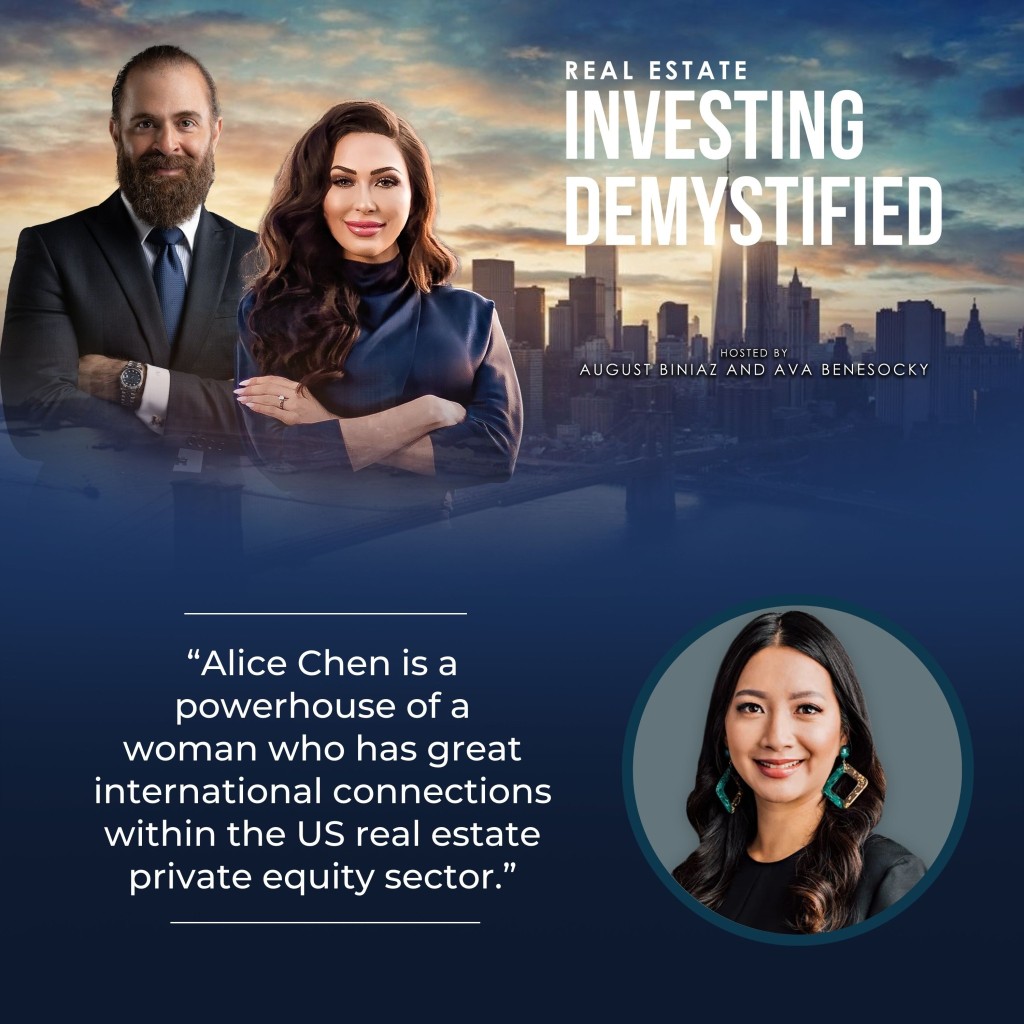
Thank you for having me. Nice to see you both.
Absolutely. It’s nice to see another woman who’s in private equity, in real estate private equity. It’s a few and far between. I think there’s like something like 3% of women are in leadership roles in real estate private equity. Happy to have you on the show, Alice.
From Securities Attorney To Real Estate Private Equity Investor
Absolutely. Instead of reading your bio, we’d love to hear about your background and your journey as from an attorney to coming into the real estate private equity space and a few other stops along the way, but tell us a little bit about your background and your journey.
Sure. I’m from Vancouver and I practiced mergers and acquisitions and securities law in Vancouver at McCarthy Tetrault, so that’s number one Canadian premier law firm. While I was practicing law, I noticed that I really have an interest in actual business because my clients were having so much fun. They’re doing the deals, whereas I was just papering the deals. It’s always been my goal to actually just jump into business, but what in business. I think typically when we’re growing up, we are prescribed a specific path or like growing up under my Asian parents’ guidance, it’s like if you’re good in school, you go to medical school or dental school or law school or engineering school or accounting school.
Those were the prescribed paths. While I was very entrepreneurial, I didn’t know exactly what business. I was watching the market. This applies to investing as well. In terms of how I ended up doing what I do now, it’s an interesting story, but I’m happy to share. While I was practicing law at mccarthy’s we had a thing every Friday, which is that the partners would have come back from their vacations in the Okanagan. For people that in the audience don’t know what Okanagan is, it’s basically like a Napa Valley but for British Columbia. Through those experiences, I got an introduction to the wonderful wine industry of BC and I just fell in love with it.
I fell in love with the craft of making wine, but at the same time was very intrigued by the market opportunity because my background, my family being from Taiwan, I speak Mandarin fluently and at the time, there’s lots of incoming traffic from let’s say mainland China into the West Coast. Into Vancouver. At the time, I was looking for a way to reconnect with my language and culture because in undergrad, you guys were asking me what I studied, so I study pre-med and then went into Philosophy and finished with a minor in Physics as well and then went on to law school. I wanted to reconnect with my culture, my language, as well as find a subject matter that would make sense as a business.
A market that’s big enough, that made sense. My first business, I saw my passion in wine, I saw that the BC producers of wine had no way to actually sup like supply their wine to a bigger market. I created the first-ever two-sided marketplace. We created an export agency to help Canadian producers sell wine mostly to mainland China
That ended up amounting to about something like 16% of Canadian dollar export to China. I was quite young and I was leading a team that’s even younger than me and by 2013, I was cemented as a top 40 under the 40 by Business in Vancouver. Life is an interesting because from that point, several things happened.
One is that President Xi came into power. My clients all of a sudden started calling me and said, “Alice, we know that you’re a lawyer, we love doing business with you, we trust you, but this is what’s happening in China. We want to internationalize our assets.” I went from exporting wine to them to helping them buy businesses in Canada. It was a funny twist.
I ended up helping them internationalize their assets through this legal M&A route. That took me back to the M&A world. From there, I ran a boutique that was then acquired by PricewaterhouseCoopers. I went there and hung out as a deal counsel for about two years. I got connected to the people running the family office practice area. We then broke away from the mothership and ran our own multi-family office. Throughout that entire journey was very interested in investing my own capital and started to get involved with private equity.
With alternative investments, I met my mentor James, who is now my business partner in Pender Hastings Capital. He’s a GP, I’m a GP in the fund. Long story short, so throughout all that journey, it took me to California. My other co-founder from PwC and I ended up starting a fintech business called My Family Office. That’s a fintech software that consolidates all the investments and different bank accounts for a family office.
The multi-family office morphed into a fintech. I continued to do my own investing which led to James and I wanting to actually create a fund in the US since I was physically relocated here. We started Pender Hastings Capital. We started to envision what it would look like in 2024 and started to explore different thesis. We went to Florida where you guys are, and we explored Texas, we explored different thesis.
This was around what time?
This was around end of 2023 beginning of 2024. We started to really look at the opportunities in real estate private equity with a very rigorous lens. Really applying
What was it about real estate that interested you? Because both your backgrounds were not in real estate, or I’m not sure if your partner’s background was in real estate. I think we actually know him, we might have had sushi with him.
We had sushi with him in Richmond.
Yes, but what was the impetus for looking at real estate deals at that time?
From my perspective, I find investing as well as creating active businesses interesting because markets run in cycles. What makes sense for one cycle may not work for another one. When I first met James, I think back in the 2013, 2014, private equity was like the king. Right now, we’re looking at even Blackstones, like the really big PE houses having that private credit crunch and not being able to redeem the redemption request. It’s a reflection of market cycles. I think in 2024, what I was interested in was I had been a little bit under-invested in in my own portfolio in in real estate.
I was quite interested in really learning more about what opportunities are available. At that time, I think James was looking at becoming a real estate developer. He has his own reasons of doing that but together, we were very openly looking at, “Okay, what’s possible?” I think he had spent at that time he had just spent a whole year in Dallas, Texas.
At this time, you guys had become partners already or you hadn’t become partners yet?
We haven’t formally become co-GPs in our fund. That came at the end of 2024 when we had solidified the thesis. While we were exploring, I think it’s important for any fund manager to really take the time to understand not only thesis as well as the project. Don’t jump in just because there’s a lot of hype. That’s what happened in Texas with the multi-family scene. I wasn’t part of that exploration or due diligence, but James spent a whole year in I believe in 2023 and basically experienced the interest rate hike. When that happened, then he saw the writings on the wall that was not the thesis to go into and so we started to explore other stuff. One thing that we explored was actually building single-family homes at scale in Florida. In places not too far from Naples, so in Sarasota, in different like pockets of that Floridian Eastern coast.
Do not jump into something just because there is a lot of hype around it. Share on XWhen you say single-family, single-family like a for-rent product, like a BTR, or single family spec home like a luxury built to sell?
Maybe not so much like the luxury segment.
More workforce, still built to sell, merchant building and built to rent.
Exactly. We explored modular, we explored BTR, as you said, we explored the different specific neighborhoods. While we were doing that, this is 2024, I ended up attending several real estate-focused conferences in the US. My purpose of doing that was to survey everything under the sun that people were doing under real estate.
At that time, multi-family was not the thing to go into anymore. We’re still just looking at and talking to a lot of people, doing a lot of market research about building single-family homes in Florida at scale. At one of the conferences I attended, I bumped into someone that’s in horizontal development, in land development.
Right, but before we get into that, let me unpack a bit because there’s a lot of great information here. We’ll get into that, I think that’s currently one of the strategies you guys utilize and I love to get into more into land development and demystify that. Taking a step back, as you talked about your background, Asian background, actually, Iranians are Asians as well because it’s in the continent.
Everybody says Asian, they think they mean Chinese or Taiwanese or people from Hong Kong or other countries in that area, but Middle East is in Asia. When it comes to Asian parents, they’re very focused on their kids going to school. There are ideas of tiger parents and it really exists. I wish our parents were tiger parents, forced us to pursue academic background and what have you. You passed the bar exam, you become an attorney. What law school did you finish in to be able to get a job at a top securities law firm?
I went to University of Calgary for law school. There’s something that I call it my superpower, is that I somehow can see the trend about three years ahead of the mainstream market. I went to high school in Vancouver, ended up going to U of T for my undergrad because I was watching MTV, I was watching I think it was Fashion TV. It no longer exists. Back in the day, I just thought Toronto was like the New York of Canada. I ended up wanting to go there, experience big city downtown living. From there, I just had a feeling like Alberta was booming.
By the time that I landed there, remember the time when they were so doing so well that they gave every resident in Alberta. I think $400. It’s $400, no big deal, but it’s just funny that that was the only time that I believe that they actually did that. I was right in the middle of that. I wanted to experience the prairies, I wanted to experience Alberta. I wanted the whole Canadian tour, essentially. That’s why I ended up there.
Getting Into The Wine Export-Import Business
You went there, got a job. You’re working for three years there when you had this opportunity with the wine export-import business that you started. Were you still functioning as your capacity as an attorney in that time or you have already pursued this business as a consultant or as a founder in this export business? Talk to us about what you were doing there. I’ll tell you why I’m asking this in a moment.
I actually went to law school in Calgary, but I came back to Vancouver to practice. My legal practice was in Vancouver. When I decided to start this business, I had left the practice because I wanted to just focus. Have you heard of that saying, “If you want to take the island, you have to burn the boats?” I continue to practice that philosophy. When I want to really move on to the next chapter of life, whether in all aspects of life, I typically will close the prior one cleanly before headed heading into the new one.
Private Equity: If you want to take the island, you have to burn the boats.
The reason I bring that up is because Ava and I both left our careers, me as a home builder and Ava as a real estate agent to co-found CPI Capital with a couple of other great partners. It was the most difficult decision of my life. I’m not sure for Ava, maybe the most difficult decision was marrying me.
It was difficult because I was already in real estate for almost a decade and I really knew the business. I had lots of success in the business. To leave that all behind to focus fully on our next venture, it was a tough decision.
It was a startup. It was no money coming in. For me as a builder, I worked for ten years to get those calls and those potential contracts. To basically say no to people who were asking me to build them a house, it was very difficult or building a spec home myself.
For me, I had contracts with developers and I had to get rid of those and get the referral fee. Realistically, we looked at it and we said, “We can’t do both. There’s no way we can do both.” There just wasn’t enough time in a day.
For you, aside from your family pressure to think that you’re completely out of your mind trying to start a new business, how were you financially maintaining? Was the wine business lucrative right from the start or was there a startup phase where you left the practice, you didn’t have any income coming in and you had this venture you were growing? Talk to us quickly about that transition.
Definitely, I was not being reckless. I had done some math and of course I had made really good money. By mid-twenties, I was already six figures. Always had a corner office, always had an assistant in my twenties. I had saved up money. I had some investments and so that was enough to give me some runway. Call it like even two years of runway to figure product-market fit and really build the connections. It was interesting because my entry into the business world, even though I was doing business with China, my family’s not from China, I didn’t know a soul there.
Taiwan is different. Taiwanese speak Cantonese. They don’t speak Mandarin.
No, we speak Mandarin.
It’s people from Hong Kong speak Cantonese. Got it. Keep going.
What was convenient was that China came to us. China was in Vancouver. The who’s who of Chinese family offices were in Vancouver. Without leaving my home for too far, I was able to network with pretty much everyone. It didn’t take long.
Let me lay a background so our readers can understand. China in the ‘80s, some experts believe that what China has achieved from the ‘80s to the 2000s was one of the greatest achievements of mankind, even above and beyond going into outer space. In the ‘80s, China was third-world, fourth-world country that over 750 million people living below the poverty line. It was a terrible. We have a family friend who traveled to China for import-export and he said when the plane would land in the airport in China, they didn’t even have electronic lights to use.
They were using a fire mantle to show the direction of where the plane should go. It was backwards, but what China was able to achieve, it became basically the world’s factory. The world’s dollar store and as economies around the world start doing their population growth started increasing around the world, China’s economy just started booming.
When that started happening, China also saw what happened to the other communist nation in the world, which was Soviet Union and the collapse of Soviet Union and the Chinese government made a decision to create this quasi capitalism within the communism hierarchy and government where businesses and cities and municipalities could do well as long as they did well in business. It allowed the economic not only to boom for the government but also for the people as well. That resulted in a lot of Chinese people wanting to move to Western countries, whether it’s Australia, Canada, the US for better schooling for their kids.
There was this huge in-migration of Chinese into Vancouver, which resulted in Vancouver real estate prices going from in 1995 to 2015 going up 500%. One of the biggest cause, and there was other immigrant population coming in as well, but the Chinese coming in with money and the first thing they would do is buy a house, buy a car. The Vancouver Ferrari sold the more Ferraris than any other Ferrari dealership around the world. More than Miami, more than Dubai.
They bought so much that there literally was a foreign buyer’s tax.
Another cultural thing that happened was also Chinese people from being farmers and basically majority peasant type, they all started becoming wealthy themselves. The Chinese culturally themselves started saying, “I want to drink wine from around the world because I have the money to spend. I want to go to Macau and gamble, I want to be able to smoke cigars.”
Making The Jump Into The Commercial Real Estate
Cuban cigars which are really top cigars in the world, the most sought-after cigars in the world, there’s so much demand from China that has resulted in in Cuba not having any cigars to ship other places. You can see that the amounts of cigars being depleted around the world. There was a cultural thing that happened and I think that’s the wave that Alice rode at that time, for Chinese coming in and then there was already infrastructure in Chinese people in Vancouver. She had that background so it was an opportunistic play. Absolutely. From there, now then you you meet your partner, you guys decide to start looking at commercial real estate, you start looking at multifamily which went through a bust cycle starting in 2022.
It went on a bull cycle from 2011 all the way to 2022 with a little dip around COVID. In 2022, multifamily really went in a crash cycle. It’s corrected from something between 20% and 40% depending on what market because of increased interest rates, because of oversupply, because of a lot of other concerns, a lot of distress in that space. We’re filling that as well. You guys pivoted to look at land development. Talk to us about that. You go to this conference, you’re already excited about commercial real estate, you see the potential there with your partner. Start from there.
I think one thing that helped us was that because we’re finance people, we had a very open lens as to how we look at different opportunities. We are not attached emotionally to any specific asset class.
Emotionally or structurally as well. That’s why I talk to Ava all the time, CPI, at some point, became a real estate private equity firm rather than our initial vision, which was a multifamily shop because as a multifamily shop, you have your analyst, your asset managers, you team members, your so multifamily value add focused that market slows down, you have to change your business plan or you have to let go of that talent that has taken you so long to acquire. Being somewhat market-agnostic, asset class agnostic allows you to be more nimble and more focused. It doesn’t mean to get confused by every shiny object syndrome, but it allows you to pivot quicker. Keep going, please.
I went to this conference and I bumped into this guy and he was asking me some questions about land. I was like, “Okay, that’s interesting and what is it that you do?” He explains that he is in land development. I would say this is mid-2024. I had not heard about land development I think as a layperson, even as a person that has invested in real estate previously, it’s just not something you would think about.
You don’t go to a cocktail party and meet a land developer. It’s just not really a topic that’s very common. Let me give the audience a crash course on land development. Okay, so before you can build homes, before you can build houses or apartment buildings or office buildings, you got to have land that’s prepped for that. Building homes and apartment buildings, that’s vertical development, because you’re going vertical. You’re building this way. Before you can do that, you got to have land that’s actually prepared for that part to kick into place. That’s called horizontal development.
Land development is two parts, it’s entitlement work, that’s paperwork. In Canada, we would call it like zoning, permits, and this and that. In the US, we would call that entitlement work. You got to turn the land, turn the dirt into something that’s buildable on paper. This is going to your county’s office, municipality office to work out a deal with them so that it the dirt becomes buildable. Once you have entitled land, you then move on to the next phase which is horizontal development. This is putting infrastructure onto the land. You’re building roads, you’re building water infrastructure, you’re building sewage infrastructure, all that. Horizontal development.
As finance people, we need to have open lens when looking at different opportunities without getting attached emotionally to any specific asset class. Share on XJust quickly on that point about the city and municipalities. Usually, in every city around the world, I’m guessing, but at least I’m for sure with Canada and the US, the zoning exists on a piece of land. No matter what piece of land you look where there’s a zoning that’s associated with that piece of land, be it urban or not urban area, there’s a zoning associated to that.
Developers that want to build a piece of land or whatever it doesn’t matter what structure they want to build, they can go to the city and apply to have that piece of land rezoned or entitled to build what they want. Sometimes the property is already zoned for what they want, so they don’t have to go through that process. When it’s not, when it’s bare land and then there’s a component that you have to go to the city and actually change the zoning or entitle it for what you’re planning to build.
It might be entitled for, in Vancouver it’s called RS-1 where you can only build single-family residential. Now you want to build townhomes, or you want to build a low-rise or what have you. You have to go through that process, so that’s what Alice is talking about. It’s getting confirmation and approval from the city to build what you desire to build on that piece of property that wasn’t zoned for what you’re planning to build in initially. Keep going, please.
Yes, exactly. Horizontal development is actually very lucrative. There are very few companies in the US that actually do this like day in and day out. Pure play land development. Prepping the land for the big homebuilders to come in and build. The big homebuilders being the DR Horton, the Pulte, the Lennars of the world. Of course, there’s regional players and there’s smaller players as well. This part of developing the land horizontally, maybe 100 players out there that’s doing this day in and day out, specialized in this. It’s very lucrative and very profitable.
We looked at all the thesis under the sun and decided that there’s no fund out there that’s actually specialized in this part of real estate. Technically we are not investing into real estate assets, we’re real estate private equity because we’re investing in the profit sharing of the servicing of the land, of the horizontal development. That’s what our fund is based on, is on this thesis.
What markets?
Mostly we look for markets that make sense. Again, we’re market agnostic, but most of the operators that we work with, they’re in the sunbelt, so a lot of Texas, Florida, the Carolinas, Arizona.
Do the operators find you or do you guys have a strategy to go find the operators?
The very first one, I just bumped into at the conference, so that was just good luck I guess. Since then it’s just a lot of networking. It’s a lot of networking and compounding effects of the network. You just start to become known in the industry. Of course, the operators they want to like they want to be funded. They can only scale so much with their own capital. A lot of the operators they come to find us.
You find these operators whose job is to find a piece of land, source a piece of land, get it through entitlement, do all the servicing, do all the horizontal, get it shovel-ready. Shovel-ready means that another developer can come buy the piece of land, go vertical immediately. You guys fund the capital needed for these projects to be able to these groups to be able to do more projects or do more without having to be stuck with their own capital. You guys come in and fund it and you joint venture with them on these deals.
The capital stack typically is that they would get acquisition development loan, of course, that covers 75% of the stack. Typically, we look for operators that actually have forward purchase contracts with the homebuilder. Before they do any work, even day one of work, they have a contract with the homebuilders that will tell them, “When you’re done your part, we’re going to buy from you like X amount per lot.”
The end user, the end buyer has already been realized and it’s already the contract is in place. You guys are just coming and funding the gap for them to get their dirt. Doesn’t the end buyer give a deposit? Can that deposit be used to start what they want to do? Is that possible?
Yes, so the other layer in the capital stack is that typically with that forward purchase contract, there’s a deposit. Typically the operators would ask for 10%, 15%, very commonplace. That will then well ensure that the homebuilder has skin in the game. They’re not going to pull out any time that they want to because they otherwise forfeit the deposit.
There’s a takedown schedule. For every 50 lots, let’s say I mean for smaller projects of 500 homes, 1,000 homes, it may be every 50 lots, every 100 lots delivered, then the deposit gets drawn. You have the A&D loan, you have the deposit from the homebuilder customer, and then we fund the rest. That layer is called the investor equity. That layer, because it’s such a small component of the capital stack and yet the profit is actually really good and so our returns are really high. That’s how as a fund, we’re able to make it a very attractive thesis to our investors.
That’s incredible. I was going to say your fund that you launched, I believe you said it might be closed now, so it was a closed-end fund. How many projects did it have within the fund?
This was our first fund in the US, so we just wanted to get one done and it’s a proof of concept, so we wanted to just get the thesis proven. We invested in one project in Florida actually, at a place called Auburndale. They’re building lakefront properties, this is near Lakeland, near Tampa. Pockets of Florida continues to be a really good market.
Nice, so just the first one was just one project that was in the fund.As part of your fund, obviously you’re from Canada, are you accepting Canadian investors to invest in your fund as well or you’re just looking for US investors?
In our second one, we will. This is just a tax structure. For the first one, let’s say it’s our debut in the US market, we just want to say hi, let’s play.
Now it’s a proven strategy. Is it Canadian or US investors?
It was US investors on the first one.

Private Equity: Horizontal development is actually lucrative. There are very few companies in the US that actually do this day in and day out.
Is it retail investors? Is it institutional investors? Is it a mixture of both?
It’s a mixture of both.
Long term, do you want to keep pursuing both retail and institutional long-term for your funds?
When you say retail, of course it’s accredited retail.
The retail term is a bit different in in Canada than the US. In Canada, when you say retail, you’re talking about non-accredited. In the US, when you say retail, anybody that’s not institutional. If you’re raising from a family office, that’s institutional, if you’re raising from a doctor who’s worth $10 million, that’s still retail.
The different terminology can confuse people.
When I say retail to Canadian lawyers, they get surprised right away like, “We can’t raise money,” I’m like “No, retail is just non-institutional retail,” that’s what I’m talking about.
Alice, what’s your minimum investment?
It’s $100,000. Our fund one is now closed, so we’re not raising right now, but stay tuned for our fund two which will be open to Canadian investors.
Would you guys be open to also partner with operators who might not have the end buyer but have a great project, get it to entitlement, and then they just want to put it on the market or while they’re going through the process, they look for somebody to buy the land. For example, our firm CPI, one of our verticals is BTR. Currently, we’re looking at a project in far West side market of San Antonio and we’re purchasing a entitled piece of land.
All the roads are built, is ready to go vertical immediately, shovel-ready. We’re looking to purchase this piece of land. The seller has already gone through that process but while they were going through the process, they didn’t have us put a deposit or anything. They went through the process because they were actually thinking about building it themselves, but then we ended up actually partnering with them. Would you be open to that or you want to strictly be deploying capital into deals that has already has the end, that forward purchase type of contract already in place.
Typically we look for deals that already have the forward purchase contracts, but because it’s you guys, I’m happy to take a look and see if there’s something we can do together.
No, of course. As far as markets, so currently you guys are in in Florida and so is the plan to keep building your footprint in Florida or again, for your next fund, you’re looking at anywhere?
Again, we’re agnostic and we’re constantly reviewing projects from different operators and we’re just looking at what fits the timing as well as the geography.
Alice is in finance, if the numbers make sense.
Yes, we’re numbers driven, data driven.
Benefits Of Adopting AI Tools
I want to get into our next segment of the show as well. I know we’re coming on top of the hour here. I wanted to also talk about you personally. You did your first fund, I’m guessing it might be somewhat of a smaller fund since it’s only one deal and since the need for your portion of the equity sounds to be somewhat minimal. How are you keeping the lights on? Is it still from your exit that you had previously and the investments that you’ve made?
That’s another thing that was difficult for us as cpis, keeping the lights on and the burn rate, and I’m sure you guys might even have some analysts or other people that work for you, maybe a marketing team to be able to create leads and connect with investors. How do you manage to keep the lights on while the deal volume hasn’t been there yet?
Yeah, so James and I both have multiple businesses. He has a multiplex development company in Vancouver. I have an AI agency. It’s funny that you’re asking about the burn rate. When we were starting this fund, I had wanted to actually see if I could replace some of the workforce with AI because that’s when Gen AI had already become mainstream.
To my surprise, I was able to work with AI in lieu of a junior analyst that would typically cost six figures. Let’s say pulling together the deck for our fund. Typically, I would have to work with a junior person for about three weeks, deal with the graphic designer and whatnot, do the research, and it would take three weeks to get complete, but because I was using AI, I was able to do that in three days. That blew my mind. I’m not the earliest adopter of AI or any type of frontier technology, but since then, I have just been floored by how much AI can actually do. Now everything that we do, we try to build in a way that’s AI native.
We’re talking about investor outreach, answering common questions. We have done that for ourselves, so we have done that for other syndicators, other fund managers, and other business owners where we can really use AI. My AI agency, we can build AI receptionists, we can build your digital twins to answer internal questions or to answer questions with investors.
We can help you set up an AI sales team that outreach to people. Let’s say if you have tens of thousands of people in your CRM, there’s no human that can help you. No superstar human salesperson that can call them, text them, email them according to a sequence and cadence that’s just going whether or not you’re supervising or not.
I think we are in a different era where a lot of that can be automated and so I think AI is really big help. Diversification, multiple streams of income, multiple businesses, it all helps so that we become patient capital and we have the runway when we’re not in survival mode. We’re able to be in a position to do the best thing, the most optimized thing for our investors as well as for ourselves as GPs.
Yeah, you’re not forcing deals, you’re just letting deals happen.Thank you for that. Really appreciate it. Let’s get to our next segment of our show. Any other questions you have, Ava?
That was really great, Alice. I was looking forward to learning more about you.Now let’s learn even more about her with the 10 Championship Rounds to Financial Freedom. Are you ready, Alice?
I’m excited.
We’re going to ask you ten questions, whatever comes top of mind. Okay, here we go. Let’s get started. First question, who’s been the most influential person in your life?
Myself. I’m a lifelong learner. I feel like I’m treating myself as a vessel or as a conduit of information. I learn very from a wide variety of sources. I think being that open vessel has been very instrumental. I don’t have one mentor. I have maybe hundreds of mentors, whether I met them in person or not. I’m constantly listening to new information and synthesizing from different angles and different perspectives.
Next question is what is the number one book you’d recommend?
For your audience?
Favorite books, it could be finance, it could be personal.
It could be something recent, maybe.
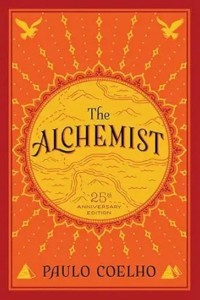
The one book that I typically recommend on the show for people that are just starting their businesses or they’re taking that quantum leap, we’re talking about the quantum leaps that you guys have taken, I’ve taken multiple quantum leaps in my journey as well. The one book that really moved me when I was really struggling at one time was called The Alchemist.
The Alchemist
This is by Paulo Coelho. That was it’s a fiction, but it’s a fiction that’s very deep and very wise. It I won’t give it away, but I think for anyone that’s struggling and thinking, “I’m really working hard at a goal, a mission, and yet how come years later or some stretch of time later I’m not seeing the results,” this book will change your life and change how you see things.
Have you read that book?
I haven’t.
We’ll have to read it.
I just read a lot so I know a lot of authors.
Yes, I love how August really should be a professor. He’s so studied across so many subjects. Listening to him talk is like listening to a professor.
Yeah, he’s like a walking encyclopedia. I learn a lot just by having him next to me all day. All right Alice, next question. If you had the opportunity to travel back in time, what advice would you give your younger self?
Honestly, I wouldn’t have done so much time in school. I would have probably dropped out. I would have found a way maybe to come to Silicon Valley. Now that I’ve been here for years, I realize that the people here are not necessarily smarter, it’s the environment. Here, you go to any random coffee shop in Palo Alto, you’re going to bump into the VC that can write you a $100 million check.
You can bump into your co-founder with whom you’re going to co-found the next unicorn. I think the environment is so important and so I think people are not doing themselves a service if they just continue to be very localized or live a very localized existence. I love that you guys are now in Florida or splitting time. I think the more you can widen your perspective and then widen your environment, the better, especially in this day and age.
Back then, in undergrad, AI wasn’t a thing but if I were a young person now, I wouldn’t necessarily go to university, like maybe for your two babies, like maybe not. It’s not the right thing to do so much school but I would get them to be somehow integrated with frontier technology. The possibilities are endless from there.
Absolutely, I love that advice to your environment too because that is super important. We’ve talked about that several times. Next question Alice, what’s the best investment you’ve ever made?
To be honest, myself. I can name this investment or that investment that paid this multiple or that percentage but ultimately, I think the best investment is always in yourself. Whether you’re just starting out, if you’re someone that’s not making an income that you’re happy with, the first thing you got to invest in is yourself. Upgrading your vessel, upgrading your operating system, that then enables you to create a business that scales or create investments that multiply.
Now what’s the worst investment you’ve ever made and what lessons did you learn from it?
Just like all professional investors, you cannot win on every deal. I have reflected on this question many times and I haven’t lost too many investments, but let’s say the one or two that I was not happy with. I think I invested because of hype or because I wanted proximity to maybe a group of people. The optics made it look very attractive.
It was a little bit of a situation where I felt like, “If I had invested then I would be accepted by this perceived prestigious group” and typically those type of situations lead to bad investment decisions because you’re not looking at the fundamentals, you’re not looking at investment through first principles. I think as someone that now invests professionally and as someone that’s investing more cautiously with my own money I ask myself, “If you take all the halo away, would that actually be a good investment?” If the answer is no, then no, don’t touch that.
Before you invest professionally in an asset, ask yourself if it is still a good investment once you take all the halo away. If the answer is no, then do not touch it. Share on XNext question is how much would you need in the bank to retire today? What’s your number?
I like a nice lifestyle so my number, I think anyone can retire probably comfortably, god knows, like with $3 million, 5$ million. A lot of people doing the 4% rule. There’s a FIRE movement, Financial Independence Retire Early. I don’t know if you guys know about this but there’s a whole movement called the FIRE movement where and even like one of the youngest self-made billionaires from tech, Lucy Guo, she’s a billionaire but she’s part of this FIRE movement.
It talks about using the 4% rule. You guys probably are familiar with that but I think anyone can probably retire okay, but it depends on your lifestyle needs. You could retire at $3 million, you could retire at $5 million or $10 million or $100 million, just depends on what you want. For me it’s like, yes, I would love to travel only first class, only private jet, and so I have a bigger number that I need to get to.
At the same time, I’m not attached to it because I think the moment that you become very attached to your psychological safety or comfort or security based on a number, I think you have lost yourself. I like to simultaneously work on a big number but simultaneously be very happy with what I have already and in some ways, I’m living ninety percent of my perfect life. Of course, more zeros is always welcome but at the same time, I’m happy and peaceful already.
Love that. Incredible. All right, Alice, if you could have dinner with someone dead or alive, who would it be?
I would actually be very intrigued to have dinner with you guys and I’ll tell you why because I didn’t know you guys were married and you worked together. Of course I had August on my show but you guys have a lovely chemistry as not only partners in life but partners in business and you don’t look like you fight very much because you’re in the same business so I’d love to get your secrets as to how you do it.
You should have seen before the show. Ava was strangling me, people had to come in the office and separate us.
One of these days, it’ll be great to get together.
For sure, absolutely, we’d love that. Next question, Alice, if you weren’t doing what you’re doing today, what would you be doing now?
I really love the technology stuff, the AI stuff. Like to my surprise, like I said, I don’t have a technology background but just having gotten really into it, it’s, it’s such a dopamine rush. I’m doing even a lot of light coding myself as I just really love it and I believe the next unicorn, decacorn companies, they’re all going to be AI based so I’m just really happy to be in that wave right now.
Other than that, I’m a deal maker. I think by default, I just love identifying opportunities, I love doing deals. Honestly, I wouldn’t be doing anything else. I’d be doing exactly what I do. Even if I’m retired, I would still be doing what I’m doing right now.
Some deal making, I love that. Yeah, you’re very good at it.
Some deal making, some technology, yeah, I love what I do.
Next question, my favorite question, book smarts or street smarts? Coming from a woman who has high education.
I would say street smarts way more than book smarts. I think going to school, it was a great way to get etiquette training, social training. Of course, you learn to ingest a massive amount of information. I think having gone to law school, it really helped me find a way to ingest massive amount of information quickly and synthesize quickly and apply judgment.
Even in law school, the exams are open book because the value is not in the memorization of facts. The value is really in how you reason. Now reasoning is even commoditized because of AI. AI does that better than any human. Judgment and taste and trust, those are the three things that cannot be replaced by AI. Your sense of aesthetics, like what’s beautiful or what’s elegant, that’s taste.
Your ability to garner trust with other humans, that’s very important. Judgment, the ability to discern, that’s very important. I think we’re headed into an era where really it’s about the street smarts because book smart means you have some advantage in terms of information arbitrage but information is everywhere, it’s free everywhere. There’s no benefit in having more information or more access to information, it’s everywhere. It’s more about how you apply, so how you conduct yourself and how you upgrade yourself. I think that’s going to be the winning formula in the days to come.
All right Alice, last question. If you had $1 million in cash and you had to make one investment today, what would it be?
I would check out your deal for sure. Right now, I’m just very geeked out on AI and I would either really amplify my, my business, really scale that, or I would be really looking at what is interesting in this space.
Bonus question, quick answer if you don’t mind. Does Vancouver have better Asian food or California?
Vancouver is the best place to have Asian food outside of Asia.
Nice, it’s the best. We miss it so much.
Yes, I miss it too.
Alice, just let everyone know that’s reading what’s the best way that they can reach you.
Send me an email. It’s Alice@YourAITeammates.com.
This was great, Alice. Congrats on all of your success. You’re a powerhouse. We really enjoyed having you on the show and thank you for your time.
Yeah, thank you for having me and you as well. Congrats on everything.
Thank you.