


For many Canadians, an RRSP or TFSA means one thing: an account at a bank or brokerage containing stocks, bonds, mutual funds, ETFs or GICs.
But the account itself does not necessarily dictate the investment strategy.
Canadian registered accounts can, under the right structure, hold a broader range of qualified investments. That distinction may give investors an opportunity to diversify beyond traditional public markets, including gaining exposure to certain private real estate investments.
For investors interested in U.S. multifamily or Build to Rent real estate, that raises an important question:
Can you self direct your RRSP or TFSA funds into private real estate investments without withdrawing the money first?
In certain circumstances, yes.
But understanding how is important.
What Does a Self Directed RRSP or TFSA Actually Mean?
A self directed registered account gives the investor greater control over which eligible investments are held inside the account.
The Canada Revenue Agency specifically notes that investors can control the assets of a self directed RRSP and make their own investment decisions. Similarly, a TFSA may be established as a self directed trust that can hold qualified investments.
That does not mean an RRSP or TFSA can invest in anything.
Registered plans remain subject to Canada’s qualified investment and prohibited investment rules.
Common qualified investments include cash, GICs, government and corporate bonds, mutual funds and many securities listed on designated stock exchanges.
The important point is this:
Self directed does not mean unrestricted. It means having greater choice among investments that qualify under Canadian tax rules.
For Canadians interested specifically in U.S. real estate, we have previously explored some of the broader considerations in our article, How to Invest in U.S. Multifamily Syndicated Properties as a Canadian.
Why This Matters for Private Real Estate
Suppose a Canadian investor has accumulated $250,000 inside an RRSP.
They become interested in a private U.S. apartment investment.
One option would be to withdraw money from the RRSP, but an ordinary RRSP withdrawal generally creates taxable income.
For an investor who wants to maintain the registered status of those funds, that may defeat the purpose.
An alternative may be to have the registered account acquire an eligible investment that provides exposure to private real estate, provided the investment and account structure meet the applicable rules.
This is where investment structure becomes critical.
An investor generally cannot assume that because an underlying asset is attractive, or because it is real estate, the investment automatically qualifies for an RRSP or TFSA.
In fact, real property itself is generally not a qualified investment for these registered plans.
Instead, access to private real estate can potentially be provided through a qualified investment vehicle, such as an appropriately structured fund or trust.
That difference is easy to overlook.
Investors unfamiliar with how private real estate investment structures operate may also want to read our guide to Understanding Real Estate Syndications: A Passive Investment Option.
The Mutual Fund Trust Structure
At CPI Capital, one of the structures used to provide eligible Canadian investors with access to qualifying private real estate investments is a Canadian Mutual Fund Trust, or MFT.
Rather than the investor’s registered account directly purchasing an apartment building in Texas, the registered account holds an eligible investment in the investment vehicle, and that vehicle provides exposure to the underlying real estate strategy.
Conceptually, the structure looks like this:
Investor → Self Directed Registered Account → Qualified Investment Vehicle → Private Real Estate Investment
This structure can potentially allow registered capital to participate in investment opportunities that would otherwise normally be funded with non registered cash.
The precise eligibility of any investment should always be confirmed with the registered plan trustee or custodian and the investor’s professional advisors before investing.
The “I Didn’t Know That” Moment
Here is the distinction many investors miss:
You don’t necessarily need to withdraw money from a registered account to change what that money is invested in.
Those are two very different transactions.
Moving from one qualified investment to another inside an appropriately structured registered account is fundamentally different from taking an RRSP distribution personally and then investing the proceeds.
This is why understanding the difference between the account and the investment held inside the account matters.
An RRSP is a registered plan, not an investment itself.
A TFSA is also an account structure, not an asset class.
What sits inside that structure can vary considerably, subject to CRA rules and what the plan’s trustee or custodian is able to hold.
Two Current Examples: Apollo Meadows and Atlas at Lewisville
CPI Capital currently has two Texas real estate investments that have been structured to accommodate eligible registered fund investors through CPI’s registered fund investment structure.
They represent two different approaches to residential real estate investing.
Apollo Meadows: Build to Rent Development
Apollo Meadows is CPI Capital’s Build to Rent investment in San Antonio, Texas.
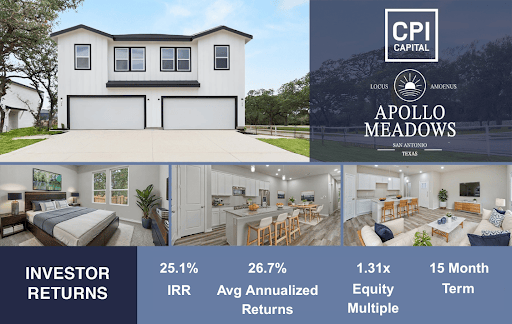
Rather than acquiring an existing apartment property, the strategy focuses on creating new rental housing.
CPI Capital currently lists Apollo Meadows as an open investment with a $50,000 minimum investment, 1.31x targeted equity multiple and 26.7% targeted average annualized return.
Development investments typically have a different risk and return profile from stabilized multifamily acquisitions. Investors are taking on construction, execution, lease up and market risks in exchange for the potential value created through development.
For an investor with a longer time horizon, this can provide exposure to a different part of the real estate value chain.
For readers who want a deeper understanding of this asset class, we have also explained What Build to Rent Single Family Residential Is and How the Model Works.
Atlas at Lewisville: Value Add Multifamily
Atlas at Lewisville takes a different approach.
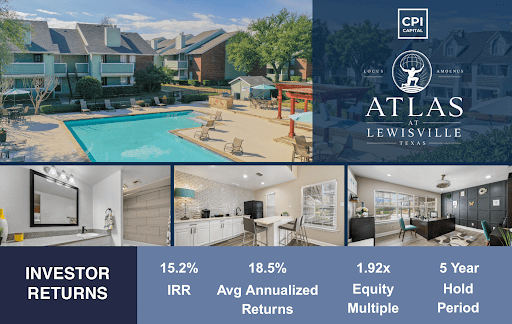
Located in Lewisville within the Dallas Fort Worth Metroplex, Atlas is a 150 unit value add multifamily community.
Approximately 77% of the units have already been renovated, which reduces part of the renovation execution risk while leaving additional opportunities for operational improvements and revenue growth.
CPI Capital is targeting a 15.2% IRR, 18.5% average annualized return and approximately 1.93x equity multiple over an approximately five year hold.
The property also represents something we believe is particularly interesting about today’s multifamily market: the opportunity to acquire existing real estate at a meaningful discount to the previous owner’s basis and below replacement cost.
For registered fund investors, Atlas can therefore provide exposure to an existing cash flowing multifamily strategy rather than ground up development.
Two Deals, Two Different Real Estate Strategies
This distinction is important from a portfolio construction perspective.
Apollo Meadows represents development.
Atlas at Lewisville represents value add multifamily acquisition.
One seeks to create value largely by building new housing. The other seeks to acquire an existing asset at an attractive basis and create additional value through operations, remaining renovations and longer term market recovery.
Neither strategy is inherently better.
They simply carry different combinations of risk, duration, cash flow profile and potential return.
For investors evaluating whether to allocate registered capital to private real estate, understanding those differences should come before looking at projected returns.
It is also important to understand the distinction between managing real estate personally and investing through an experienced operator. We discuss that distinction further in Active vs Passive Real Estate Investments.
What About the TFSA?
The TFSA creates another interesting consideration.
Unlike an RRSP, where contributions generally provide a tax deduction and withdrawals are generally taxable, investment income and capital gains earned within a TFSA are generally tax free in Canada, and qualifying withdrawals are also tax free.
That can make the TFSA a particularly valuable long term investment vehicle.
But the same fundamental rule applies:
The investment held by the TFSA must qualify.
Investors should not withdraw TFSA funds simply because they want exposure to an alternative investment without first determining whether that investment can potentially be held within an appropriate self directed TFSA structure.
A withdrawal and a transfer between qualified investments inside a registered account are not the same thing.
What Investors Need to Watch
Registered account investing comes with rules that should not be ignored.
The CRA imposes consequences for non qualified and prohibited investments. Prohibited investment rules can also become relevant where an investor has a significant interest, generally 10% or more when applicable related holdings are considered, or otherwise does not deal at arm’s length with the underlying corporation, trust or partnership.
Investors therefore need to consider more than whether an opportunity offers an attractive projected return.
Questions should include:
- Is the security a qualified investment for my particular registered plan?
- Can my trustee or custodian hold it?
- Does the investment create any prohibited investment concerns?
- What are the fees associated with using a self directed account?
- How liquid is the investment?
- What is the expected holding period?
- How does the investment fit within my overall portfolio?
Private real estate is generally less liquid than publicly traded stocks and ETFs. Investors should therefore think carefully about liquidity needs before allocating retirement or other registered capital.
The investment itself still needs to be carefully reviewed. Our article on The Role of Due Diligence in Passive Real Estate Investing explores some of the factors investors should evaluate before committing capital.
The CPI Capital Perspective
We believe Canadian investors should think about their registered accounts as part of their total investment portfolio, rather than as capital that automatically has to remain exclusively in publicly traded securities.
For the right investor, private real estate can potentially add diversification, exposure to tangible assets and access to return drivers that differ from those of the public equity markets.
But the structure matters.
The objective should never be to use a self directed account simply because it is possible. The investment still needs to make sense on its own merits.
That means evaluating the underlying real estate, acquisition basis, leverage, market, business plan, sponsor, projected cash flows and downside risks first.
Registered fund eligibility is an additional feature, not a substitute for proper investment underwriting.
Key Takeaways
- Canadians can self direct certain registered accounts.
CRA rules allow self directed RRSPs and TFSAs to hold qualified investments beyond simply leaving capital in cash or GICs. - Not every private investment qualifies.
The security and investment structure must satisfy Canada’s registered plan requirements. - Structure can create access to private real estate.
Qualified investment vehicles can potentially provide registered accounts with exposure to private U.S. real estate without requiring investors to first withdraw those funds personally. - Apollo Meadows and Atlas at Lewisville provide two different strategies.
Apollo provides exposure to Build to Rent development, while Atlas provides exposure to value add multifamily. - Eligibility should never replace due diligence.
Investors should evaluate the underlying investment first and then determine whether registered capital is appropriate for their circumstances.
What Should Canadian Investors Do Next?
Many Canadians have spent years building their RRSPs and TFSAs without ever asking a simple question:
What else could I potentially own inside these accounts?
For investors interested in private U.S. real estate, understanding self directed registered accounts may expand the range of opportunities available to them.
CPI Capital’s Apollo Meadows and Atlas at Lewisville investments are currently open and have been structured to accommodate eligible Canadian registered fund investors through CPI’s registered fund investment structure.
Investors interested in determining whether their RRSP, TFSA or other eligible registered funds may be able to participate can contact the CPI Capital team to learn more about the investment structure, eligibility requirements and current opportunities.
Contact the CPI Capital Team → Ava Benesocky

Ready to build true wealth for your family?
It all starts with passive income. Apply to join the CPI Capital Investor Club.
Search
Recommended

What is the Correlation Between Bond Yields and Real Estate Cap Rates?
Dear valued existing investors and future investors, Welcome to CPI Capital's regular news...

The Sunk Cost Fallacy In Active Real Estate Investing: Embracing The Power of Multifamily Syndications
Dear valued existing investors and future investors, Welcome to this week's CPI Capital's news...

Key Metrics Every Multifamily Investor Needs to Know
Dear valued existing investors and future investors, Welcome once again to this week’s CPI...