
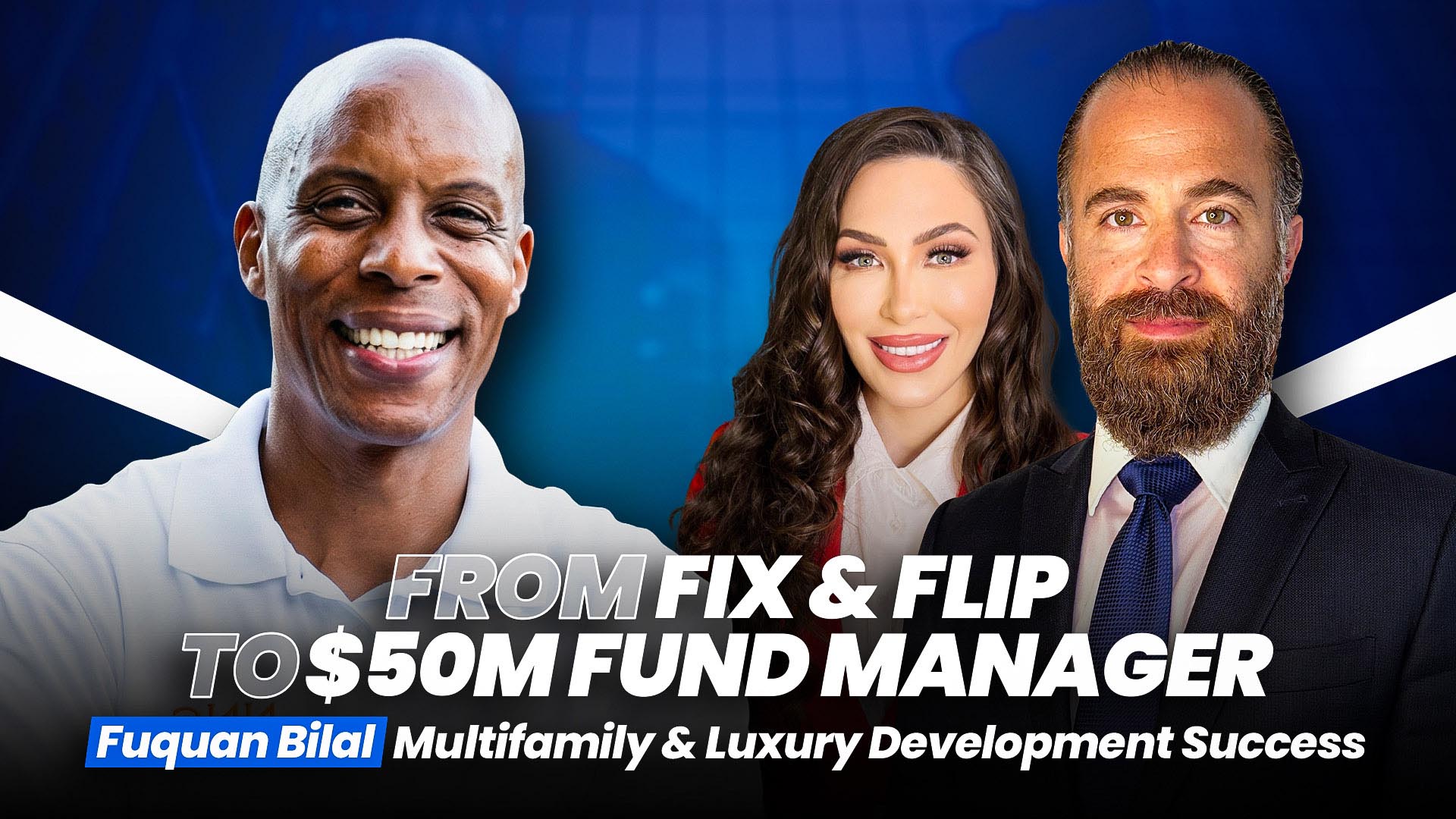
Dive deep into the world of real estate investing and fund management with Fuquan Bilal, a visionary who has spent 25 years transforming distressed properties into high-yield assets. As the CEO of NNG Capital Fund, Fuquan has not only raised over $50 million in real estate capital but has also built a thriving portfolio of Class B multifamily properties and luxury single-family homes.
In this exclusive interview, Fuquan shares his unique journey—from the early days of “lipstick on a pig” flips and navigating the 2008 global financial crisis, to pivoting into note-buying and scaling his operations into large-scale institutional multifamily assets across New Jersey, Alabama, and Georgia. Discover his secrets to raising capital through relationship-based strategies, the shift from syndication to a debt-focused fund structure, and his powerful vision for creating social impact through affordable housing. If you’re looking for lessons on diversification, due diligence, and building a long-term, impactful real estate business, you won’t want to miss these invaluable insights.
Get in touch with Fuquan Bilal:
- Website: https://nngcapitalfund.com/
- LinkedIn: https://www.linkedin.com/in/fuquanbilal
- Facebook: https://www.facebook.com/fubilal/
- Instagram: https://www.instagram.com/fuquanbilal/
- TikTok: https://www.tiktok.com/@fuquanbilal
- YouTube: https://www.youtube.com/@FuquanBilal
If you are interested in learning more about passively investing in multifamily and Build-to-Rent properties, click here to schedule a call with the CPI Capital Team or contact us at info@cpicapital.ca. If you like to Co-Syndicate and close on larger deals as a General Partner, click here. You can read more about CPI Capital at https://www.cpicapital.ca.
#avabenesocky #augustbiniaz #cpicapital
—
Watch the episode here
Listen to the podcast here
Important Links
- NNG Capital Fund
- @FuquanBilal on Instagram
- Fuquan Bilal on LinkedIn
- Fuquan Bilal on Facebook
- Psycho-Cybernetics
- Outwitting the Devil
About Fuquan Bilal
 Fuquan Bilal is a visionary real estate investor and educator who has spent the last 25 years transforming distressed properties into high-yielding assets.
As the CEO of NNG Capital Fund, Fuquan has raised over $50 million in real estate capital and built a thriving portfolio of Class B multifamily properties and luxury single- family homes.
His unique strategies and ability to connect with investors have made him a leader in the industry.
From Fix & Flip To $50M Fund Manager: Multifamily & Luxury Development Success – Fuquan Bilal
Everyone, welcome back to the show.
Welcome back. We’re in our beautiful studio over here in Southwest Florida.
Christmas is upon us. It’s next week. It’s my favorite time of the year, especially now that we have two boys calling Santa every day with August. He’s loving it. Magic is in the air.
We’re leveraging those Santa phone calls. That’s the way you try to play games with your kids. You try to use it as reverse psychology to get them to do things that they might not want to do.
That’s right.
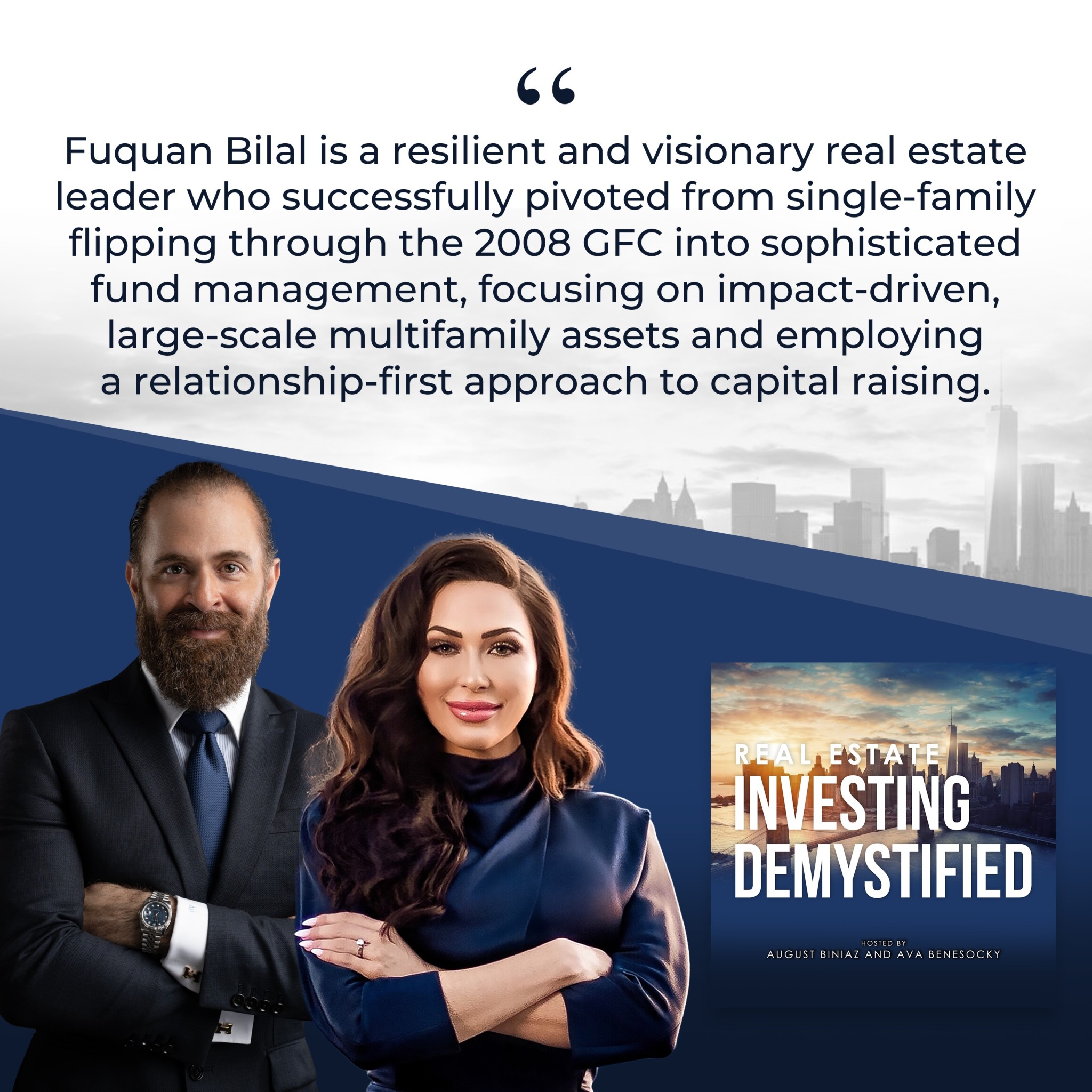
We have a great show for you. We have an interesting guest who has a great background, very similar to mine, August Biniaz’s background, when it comes to being a general contractor, fixing flips, building homes, syndicating deals, multifamily, all that good stuff, and raising capital. We’re going to be talking about all of that. Maybe you can quickly tell if you want to borrow our guests.
My favorite topic is raising capital. I did a whole presentation on that. I shared all my secrets. I’ll dive into some questions about that with our guest as well. Let me give you guys a quick bio about our guest. We’re joined by Fuquan Bilal. He is a visionary, real estate investor, and educator who has spent 25 years transforming distressed properties into high-yielding assets.
As the CEO of NNG Capital Fund, Fuquan has raised over $50 million in real estate capital and built a thriving portfolio of Class B multifamily properties and luxury single-family homes. His unique strategies and ability to connect with investors have made him a leader in the industry. Welcome to the show, Fuquan. We’re happy to have you here. We’re looking forward to our chat.
Thanks for having me. I’ve been waiting for this show. I’ve been waiting to get the chance to speak to you guys. I love your content and the information that you provide to your audience, so it’s an honor to be here. Thanks for having me.
Honor is all ours.
Fuquan, where are you located?
West Orange, New Jersey, is where our headquarters is. We do projects in Northern Jersey, which is about 25 to 30 minutes away from the city, some parts closer, and then also in the southeast in Alabama and Georgia.
Have you always been from New Jersey?
Yeah. Born and raised in North New Jersey.
Early Career: Starting In Real Estate & Flipping
Let’s take a step back. We’d love to hear about you. Were you always in real estate? Did you have a W-2 or a different career before you started in real estate?
For sure. I started off in corporate in ‘99. I jumped out the window, grew wings falling down, as they say, and cut my teeth in the real estate business. The first nine years before the GFC, Global Financial Crisis, I did all flips and then pivoted to buying notes directly from the bank. I then pivoted back to flips and diversification with notes. Fast forward, we do a lot of luxury spec homes and multifamily properties.
Talk to us about the early days when you started in real estate. Talk to us about when you first got started. What was that like? Talk to us a little bit about your journey.
Why don’t you tell us about the first home you ever built? You touched on those early parts a bit. Talk to us about the first home you ever built. What was that process like? I remember the first home I built and how it all came about. I’d love to hear about your journey.
I was lipstick on the pig, as they say. A quick, fast turnaround. I had no idea what I was doing. I can remember the property I had. It was a two-family rental property. It had commercial carpet throughout the whole property. Everywhere throughout the apartment, hallway, stairs, kitchens, and bathrooms had ceramic tile. That’s what we were doing back then, putting commercial carpet in properties, Home Depot cabinets, and turning them around.
It was a good deal. It was very profitable. It encouraged me to leave my 9:00 to 5:00. The next six months were hell, but I learned a lot. It was fun. It was fun and exciting. It’s like any new venture that you get into. I’m a builder. Not like a construction builder, but someone who likes to build things, whether it’s a new business, whether it’s rebuilding myself, or whatever it is. I always take joy in learning something new.
It was exciting because I was obsessed with it. Not just on the money that I can make from it, but the impact that I was able to create by revitalizing those properties in the neighborhood that I came from. There were a lot of dilapidated properties that were either burnouts or vacant. I felt like a superhero coming back to the hood, repairing houses, putting them on the tax roll, giving the residents a better place to live, and providing better quality housing for residents. We had a lot of slumlords in the area.
It was a great experience. I wouldn’t change it. I wish I had gotten into not the masterminds, but the local REIAs. I didn’t do that until after the GFC. I started to figure out what was happening on a macro level. I thought I knew what was happening on a micro level, but I got my behind handed to me, as most people who were investing during that time. There were a lot of valuable lessons that were learned from there. To answer your question, it was exciting getting started. I’m still on fire. My heart is still on fire for the business. Real estate is the puzzle you never figure out. There are so many different things you can do within real estate.
A lot to unpack there. Aside from fix and flips, you also build from the ground up, like actual custom homes, right? What was your experience in building your first custom or spec home?
Always focus on spec homes. I don’t like custom homes because they take too long to get to the closing table. There are so many changes and different people’s opinions on what it is. There are changes as you go along. You can never make that person happy. I build it, and if they like it, they buy it. If not, then there’s someone out there who will like it.
I build it, and if they like it, they buy it. If not, there’s someone out there who will. Share on XIt was a great opportunity for me to make that transition to that part of the business after COVID, because pricing went up in the areas where we were developing. We were doing regular bread and butter with affordable housing. It was anywhere that we would resell for $350,000, maybe $400,000. Maybe we purchased it for a little bit more than $100,000, put some renovation into it, and made a nice profit.
After COVID, we had a lot of New Yorkers coming into our area, paying 30% over list. I was competing with retail buyers, and it wasn’t profitable. That forced me to go into the higher-end homes where there was less competition. I used the resources we had from our capital partners to take these properties down cash. They were bigger profits and more predictable.
You know when you’re doing ground up what the timeline is going to be and what the cost is from the build. It’s easier to calculate the profits on that versus the unknown when you have a house out, and you have foundation issues. You look behind a basement wall or at things you couldn’t foresee. Maybe the stack in the house is old, so you have to replace the whole thing and put it in the sewer line. There are a lot of unexpected costs and expenses that come with the regular fix and flip if you do it the right way.
I always say that renovations are sometimes harder than new builds. A new build has its own process and its own trades. You know what you’re getting into, whereas with renovations, there are so many unknowns. There might be walls you have to take down. There might be beams.
There might be things that come up on the wall.
Behind some walls, for sure.
Did you ever get your GC license, Fuquan?
Yes. I am the general contractor on all my projects in New Jersey, but in the South, we leverage the GCs we have there on our CapEx team to do those projects. It gives us more control in managing a project better and getting things done. I’ve been doing that for a very long time. I started in ‘99. I got my license around 2010 and started going from there. I’m not picking up a hammer or running around properties doing work for other homeowners. We only focus on building the properties that we own. We don’t take any outside contracts.
Any more questions about single-family, August?
Yeah. I want to touch on the ‘08 GFC and see what lessons Fuquan learned from that time. It was one of the worst catastrophic times in the economy in real estate. Real estate prices in the US had gone up every single year starting from 1945-ish until 2008, when they dropped 30% nationwide. It was a cataclysmic event. We’d love to hear what happened to you at that time, what you learned from it, and so on.
How did it affect you?
The Impact Of The Global Financial Crisis (GFC)
It affected me financially. It was pretty much starting all over again. Everything from there, divorce, and all the other stuff, once the financial problems come in. I was able to pay off all my investors, which was the focus. We had to fire and sell a lot of the properties. I had a lot of my capital tied into the property, so that’s where I took the loss.
The two biggest things that came out of that were that real wealth is within. Meaning, I had to look within myself to do some soul-searching and rebuild myself so my business can grow. I was quite devastated because real estate was my identity. The other thing that came out of that is diversification. I was only flipping homes, and I was not building a portfolio of rentals for that cashflow. When the music stopped playing, I didn’t have a chair to sit in.
That’s how it ended up for me. I was grateful that I went through that because I was a slave of money instead of a master of it. I was chasing every deal, not understanding how money works, and putting that money to work to generate more money. It was just going from one flip to the other because they were huge cash injections, and that was sexy at the time. The little couple of hundred bucks a month in the property appreciation wasn’t something that was on my radar. I had to go through that to understand why I was doing this and what was important to me before I set out to restart. It was the best thing that ever happened.
When you restarted, did you start doing single-family again, or was this around the time when you started understanding syndication? Did you acquire a multifamily property? Talk to us about when you got into commercial real estate. When was that? At what point did that happen? Your first property, we’d love to learn more about that as well.
Transition To “The Bank” (Note Buying)
Transition at the GFC was into the note business. I started doing short sales because that was a big market at the time. If you can recall, everyone was short-selling a home. During a conversation with the negotiator, they asked why I didn’t buy the note. I had no idea what they were talking about, so I did some research, made some calls, spoke to some people, and was able to buy that note.
I sought out mentorship on note buying. I got some tutelage and started to buy notes myself. That was, and still is, the best investment strategy in the universe because it’s a laptop-cell phone. The homeowner owns the property. They’re shoveling the snow. They’re paying the taxes. They’re doing everything, and I’m just the bank. I learned that strategy and started to buy more notes.
I launched my first fund in 2013. That’s when NNG was born. We started the company in 2012. We launched our first fund in 2013 after I had spent about a year building case studies using my own money. I went over the hill and got the arrows in my back, so to speak, and then went out to raise capital for that. We stayed in the note business, buying notes all the way up until 2018.
From there, we had a lot of relationships that we built with banks from selling REOs, because they would sell us their notes also. We started to buy more REOs in the judicial states, in which most people don’t like to buy. In New Jersey, it takes favor to foreclose. We started to get back into flipping, and then from there, we started to get back into renting.
We were buying notes and doing flips and rentals. After COVID, we stopped buying notes because we didn’t want to foreclose on people during the COVID era. We dialed down the note business and laser-focused on the rentals and flips. We then transitioned after COVID to higher-end flips because of the pricing that went up in the low-income areas for the flips.
We decided to jump on the bandwagon of COVID, with everyone paying 30% over list price. It was to put our rentals up for sale, divest that portfolio, and take the war chest to the Southeast. We start building rental portfolios down there to stay in alignment with our rental projects. To answer your first question, the first property we purchased was in 2000. It was a 95-unit property we purchased. Subsequently, from there, we purchased a 120-unit, a 140-unit, and so on.
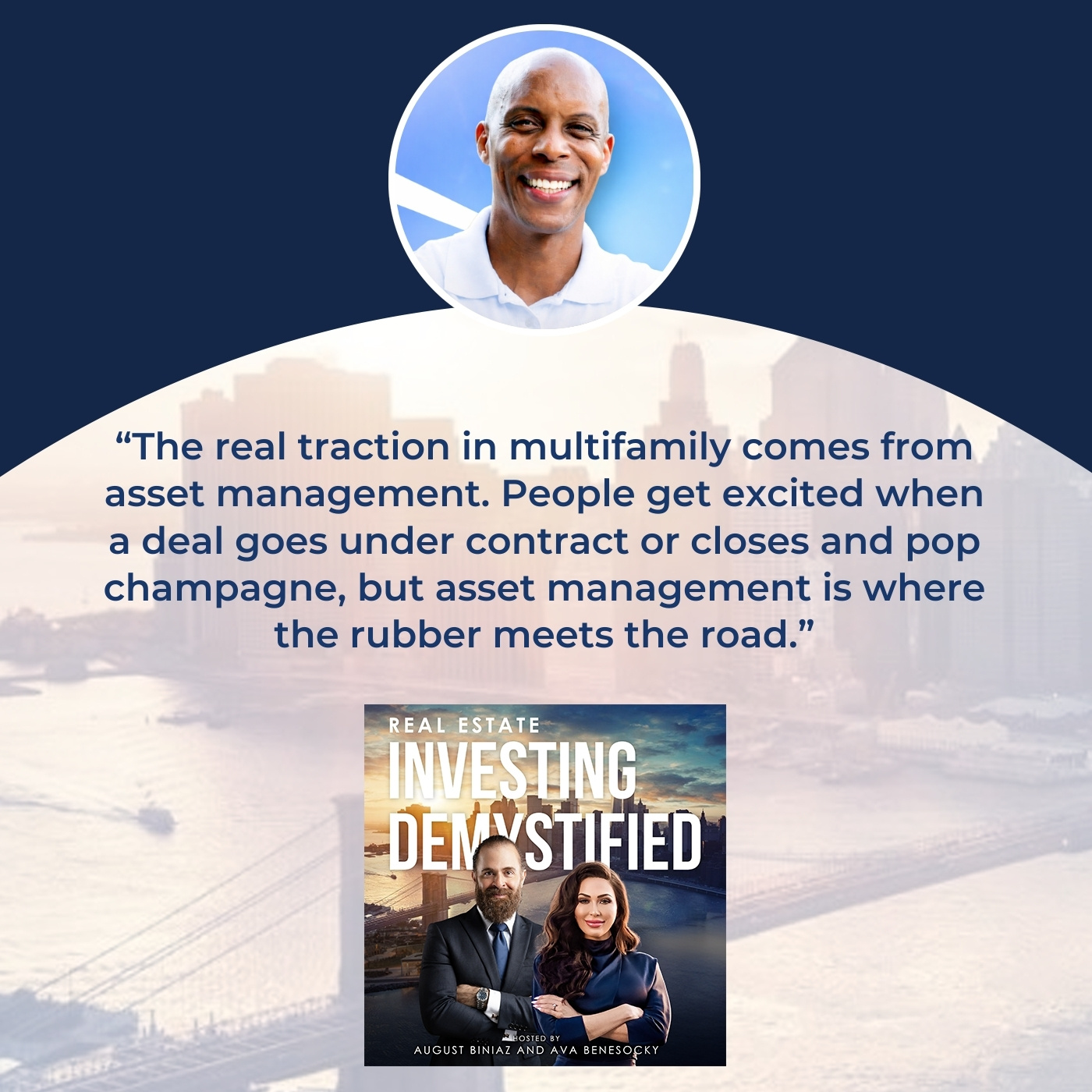
Multifamily is a whole different beast. It’s not the same as if you own a 3-unit, 4-unit, 10-unit, or 12-unit. Managing a 100-unit versus a 12-unit is 2 different strategies, so we had to learn, get educated, and build the processes and SOPs out for that. We had to get the right boots on the ground to manage that process. The real traction with multifamily comes in asset management. People get excited when they get a deal on a contract. They close and pop champagne, but the real traction is asset management. That’s when the rubber meets the road. Constantly learning things and updating our KPIs to get better results from those assets is what we’ve been focusing on.
You started in a larger, institutional-sized multifamily after COVID, I’m guessing. Were the markets in Alabama?
It was in the middle of Georgia and Alabama. Columbus, Macon, those areas.
These deals are syndicated. Meaning, you bring in investors.
Fund Mechanics Vs. Syndication
We bring in investors for them, but they’re not syndicated. I have a fund, and the two strategies are within the same fund. Investors will come in for a 2-year term or a 3-year term. They’ll get monthly or quarterly distributions, but there’s no profit participation. They don’t get a piece of the action when a property sells, but they get a pref payment. They’re like lenders.
I looked at the syndication model. There are so many proformas that say, “You’re going to make a 21% return with 2 extra capital,” and it comes out to be 10% after everything settles and they sell. Unless they were in the market selling to us that were coming in in 2000 or 2001 and buying, those are the guys that made the bulk of the money. The guys who owned the stuff 7 to 10 years prior started selling in the 2000s.
The best deals were purchased before 2000. After 2000, we were buying based on the low interest rates. It was the same thing in Q4 of 2022 when interest rates went up and the 10 Year went up. The music stopped playing. There have been a lot of challenges for a lot of multifamily operators since then, getting operational efficiency to meet that business plan that they said they were going to execute on. Meaning, stabilize, refile a lower rate, pull out equity, or whatever it was when interest rates doubled. They didn’t finish their execution plan on stabilization, so a lot of them are going into default selling.
That whole part of the industry is in a frenzy. If you have capital and you have a great track record to raise that capital, go on and start buying multifamily. Case in point is that we were making it $78 a door. It’s stuff and making $50 a door. It’s a great opportunity to go in, increase the occupancy, and do the things that need to be done to bring value there. There are some great deals on the market.

Fund Management: If you have capital and a strong track record, now is the time to raise that capital and start buying multifamily properties.
There are trillions of dollars of commercial real estate loans that have matured and are maturing. We’ve been preparing our investors to get ready for a great 2026 because we’ll all get our hands on some great deals.
Talking about the mechanics of your fund, your fund has been designed in a way that it behaves a bit more like a debt fund rather than an equity fund.
It’s a syndication.
If you have a deal in Alabama, let’s say a 100-unit multifamily deal, and you need to raise a few million dollars for that particular deal, you market that deal to your investors. For investors who want to have only exposure to that deal, could they go through the fund, or as soon as they invest in a fund, they get exposure to all the deals that you have in the fund?
They can go into a mezz fund. They can be a mezz lender that have pref equity over other investors. It’s a pref place with a higher position in the capital stack by going into a mezz fund that will fund that deal. It’s not a syndication. It’s still debt. They don’t get a PC action, but they’re tied to that specific property through a mezz fund that we have. They can do that.
I wanted to understand the mechanics of it. Most people, when they think about a fund, compare a fund to a syndication. A syndication is a project-specific fund. A fund is any vehicle that holds money, right? That’s why you hear the thing about college funds or a sovereign wealth fund. They’re all a vehicle that holds money.
When you compare a syndication to a fund, the difference is that in a syndication, investors only have exposure to that one deal. They’re investing in that deal. Whereas in a fund, in more standard cases, investors have exposure to all the deals that are sitting in the fund, the basket of deals. I’m guessing the way you’ve structured your fund, either your debt fund, or if you have an equity fund, or what have you, investors can have exposure only to one deal if they wish.
Maybe you create different series or different classes of units or shares. I’m not sure how you’ve done it, but maybe that’s how your legal team has put it together. Somebody investing in the fund doesn’t mean that they have exposure to every deal you have. They can only have exposure to that one deal, even though they come through the fund, I’m guessing.
The way it’s structured is that some people like diversity. They like being in a debt fund, where they have their capital attached to all of the assets in a fund, versus one asset. Case in point, in multifamily, a lot of people who went into those syndications, when that property is not performing, there is no equity for them. They have to sell and probably pay off the first lender.
Investors may take a loss. They may get 6% pref distributions with the promise that once they execute in a plan, increasing the rents three years later by refinancing or selling, investors will get some type of equity participation, which may get them to 12% or 16%. I was seeing that a lot of the time, that was not the case. I structured a vehicle where all of the assets we buy, whether it’s a luxury spec home or multifamily, are in the same fund.
Investors have more diversity where their capital is collateralized against, and they get a debt payment, but there’s no profit participation. There are downsides to that also, because there is no depreciation, which most people look for. Mostly, we have people invest in the IRA, so they already set up a Roth or whatever. They don’t need that bonus depreciation, accelerated depreciation, or all that stuff that most of the sponsors are selling. That’s the way it’s structured for diversity.
It gives you the autonomy to use the capital opportunistically for any deal that you have on your desk at the moment.
As long as it’s within the guidelines of what we told the investors we were going to buy. It says in our operating agreement what we can buy, what we can’t buy, what the risk is, how we evaluate it, our experience, and the team members. All that’s in the PPM.
Those are all there, but it allows you to decide where that capital should be allocated, depending on where the lifespan of your deal is. The last thing you want is those returns accruing for investors. They’re preferred returns, so they keep accruing. They end up diluting the fund for the GP for yourself. Let’s continue the conversation a bit more about Ava’s favorite topic, which is raising money. We have all these great ideas. You have this great business plan, multifamily value add, fix and flips, and building spec homes. The money has to come from somewhere. That money comes from investors. How do you go about finding these investors?
As I was listening to you, you talked about raising money even prior to the GFC. Most people got into the space post-2013 or post the Jobs Act, where the process of raising capital became a lot easier, including us. I was in real estate most of my professional career, but I learned about this idea of raising money not too long ago. For you, you’ve been raising money for a long time. You might have some questions about raising money and what have you, Ava.
We’d love to hear how you connect with investors. When you get into institutional multifamily, these projects have a large ticket on them. You have to raise not just a couple of hundred thousand dollars for a single-family home, but we’re talking millions of dollars. I know myself that raising capital is probably one of the toughest parts of the business. We’d love to hear about your journey. We’d love to hear about your first capital raise on a large institutional multifamily asset. How did that go? What strategies did you use to connect with investors?
Raising capital is a whole other business. It’s relationship-based. A lot of people look at raising capital as something transactional, but you want to create a customer for life, if you will, from those investors. They have to get to know, like, and trust you. Some of the ways they get to know, like, and trust you are by tuning in to this show, doing more due diligence, watching content, becoming familiar with what you do, and getting educated on that asset class that they’re interested in. Eventually, they will become a capital partner if what you do resonates with them. What do you do once you create that relationship? If you do them right, they’re going to refer friends and family. That’s how your network grows.
Before the GFC, the majority of the capital was raised from doctors and lawyers. It all started with the landlord at my building, from whom I was leasing my office. He would see contractors. He would see a lot of traffic come in and out of the doors. He’s asking one day, “What is it that you do? I know you say that you do construction and real estate, but what do you do?” I explained I was fixing and flipping houses. I have lenders, and I put up the money for the closing and the renovation. He had asked if he could be a part of that and start lending the money.
He had made money in the dot-com boom and started leveraging his lines of credit and arbitrage them. He would lend me money at 12%. He was getting money at the bank for 8%. He was getting arbitrage. That worked out for a very long time, where he became the gap lender for the purchase in the first phase of renovation. I had to pull nothing out of my pocket but just manage the process, put that money to work, and get the returns. He then started to refer friends, and I created more relationships. That’s how my business blossomed from raising capital from investors before the GFC.
After the GFC, it got a little bit more sophisticated, where I consulted with an SEC attorney. Those were based on properties. It was the 1st mortgage, 2nd mortgage, or whatever it was, somewhere around there. The 2nd mortgages, I was getting from lenders, because the 1st mortgage was the hard money lender, and then they became the 2nd lender.

Fund Management: A lot of people see raising capital as purely transactional, but you want to create lifelong relationships with your investors. They need to get to know, like, and trust you.
From there, we put together a prospectus to start to raise capital. We started with non-accredited and accredited in the first fund. You can have a mixture of both of them in there. There was too much work with reporting, disclosures, and not being able to be on a podcast and talk about, “I pay 8% to 10% returns.” You can do general solicitation with that type of structure. That was our first fund.
After we raised that and paid all the investors, we decided to open up a fund for accredited investors. It was so we could promote and market the offerings that we have and do general solicitation, whether it’s from our website, podcast, webinars, and things like that. It was about being able to stand up in the front of the room and educate on what we do.
I was talking about this. It’s about investor psychology and understanding the investor and what they’ve been through. You went through 2008. You’ve lost and won in real estate deals. It is understanding what the investor has been through as well. It is understanding what their needs are, where they’re at, and if they’ve lost money. It’s how you talk to the investor to build that relationship with them as well. A big portion of capital raising is psychology and understanding the other person.
I’ll let you guys get into that, but what I care about is where those leads are coming from. Let’s say investor psychology, connections, making them feel warm and fuzzy, showing your track record, and getting them to sign this 200-page PPM.
You can tell that this is what I do. I’m more focused on the equity side.
Where do the leads come from?
The Art Of Raising Capital Through Proximity
There’s a lot of shaking hands and kissing babies. I try to put myself in areas where I know these people are going to be. They’re going to be at a Rotary Club or a golf club. I’m a member of a golf club. I belong to a few masterminds. One of them is CG, Collective Genius. They’re all high-net-worth individuals there. It is putting yourself in a room where these individuals are, like the local commerce or the chamber of commerce in your area, where you have political figures, doctors, and lawyers. There are people going there to donate. It is constantly putting yourself in those areas where you can create those relationships.
Constantly put yourself in spaces where you can build those relationships. Share on XTalk to us about that. Proximity is one very important thing. First of all, as a smaller firm that works, you can raise a few million dollars. If you want to do bigger than that, there’s got to be other means.
Fund the fund.
We’ll touch on that as well. When it comes to proximity, this is very important. I always understood capital raising. That’s what I understood. The proximity is the most important thing. You have to be part of these country clubs, golf clubs, these private gentlemen clubs, the Tiger 21s, and what have you. There are fraternities you have to be part of. When I was part of some of those groups, raising money wasn’t the easiest part because a lot of other people who were part of those groups, a lot of times, they’re there to raise money as well.
I’d love to learn about a strategy that has worked for you. Let’s say you are part of a golf club, and people are curious about what it is that you do. It’s as if I’m talking to you about how to pick up girls. Every guy who’s good at picking up girls has their own strategy. They have some of these guys sell courses about it. Raising money has some similarities as well because if you try too hard and go after people, you’re usually going to get denied.
You talked about that for one of your first investors. He came up to you and started asking you questions. Is it to build that aura and impression that you have success and that you’re busy in the world of real estate to get them to be attracted and come ask you questions? What is the pitch strategy that has worked for you when you do have that circle of influence and when you do have that proximity, which has resulted in actual investors from those connections you have? Sometimes, you might also burn those bridges. You might also cause issues. There’s part of that group saying, “August, we’ve heard you. You’re pitching to a lot of other members. We don’t appreciate that.” How do you stay above board? How do you still leverage those proximity connections that you have?
They say success is something you attract, not something you pursue. That was Jim Rohn. What I spoke about before is all about relationship-building. I’m not going there with a T-shirt saying, “I pay 10% returns,” and asking about it. I’m not doing any of that, although that’s a good idea. That would get a lot of people to come up to you.
A QR code right below it so they can scan it.
That’s a great idea. The QR code in the back and the front says, “I pay 10%. Look in the back,” and they ask you something like that. It’s relationship-building. Those conversations that you’re having with each person are different. People may ask you, “What do you do?” I invest in alternative assets. You then start to have conversations about what they invest in. They’ll ask, “Are you traditional or alternative?” You can explain Tiger 21, how portfolio diversification is, and how it’s not a 60-40 split. It’s more with alternatives for them to get to the goal faster.
Start talking about your experience and have those conversations that make them curious about following up with you later. Maybe you get an email address or a phone number from them, and then you put them into your nurturing campaign. Maybe they’ll download an eBook or watch a webinar. They’re in your ecosystem, where you have an omnipresent. They’re seeing you pop up in their social media feeds, seeing you on a podcast, and seeing you in events. You’re nurturing them by building that relationship. You can easily look at your drip campaigns and your email to see who’s the low-hanging fruit.
It’s a nurturing process. You can be in a group, and it could take you two years before you’re having those conversations with that person, before they want to invest because they have to get to know, like, and trust you. If you go to these events with the intention of raising money, you’re not going to raise the money. You have to go with the intention of creating relationships. I would get a part of groups that you’re going to benefit from and learn from as well, at the same time, while you’re creating relationships.

Fund Management: If you go to these events with the sole intention of raising money, you won’t. You have to go with the intention of building relationships.
Another good one is I’m a part of this CEO mastermind with business owners that run businesses that are anywhere from $3 million, $5 million, $10 million to $25 million. We’re all sitting in the same room and having conversations about challenges in our business. We’re sharing and masterminding with each other on how we’re going to fix sales, marketing, and certain things that are coming up in the group.
We’re bonding and creating those relationships, too, in those CEO Think Tank-type structures. From there, you create those relationships. They have money that they want to deploy, also. Most business owners who have 25 or more employees generate $5 million, $3 million, or more. They have income that they want to invest, whether it’s from their solo 401(k) or whatever it is.
It can be a conversation talking about IRAs or certain things that they may not be up on. You educate them, and you’re creating those relationships. It’s a relationship business. It takes time. When I first started, I would go to a room and think I was going to raise capital. I’d be like, “I’m going to this event because there are going to be investors there.” That was the wrong way that I went for the first few years of being in this business. I still haven’t mastered it.
That’s great advice. There are a lot of great points there. It’s an art.
It’s a lifestyle business.
You touched on some great points there as well.
A couple of times, though.
The nurture process and adding them to your CRM is so key. Before getting to the next event of our show, we have a few questions we want to go over quickly because our time is running out here. Are you part of any real estate masterminds? Some of those terminologies you’re using are classic stuff we’ve heard a lot. Are there any groups you’re part of or have been a part of?
The Collective Genius is the main one that I’m a part of. There’s another mastermind. It’s a local one. It’s not big. It’s called CEO Think Tank. It’s one of my mentors. They teach you business operating systems like Scaling Up. In Collective Genius, I learned things like EOS by Gino Wickman, the Entrepreneurial Operating System. It’s about how to run your business on system processes.
Scaling Up talks about the four parts of the business, which are people, strategy, execution, and cash, and having quarterly goals around those four things to optimize your business and create operational efficiency. In being a part of these groups, I’m getting something out of it, but I’m also creating relationships with people as well.
That’s very smart. That was a good point. Let’s go over a few more before we get to the next segment. The next question here is about the tools you’re using, whether it be AI or software. You talked about CRM. Run through some of the tools you’re using within your company, both on the construction side and on the multifamily syndication side and the fund management side. What are some tools you’re using, and AI, if you are using any AI?
On the construction side, we will take off from architectural drawings. We’ll put it inside the system and figure out the lumber we need, sheetrock we need, how much paint, square footage, floors, and ceramic tile. In the projects part of ChatGPT, we’ve built some information. We put the instructions in. We post the architecture drawings, and they give us all the information about the property we need. We still have the guys measure, but we at least have some idea of material costs or paint labor in an area.
We use it a lot for construction. That’s mainly what we use for construction. We played around with it, analyzing deals, but we stuck with the spreadsheets in Excel to be a little bit more accurate because the AI has a tendency to hallucinate. We started off trying to build deal analyzers in it. We have something that’s probably 80%, but we stick to those spreadsheets and the way we’ve been doing due diligence to mitigate risk on that.
With your CRM, which CRM do you use?
We use GoHighLevel.
HubSpot, ActiveCampaign, GoHighLevel.
GoHighLevel seems to be the one that a lot of people are using.
HubSpot is too expensive.
You’re telling us. It’s ridiculous. That’s what we use, unfortunately. Next question, Fuquan. Talk to us about your vision. Where do you see yourself in the next ten years?
Also, your company. Not just yourself. Where do you see yourself and the company?
With the company, our Big Hairy Audacious Goal, our BHAG, is to provide quality, affordable housing for 5,000 families. When I first got into real estate, it was about the money. After the GFC, it was me figuring out my why and what impact I could create. I get more out of it. What gave my fill of importance was going back to the low-income areas. It was getting them back into properties, putting them back on the tax roll, and giving the residents a better place to live.
My big, hairy, audacious goal is to provide quality, affordable housing for 5,000 families. Share on XWhen we took the war chest and took it to the Southeast, we could do this on a scale. When we go into these complexes that we’re buying. The goal is to transition from complex to community. How do we do that? Everybody who buys a multifamily or one of these buildings has the anticipation of increasing rents, curb appeal, selling, and making a profit. What happens to that person who’s in there? What change did you make with that person?
How do you go from complex to community? You can have nonprofit organizations come in and do financial literacy. They can teach people how to do resumes and teach people how to get home ownership. It is about adding value to the residents there instead of just the property. That’s what our Big Hairy Audacious Goal is. Where I see ourselves in ten years is building that vision out.
You’re still a believer in multifamily value add. You continue to build your portfolio and your footprint. How about geographical? You said Alabama. What was your other market? Georgia?
Georgia. Those areas are great because it fits within our business plan. I come from North New Jersey, which is a low-income area. The whole goal is to go and create impact. If you go to those low-income areas where they have affordable housing for battered women and children and seniors who can’t afford a rent bump, it’s a good feeling to be able to do that and to do it quality-wise, not like a slumlord. We put good stuff in it, like LVT flooring and new appliances.
If they don’t pay rent, they’re out, right?
For sure. It’s a business, not a charity.
Last question before our 10 Championship Rounds to Financial Freedom. We can focus more on multifamily and commercial real estate because real estate is very localized. Overall, if multifamily, commercial real estate, and the real estate cycle were a clock and 12:00 was top of the market, the best time, mania, multiple offers, non-refundable deposits, and it’s insanity, and the bottom of the market was 6:00 where people are walking away from deposits, a lot of foreclosures, a lot of distress in the market, what time is it now?
The 2026 Market Outlook & “6:00” On The Clock
It’s 6:00. It’s all over the place. If you have capital to buy, now is the time to buy. You can do so many creative deals with sellers or sponsors who bite off more than they can chew. They’re willing to let the deal go without getting foreclosed on. There are a lot of great opportunities out there. It’s 6:00 all day.
If you have capital to invest, now is definitely the time to buy. There are many great opportunities available. Share on XI tend to concur with you.
Same.
Thank you so much for sharing all your wisdom, experience, and journey. We’d love to have you again on the show at some point in the future. Let’s get to the next segment of our show.
It’s the 10 Championship Rounds to Financial Freedom. Are you ready, Fuquan?
Ready.
Let’s do this. First question. Who’s been the most influential person in your life?
Dr. Maxwell Maltz. Psycho-Cybernetics was the name of the book. It talks about a winning self-image. That book changed the way I think about myself and things that I’m doing. It is Maxwell Maltz.
The next question is, what is the number one book you would recommend?
The number one book I would recommend would be Outwitting the Devil by Napoleon Hill.
Next question. If you had the opportunity to travel back in time, what advice would you give your younger self?
Diversification. That was what I lacked from the GFC.
Don’t put all your eggs in one basket. The next question is, what is the best investment you’ve ever made?
I would say when I made a large profit, somewhere around $800,000, which was a single-family flip that was done within 1 year.
What’s the worst investment you’ve ever made, and what lessons did you learn from it?
Thorough due diligence was a lesson I learned. The worst investment was a single-family house I purchased at a crazy price. I got it for $25,000, and the property was worth maybe $160,000. It had some remediation that needed to be done and some environmental challenges that went to the tune of over $100,000. I purchased it from somebody I knew. It was a quick deal. I had to get it fast. The greed kicked in, and I didn’t follow the steps of due diligence. That was a very valuable lesson. I was able to recoup from it. I had to hold onto the property for five years. It became profitable because the market shifted.
The next question is, how much would you need in the bank to retire? What’s your number?
My personal number of what I need in the bank to retire is $10 million.
Nice number.
That seems to be a very common answer that we get on the show.
Ten percent of $10 million is more than you need.
Next question. If you could have dinner with someone, dead or alive, who would it be?
I would say Charlie Munger.
Do you want to elaborate on that at all?
He is one of the greatest investors who ever lived.
Next question. If you weren’t doing what you’re doing, what would you be doing?
I don’t have an answer to that question. Someone else asked me that before.
Hobbies, sports, or anything else, even imaginary.
I do dirt bike riding, snowboarding, and all the dangerous stuff. I like sales. I’ll probably be doing sales. I like talking to people, helping them reach their goals, and making money. It would be something in sales if it weren’t real estate specifically.
Next question. Book smarts or street smarts?
Both.
If you had to choose one.
I would choose street smarts. Street smarts always beat book smarts.
Last question. If you had $1 million in cash and you had to make 1 investment, what would it be?
Real estate, 100%.
What type? What would you do?
A single family. It has a faster turnaround. I get the cash back and keep flipping it.
Fuquan, quickly let everybody know who’s tuning in. What is the best way that they can reach you?
I’m on social media at @FuquanBilal. I’m on LinkedIn and Facebook. You can go to NNGCapitalFund.com if you want to schedule a discovery call and learn more about what we do.
He’s got a pretty unique name, so he is not going to be that hard to find, like some of our guests. I appreciate your time. Thank you for coming here with us and sharing your journey. We appreciate it.
Thank you so much.
I appreciate you guys for having me.