


US businesses often create offshore accounts so they can pay less tax. But here is the million-dollar question: Is this legal? Ava Benesocky and August Biniaz address this hot topic with Vincenzo Villamena, Founder and CEO of Online Taxman. Together, they discuss the major reasons to embrace offshore strategies, from asset protection to tax savings, as well as the countries where you can take full advantage of them. Vincenzo also talks about the leak of confidential information through the Panama Papers, what makes a qualified real estate professional, and his work in helping people in the e-commerce space.
Get in touch with Vincenzo Villamena:
LinkedIn: https://www.linkedin.com/in/vincenzo-villamena
Website: https://onlinetaxman.com
➤Newsletter: Join 10K+ investors reading the CPI Capital Newsletter each week:
https://cpicapital.cpicapital.ca/newsletter
➤Investors: Access CPI Capital exclusive investment opportunities:
https://cpicapital.cpicapital.ca/investor
➤Underwriting: Access to CPI Capital’s proprietary back of the envelope underwriting model:
https://share.hsforms.com/14uV3n5iJStO6Soy2RO6tmQ4rx4j
➤Website: https://cpicapital.com/ (https://cpicapital.ca/)
#avabenesocky #augustbiniaz #cpicapital
—
Watch the episode here
Listen to the podcast here
Important Links
- Vincenzo Villamena on LinkedIn
- Online Taxman
- Online Taxman on Facebook
- Online Taxman on LinkedIn
- Online Taxman on X
- The 4-Hour Workweek
About Vincenzo Villamena
 I have extensive experience in both tax preparation and advising clients in accounting and financial transactions. At Online Taxman, I oversee corporate and individual filings. I specialize in offshore structuring for US entrepreneurs abroad and US real estate transactions by foreign nationals and funds.
Before founding Online Taxman, I served as partner in 4 Corners Inc., focusing on individuals and businesses for accounting and tax preparation matters as well as advising high net worth individuals in private equity investing.
I also have “Big 4” audit and corporate accounting experience during my time with PricewaterhouseCoopers, involved in Fortune 100 audit engagements and M&A transactions, giving me the knowledge to perform analysis in valuation, corporate finance, and technical accounting issues.
I have both a Masters of Accounting and Bachelors of Business Administration with distinction from the University of Michigan’s Stephen M Ross School of Business. I love to travel and I am fluent in Spanish, Portuguese, and Italian. I currently live in Rio De Janeiro, Brazil.
How The Wealthy Legally Pay Less Tax (Panama Papers, Offshore Strategy & Real Estate) – Vincenzo Villamena
Welcome back to the show.
You have only done this 400 times, Ava.
August does not say what happens behind the scenes. For two years now, I have probably been up 3 to 5 times a night, but I am superwoman. What are we talking about?
What have you been doing? Have you been up all night? Doing what? Three times a night, you have been up doing what? Tell me more about what you have been up to at night. I fall asleep. I wake up in the morning.
Two babies.
You have demystified real estate.
Yeah, I have been demystifying real estate while everybody is sleeping. I am excited about this episode. I am about all of our shows because we bring on amazing guests, and who does not like to learn about tax benefits?
I never want to hear about taxes at all. That is why you and your team manage that department of the company. I do not want to even hear about it.
It is not what you are about. He just says, “Ava, deal with it.” I’ll go and deal with it.
When there are ideas and concepts about taxes, and we are going to talk about more than taxes. We are going to talk about tax havens and different strategies that the rich and the famous use to not pay taxes legally. I’m excited about this episode. Do you want to give a quick background about our guest?
You know what? Why do we not just welcome our guests? We have Vincenzo Villamena. Thank you for being here. You are living in Brazil. Tell us a little bit about your background, please.
Thank you for having me. I used to work at the Big Four. That is where I got my CPA, got my stripes there. I have been having my own tax firm for fifteen years, Online Taxman. We help people around the world with primarily US tax, as well as offshore structures, offshore trusts, and really just the tax planning, as well as the compliance. All these CPAs just focus on compliance, but we want to try to optimize and plan for people as well.
Demystifying Offshore Strategies: Is It Illegal Or Not?
Let us just get into that a bit more. Let us demystify offshore. When you say offshore, what do you mean by that?
Offshore has such a bad connotation in a lot of ways, but it is really just being able to, whether it is putting money or assets, etc., in a company, in my case, outside of the United States. There is nothing wrong with doing so. Of course, one, there is asset protection purposes, and in some cases, there is tax optimization, but it is not illegal to put stuff offshore. The other side of that is it is really important to file correctly and disclose. I tell my clients that it is no longer a game of hide and seek. It is a game of show and tell. If you want to set up these sexy structures, no problem, but you do want to report them to the IRS accordingly.
Got it. The main purpose is sheltering from lawsuits, from potential divorces, and other things, but is there a tax-saving component as well to have things offshore?
It depends. If somebody has active income, such as a consulting business or global business with clients around the world, and everything is being managed from outside the United States, then you could set up an offshore company and get a lower tax rate, roughly. Now, it was 10.5%. The US corporate tax rate is 21% with an offshore company. It is 10.5%, although they are raising that with the big, beautiful bill to ultimately 15%.
Businesses that actively manage outside the US and do not have US-based employees could qualify for reduced tax rates. Share on XAgain, there are a couple of stipulations. You cannot have US employees. You have to be managing an offshore. It is primarily focused on global entrepreneurs and founders like myself. I live in Brazil. I have set up an offshore company because I have a global company. Most of my employees are outside the US. In those cases, you get a lower tax rate, and you can also keep the money in the company and get a little bit of a tax deferral on that money.
You have to operate it outside of the US? What does that entail? You have to be yourself? You have to leave and be where the company is founded?
Yeah, not necessarily where the company is established, but you do have to live outside the US or at least manage it outside the US.
What does that mean? Define managing.
It is also not like a bright-line test. What I would say is this. If you have employees outside the US, and you have somebody who is running the day-to-day activities outside the US, and you are a board of directors, and just high-level, not running day-to-day, then you could set up all those structures. What we end up doing is that people who are ready to leave the United States, they want to leave the US. We give them a tax residency, whether it is in Dubai, Panama, or wherever they really want to live.
With that, set up an offshore structure. Because they are actively managing outside the US and they do not have any US employees, their employees are in the Philippines, India, or wherever, just around the world, let us say, then you could qualify for these reduced tax rates. Whatever money you pay the 10.5%, let us say, and then if you keep the money in the company, then you could use it to invest and expand your business. You would only get taxed on the money again when you take it out as a dividend.
They just followed that line there, so you are a global service provider. Most of your clients are outside of the US, and all your employees are outside of the US. You go ahead and end up having your main office and residences somewhere outside of the US, wherever it makes sense from your advisors, such as yourself advising them. Now, any income they make, they are paying 10.5% on an annual basis. Their remainder is sitting in their account. You said they can invest it. When you say invest, is it investing it back in the company or investing in whatever they want?
Again, not a bright line test. Part of it definitely needs to be for investing in the company. There are some high-level retained earnings rules. You cannot just keep it in the company just to keep it in the company. You have to have a plan, like, “I am going to invest in further expanding my business or other acquisition opportunities within my space.” In the meantime, if you are going to have a stock portfolio, have a couple of passive income investments, it is okay, as long as your ultimate intention is to stay in the company to expand the company’s business.
As long as your company is expanding, as long as you are using some of those funds that are remaining, as long as you are using that to grow the company and actively doing so, you can use some of it for investing in real estate or equities or whatever you wish. Now, let us talk about those dividends you pay yourself. Let us say you are living somewhere in the world, say Panama, Puerto Rico, or living somewhere else. Does it not matter where you live in the world? I guess non-sanctioned countries, not Iran, for example.

Iran, Cuba, and North Korea, no. As to your point, the natural question, of course, is, “Great. I am saving money on this corporate tax at 10.5%. What about me personally?” There are two options again for a US citizen. If you are living outside the US, you can take a salary of $130,000 from a foreign company. That is completely tax-free in the United States. There is something called the foreign earned income exclusion, which basically means, husband-wife team, that is $260,000, because you are getting $130,000 and $130,000.
I mean completely tax-free, meaning no federal tax. Also, if you are taking a salary from a foreign company, there is also no FICA or Social Security, etc. It is a straight $130,000 directly to you. If you want to take money on top of that, then it would come out as a dividend, and then that would be taxed at a qualified dividend rate of anywhere from 15% to 23.8%, depending on how much money you are taking out.
Depends how much money you are taking out.
Baby, we are moving to Brazil.
We are not even American citizens yet, so just wait. We are not moving to Brazil. Brazilian guys are really handsome. We are moving to the Philippines if we are moving. Going back on this, so would average everyday accountants notice? Let us say somebody is currently, as we speak, somebody is living abroad, somebody is making a bunch of money living abroad. As soon as $130,000 from our US income, and then been tax-free in Canada. That would have been amazing. We have to research it. Do you know if Canada has a similar thing?
Canada is a little greedier. You know what I mean? I think you need to be either fully out of Canada and give up your Canadian tax residency, which, for you, all means basically giving up any access to Canadian health care. Of course, you still keep your Canadian passport.
Selling all real estate assets, doing that.
Yeah, you have to really show that you are cutting ties. I remember there was some, it was a few years ago, but there was some Canadian hockey player that they tried to pull back in the system because he did not fully divest of assets in real estate, etc. You have to just sort of give up your life in Canada, and then you do not have to pay tax in Canada. In some ways, it is easier in the sense that, as long as you get out of the Canadian system, you could earn more than the $130,000 each and still be tax-free. The threshold for Canada, as far as “getting out” of the system, is higher.
Territorial Taxation Countries You Should Know About
I guess as an American, when you are moving from the US to utilize this tax strategy that exists, the country you are moving to, and you are becoming a resident of, is important as well, because if that country has a high tax bracket, what is the point? You are again double taxed in a way. What are some of those countries that people move to from the US? What are the top three or top five that you hear about?
For a long time, Portugal they have something called the NHR, non-habitual residency. It is like a ten-year thing where again, you do not get taxed on anything outside of Portugal, like capital gains or even a salary. There is a withholding. They have changed that a bit. You have to pay like 12.5%, but Portugal is one. Costa Rica, Panama, and even the Philippines, actually.
There are these countries that are territorial taxation countries, which means that you are only taxed on the money that you earn inside the country. If you are living in Costa Rica, let us say, but all your money is from a US company or another offshore jurisdiction, then technically, you are not paying tax there. There are also other countries where there is just not a lot of enforcement.
I have a lot of clients in Mexico, and they are living there, and they are tax residents, but they are not paying taxes locally, and they are sort of off the grid. I would say that in LATAM, there are some favorable tax regimes. I know Greece is having one. There are a lot that are sort of popping up, which are relatively favorable, and trying to attract people to us.
Those countries will literally know that the US has 300 and over 340 million, and a lot of these people have different business ideas. They actually put these initiatives to attract them, possibly as well from other places in the world as well. Dubai is another one. Their taxes recently went up, or something happened there. Somebody was saying 0% to 10%, I believe.
Dubai is still 0% tax on the personal level, like capital gains and all that. Singapore is another great example. They increased the corporate tax to 9%.
Is your company a US company?
It is still not.
For this strategy, does a company have to be a US company, or can it be an offshore company, right? What did you say?
For Americans, it should be offshore. For a Canadian, the other side of this, and we do a lot of this too, is for people who are digital nomads, and they are a non-US person, the greatest tax haven in the world is the US LLC. The US is essentially also an offshore jurisdiction. It is just not for Americans. If you are a Canadian living in Bali, let us say. You could set up a US LLC, receive all your payments, process credit cards and Stripe, and have a US bank account. As long as you have no offices, warehouses, or employees in the United States, it is tax-free.
Really?
Yes.
If you are a Canadian, you have a US LLC, and your business is in Bali. Does it not matter if you are a Canadian resident or not?
No, you have to get out of being a resident in your home country. Whether it is Canada, Australia, or Germany.
Sorry, you have to be a resident, or you should not be a resident?
You do not want to be a resident.
You are a Canadian living in Asia, doing business in Asia. You create the US LLC. You have all your payment processors going through that LLC and bank accounts. Does that company pay no taxes because it is operating outside of the US?
It’s because there are no US employees, warehouses, or offices.
Who would have known that? Let us move on to this. I am sure we will come back to some other items.
Is Bitcoin Covered By Tax?
Vincenzo, the next question is about Bitcoin as an American, Canadian, or a resident of any other country. If you bought Bitcoin when it was a thousand dollars or less, and now it is 70 times worth that, what are your obligations as a taxpayer? Are you getting taxed on unrealized gains without investing?
You are getting taxed only when you sell or when you switch it to another altcoin. One misconception is that I did not turn my Bitcoin into fiat, so it is not a deemed sale. In reality, if you got out of Bitcoin and you traded it in for Solana or ETH or wherever, that is considered a sale, and that is when you pay US capital gains tax on that.

Less Tax: You are getting taxed only when you sell Bitcoin or switch it to another altcoin.
As an American, you bought Bitcoin when it was really cheap. It has obviously gone unbelievably high, up to over $120,000, and back around $70,000. If you have not converted into any other coins or gone back to USD and come back to it, if it is just sitting in Bitcoin and it is worth millions of dollars, you have no tax consequences at the moment. Can you use that as a net worth statement when you are applying for loans and what have you, or anything else as an American, or do you have to report it every year to the American government?
You do have to report if you own, buy, hold, or trade Bitcoin or any crypto. You could use it for your net worth statement for sure.
Usually, net worth. They want it to be a US bank account, which is guaranteed by the US government or something. I did not know about that, unrealized gains. Now there have been riches made around the world, and a lot of these nomads these days are people who are literally living off their Bitcoin, who bought these things. Bitcoin, if it were a few bucks or a few hundred bucks, or a thousand bucks. I know some of them who are literally traveling the world, living off Bitcoin. What is the tax?
You can have a wallet, nobody will know you have that wallet, and you live off that wallet. Now you can get a credit card that is associated with the wallet. You are traveling the world spending this credit card with the Bitcoin that you have. Is there some way to stay in the shadows? Even Iran, right now, is charging ships that go through the Strait of Hormuz a fee to pass through. That is their form of currency that they are charging the ships that pass through. Is it just “Do not tell anyone and just stay in the shadows?”
It is a good point. That is the thing with crypto is there are a lot of ways to conceal it. Of course, people have used it tremendously to conceal it. You technically should be paying US tax on any capital gains from Bitcoin or any crypto. I am sure there are a lot of people out there who do not or are changing the cost basis and things like that, and paying it, etc.
Whenever you receive Bitcoin for doing a service or selling a good or whatever, that is taxable revenue in the US, and then, of course, if you were to just hold the Bitcoin and then sell later, then again, that difference, that change of value is also taxable in the US. It is really just a matter of reporting that, apparently. A lot of people, of course, do not do it. It is definitely a focal point of the US as far as going after people with Bitcoin. Again, I think it is also a bit of a black hole, too, as far as it is to your point. People are using it and spending it and not paying tax on it.
Last quick question on that. Somebody bought Bitcoin at $1,000. It is approximately $70,000. Let us say they got a million dollars’ worth of Bitcoin, and they sell a portion of it. Let us say they sell $50,000 this year just to live off. Do they pay tax on that sale of that $50,000 attached to their ordinary income? How does that work? Do you know?
It used to be that you were able to specifically identify, like, “What did I buy that at?” Let me try to pinpoint that 50 to the Bitcoin that was the most expensive, which has the highest cost basis. Now you have to do it on the other, like first in, first out or last in, first out. You have to pick a methodology, whether it is last-in-first-out or first-in-first-out. That is how you ultimately have to treat every sale that you have of cryptocurrency.
Getting Low Tax From No Tax Jurisdictions
Let us switch the conversation a little bit, and let us talk about tax havens in Panama, the British Virgin Islands, Cayman Islands. Why are these destinations used for tax savings, and what does the process look like, Vincenzo?
A lot of those places you listed, the low tax is really those no tax jurisdictions, which means that any money that is earned in those countries that comes from outside is taxed at 0%. Really, what it comes down to is they are all really similar, but they have certain nuances behind them. For example, we generally set up a lot of companies in the British Virgin Islands, because it is part of the Commonwealth.
Money earned in no tax jurisdictions is taxed at 0%. Share on XIs that where Epstein was?
He was in the US Virgin Islands, actually in the USVI. BVI is, in our opinion, just sort of a go-to, cost-efficient, easy-to-operate. If somebody is going after any institutional money, like going to the United States or not just the US, but around the world and trying to fundraise for a startup or something like that, some sort of venture.
We generally recommend Cayman because Cayman modeled its laws after Delaware and is very solid. You have places like Hong Kong, again, for people that are doing business in China, for example, buying goods from China, e-commerce, etc. We generally recommend that. Again, a lot of these jurisdictions around the Caribbean are very similar, and they all have zero tax.
When you say zero tax, just for me to understand, what is this idea of a tax haven? You described perfectly somebody who does not live in the US anymore, has a company offshore, his employees are offshore, and makes money. Talked about his income, up to $130,000, is not taxed. I fully understand that. When you talk about a tax haven, from what? Haven from what?
In the example you just described, that setup. Generally, the real setup is like you have a US C Corp that owns an offshore company or a tax haven company, and then you get the 10.5%. The reason for that tax is that the person is American. US citizens have to pay taxes no matter where they go in the world because of US citizenship. For somebody from Canada or another country, they can open up and operate a very similar setup as an owner of a BVI company, and have no employees in Canada, the US, or anywhere around the world. They would pay zero percent tax. The haven is basically that these countries essentially have zero percent tax.
They can be a US citizen, US resident, or do business in the US, but then what they do is they would create a subsidiary of their US company that is in the British Virgin Islands, and they would flow a portion of their income, or a portion of their profit or all of it into that company and they would not pay taxes there.
If you are a non-US citizen and you live outside the US, and everything is outside the US, and you are wherever, you can pay zero percent tax on your income, whether it is a US LLC or one of these other tax-saving countries like the BVI. If you are a US citizen, because of your citizenship, you cannot get a zero percent tax if you own at least 50% of the company. The best you can do is 10.5%.

Less Tax: If you are a US citizen, you cannot get a 0% tax if you own at least 50% of the company. The best you can do is 10.5%.
Ten and a half percent in the British Virgin Islands. Anywhere.
Yeah, exactly, because it is majority owned by a US citizen.
You are saying that these countries, Panama, British Virgin Islands, or British Islands, Cayman Islands, the reason that they are preferred by people using them for tax strategies is that they have the infrastructure. Hong Kong, you mentioned as well, has the infrastructure. They are not necessarily because of any tax code that gives them preferential treatment.
They have the infrastructure, and they are zero percent tax. For the BVI, Hong Kong, or whatever, there are also a handful of other ones, like Seychelles, St. Lucia, St. Kitts, or a bunch of Caribbean countries. My point is that some of those countries do not necessarily have the infrastructure or have the set of laws and whatnot that are reliable. There is nothing wrong with them. It is just like when you have to pick between a list of twenty countries, you are looking at what the laws are. Represent and asset protection, etc. That is why our banking.
Let us go over this. You are a US guy, a US citizen. You have a US company. You are making a lot of money. You want to reduce your taxes. You come and seek your services. You open an account for them in the British Virgin Islands. They now take a portion of their profits annually to that company. They are only paying ten percent a year on that portion of profits. How do they end up getting their hands on that money eventually and using it or paying themselves dividends or what have you? As an American, do they pay themselves dividends, or do they pay taxes on it?
What they are doing is basically, they set up the offshore company, which is like a US C Corp that owns a BVI company. They are paying themselves roughly $10,000 a month, or basically $130,000 a year. That is a tax-free salary. If they want to take out more to cover more living expenses, then that would be a dividend. How they technically would do that is they would transfer the money from the BVI company to the C Corp holding company, the parent company, and then they would take the dividend from the parent company.
That is, even if they are living in the US, still, right?
All that structure means they have to be living outside the US.
That is right.
This whole thing. The guy has to be living outside of the US still. Nobody living in the US can use it, but I know a lot of Americans who use the British Virgin Islands. I do not know them. I have heard over the years that I have heard a lot of Americans utilizing these. Which we will get into in a moment as well.
You can use it for asset protection, or again, if you have somebody managing it outside, you could totally do it. There might be some people who are stepping up like the gray, if they are living in the US, actively managing an offshore company, and not paying zero percent tax or the lower tax rate, ten and a half percent. It is an area where you could get significant savings, but you also have to really be careful on how you are reporting, making sure you are doing it by the book, so to speak, etc.
Talking about the gray area, let us talk about a little bit of gray area.
Massive Confidential Leak Through The Panama Papers
Let us discuss the Panama Papers, and I am just going to let everybody know what the Panama Papers are, if you do not know. The Panama Papers were a massive leak of confidential financial documents in 2016 that exposed how wealthy individuals and companies used offshore entities to manage their money. My first question to August when I was learning more about this was, “Is this illegal?”
What I learned was that there is a legal aspect that you were just talking about. You said asset protection, tax planning within the law, and then international business structuring. The illegal part of it is obviously tax evasion, hiding income, money laundering, and then hiding assets from authorities. It was interesting to learn about this, and now learning with you on the call, Vincenzo. Even the Queen of England was embroiled in this scandal.
It was definitely a scandal.
The amount was around ten million pounds. It was not that she personally did something illegal. It was more about the optics and the ethics behind this. Offshore Investing is often associated with tax avoidance or secrecy. Even if legal, it can look questionable for a public figure like the Queen. She was literally taking away money from her own subjects.
Again, every situation is different. There are definitely those people who do it in an illegal sense. They are just hiding money, especially from around the world. I look at it as it is not illegal to put your money offshore for asset protection or in these scenarios that we have just discussed, where there are legitimate tax planning opportunities.
It is a fine line, and people have to be aware of that. Of course, if you do have to create an offshore company or an offshore trust, you need to report it to the IRS, etc. Asset protection and other things it is definitely not illegal. You also have a lot of the Apples and Googles of the world that are also setting up these structures.
Whether it is a no-tax jurisdiction or they are setting up in a low-tax jurisdiction like Ireland, when you are talking about billions of dollars, you are saving millions, and also the everyday entrepreneur can also do that as long as they are, again, following the rules, managing things outside the United States, and not having US employees, etc.
Let me ask this differently. When it comes to setting up offshore accounts for US citizens, US residents who want to use offshore mainly for asset protection, but also for some tax savings, how much are we talking about, and is it worth going through? It has got to be in the tens of millions, hundreds of millions, or even in the few millions. What is that line?
No, it is a fair question. I generally look at it as you have to set up, let us say, like an offshore trust, like in the Cook Islands, and have that protection and also that estate planning aspect. You want to at least have a million dollars to put inside it. Also deciding what assets go into a trust or an offshore company is also important, because if you are really going for asset protection, of course, like putting your brokerage account and things like that.
That is what I am asking. Another question is this, sorry, forgive me. Can your offshore account be an exchange account where it is invested in, like say index funds or what have you, or does it have to be cashed in there?
Yeah, it could be an offshore account.
We can have an offshore account, a million dollars protected from any litigation in the US, but it is invested in equities, invested in S&P, NASDAQ.
Where it gets more complicated is when people like, “I want to put a piece of real estate in an offshore trust, like a whatever place in the US.” You can title it obviously, in the name of the offshore trust. At the end of the day, it is still a piece of land or real estate in the United States. Of course, there are ways for whatever the US courts like to circumvent or rule against you. You are not getting true asset protection versus if it is a brokerage account that is already offshore. There is little that can be done to go and get access to that money.
If you do the strategy in the British Virgin Islands, do you have to actually open a bank account and use the brokerage accounts that they have there on the island?
No, you could use a US brokerage account or a brokerage account in another jurisdiction.
All banks have branches there, like big banks, branches in?
You use the European and the UK branch, or whatnot. The subsidiaries go into almost like this notion of flag theory, which is like having a company in the Virgin Islands, BVI, but then having your brokerage account in Hong Kong, and then having a tax residency in Panama or some sort of second residency in Panama. This notion of planting different flags around the world from an asset protection or like plan B perspective to prepare for any litigation, or who knows what happens. The world is a crazy place, candidly. We do not know where things are going either way. It has always been like that, right? It has that notion of like a plan B essentially.

If somebody transfers a million dollars in their exchange account to the British Virgin Islands using your services, do they have to physically go to the British Virgin Islands, or can they not?
Sometimes, yes. It is not necessarily BVI. I am just saying, like the company is in BVI, but you can have a bank account in Switzerland, or I would literally just met with the princess and people from Liechtenstein because they have a big bank in Liechtenstein for high net worth individuals, etc. You could have a bank account around the world, and it is just entitled in the name of a BVI company, for example.
Tax Benefits Of Puerto Rico’s Act 60
A few more questions before we move to the next round. This one is from me. The last two can be from Ava. Actually, no, I will do the two, and then you will do the last one here. Puerto Rico, in our space, real estate private equity. We deal with a lot of US commercial real estate, syndication funds, and raising money from investors. A lot of people in our space have made the move to Puerto Rico recently. The most famous one that is not in our space is Jake Paul. He is a primary resident in Puerto Rico.
What is it about Puerto Rico? Is Puerto Rico a US territory? Is it not? Why are people choosing Puerto Rico? I would be concerned. I live in Naples, the safest city in America. If I lived in Puerto Rico, we would have a couple of bodyguards around us with guns all the time. Aside from the security side of it, what is it about Puerto Rico in particular that you are seeing a lot of these individuals move? One of them is actually a lawyer friend of ours who moved to Puerto Rico.
Basically, Puerto Rico, a few years ago, more than a few years at this point, but to bring in local tax revenue, they set up what is called Act 60, which basically is an act to attract people to live in Puerto Rico. It is a US territory. As an American, you can move to Puerto Rico without a problem. You do not have to go through the visa process or whatever. It is already a US territory. You go there, and you can set up a company and pay roughly six percent on your income.
We are talking about the ten and a half percent on the offshore, and Puerto Rico is six percent. Could be even less. Essentially, you could set up a Puerto Rican company and get paid from your real estate syndicates, or whatever, it’s like a GP, you are like a management company. That would be a lower tax rate. Any capital gains would also be tax-free. We see a lot of traders and people in finance, etc., who are day trading and getting capital gains, which should also be tax-free.

Less Tax: Essentially, you could set up a Puerto Rican company and get paid from your real estate syndicates. That would be a lower tax rate, and any capital gains would also be tax-free.
It is a great strategy for people. You have to be in Puerto Rico for over half the year. It has been a bit of a honeypot, as a lot of people have moved there. Now they are actually auditing a lot of people. The only thing I would say is that with Puerto Rico is it is 183 days, half the year in Puerto Rico, but you really want to be able to show that you are living in Puerto Rico and all your belongings are there, your family is there, etc.
In other words, you cannot half-ass it because some people think it is great. They are like, “My kids are in school in the US, but I will move down there so I can take advantage of the tax advantages for my family.” Again, their household, their belongings, everything was in the United States, in the continental United States. Those are the sort of people who have gotten out of it. I would just be very cognizant of that, as far as, if you are going to do Puerto Rico, go all in.
Do they still get the benefit of $130,000 individual per year, up to $130,000 tax?
No. You do have to pay yourself a salary and pay some Puerto Rico local taxes. Again, everything else is tax-free, and it is zero percent dividends.
You are not paying federal tax. You are just paying the Puerto tax. Even in the case of Jake Paul, who possibly makes tens of millions of dollars a year.
Yes, exactly.
Helping People In The E-Commerce Space
On doing research on you before the show, e-commerce seems to be a space that something associated with e-commerce seems to be a space that you help a lot with. I saw the Amazon logo somewhere in your material. What is it about those types of clients, and how do you help them, and what is it that they do?
There are a lot of e-commerce sales around the world, and we also set up these types of structures. You have to be very careful with e-commerce because, in the end, you are selling goods in the United States. By selling goods in the US, there is a little bit of tax there. For example, we will set up a Hong Kong company that will buy the goods from China, and then they will resell them to a US C Corp LLC. That wholesale Hong Kong China will be taxed at a lower rate, 10.5%.
Be careful with e-commerce. Whenever you sell goods in the US, there is a little bit of tax there. Share on XOf course, they do have to pay some tax on the local company that is selling in the United States. The big thing about e-commerce is that there is effectively connected income in the US. There are also ways to strategize. Again, set up this offshore structure, but you also need to be aware of that. On the retail level, you are selling in the United States, and you should be paying local tax on that money.
Just doing an exercise here. You buy something for a dollar in China, and you set up a company in Hong Kong. That company is the buyer, buys it for a dollar. That company then goes through a US C Corp through Amazon, sells that to a consumer in the US for $10. You have made $9 of profit. Do you realize that on the US company C Corp level, or do you purposefully make your profits on the Hong Kong level, $8, and just make a buck on the US?
Yes. I probably do it a little more even than that. I would say you buy it for a dollar from your Hong Kong company, you sell it to the United States for $6, and then your US C corp sells it to the retail buyer for $9. You are getting like $3 profit in the US company and then like $5 profit in the Hong Kong offshore.
You are doing it very fairly.
I am the accountant here.
You want to be reasonable.
You have to be reasonable because there is a term for like arm’s length. Within the reason for what is happening out there.
For sure.
What Makes A Qualified Real Estate Professional
Last question that we have before we get into the next segment of our show. At CPI Capital, we are real estate syndicators and have lots of high-net-worth passive investors who partner with us to acquire institutional multifamily. One of the tax benefits of acquiring multifamily property is depreciation. Now, what a lot of people know and what we do is depreciation. The losses can flow through to the passive investors. Now, a lot of syndicators out there, they advertise this. It is very exciting. There are so many tax benefits when you invest with us.
100% year one write off. I have seen a lot of advertisements. Initially, as Canadians, we had no idea what they were talking about. Like, “This person has a $200,000 tax liability this year, and they can invest in this syndication, and that gets completely written off,” but keep going.
They have a W-2 on the side, right? They are making their income, and then they have invested in this syndication where they can use these losses against their ordinary income. One of the things that we want to point out, and I wanted to discuss with you, is that some of the fine writing, I guess, is to use these losses. You have to be a qualified real estate professional. Vincenzo, if you could just give a crash course, I guess, on what a qualified real estate professional is. I will get into the next questions that I have on this topic.
Let us call it REPS, a Real Estate Professional Status, which is a great way to, again, deduct losses, especially in your first year of owning it, especially with a bonus depreciation. The concept of falling, you buy a rental property, and now if you have somebody in your household, you have one person that is a high earner, and then their spouse maybe does not earn a lot or part-time or whatever, I automatically say, “Let us try to figure out how to turn your spouse into a real estate professional.”
What that means is they need 750 hours dedicated to real estate per year. That is not just learning them. It is like managing real estate or looking for deals, etc. They need over 50% of their time doing real estate. Again, that is why it is great for somebody who is not working or maybe like a little side hustle because, of course, over 50% of their time needs to be done real estate. The big thing here is documentation.
It is just self-verifying that you are a real estate professional because you spent 750 hours this year managing or doing some active stuff in real estate.
Document that, for example, I guess.
The REPS Tracker is like an app that I would do. I tell it because it is an honest system self-verification, but in order to avoid any audit risk, I think documentation in these situations is super important. Literally, you need to track it. I had a phone call with whatever perspective tenant or real estate broker. I visited the site. I went around and looked at houses, etc.
You want to just document all of that. You have that log. Of course, you will hit the 750. As long as you are not dedicating your time to anything else, you are essentially good. Along with that, let us say you buy this property, and you get a long-term lease, and you want to get what is known as a cost segregation study. Let us say, for round numbers, the home is a million dollars, and $200,000 of that home is land, $800,000 is the real estate portion, but then within that, $150,000 is fixtures, the refrigerator, the door handles, all that stuff outside.
The lawn, like lawn improvements or whatever, and then all those fixtures and furniture, etc., that $150,000 worth can be accelerated depreciation, and you get the $150,000 that same year. You get this bonus depreciation. I have clients who, again, buy real estate every year so they can continue to deduct the bonus depreciation. The other side is if you cannot be a real estate professional, let us say both spouses work full time, you can potentially do something called short-term rentals, like Airbnb. With that, you do not have to qualify for REPS status, but you do have to be somewhat active.
Spouses who work full-time can potentially do short-term rentals. They do not have to qualify for REPS status, but they have to be somewhat active. Share on XHave short-term rentals and actively own and manage short-term rentals. That is the thing, because a lot of doctors and lawyers, accountants come to you and they say, “I can use these losses against my W-2 income.” They actually cannot because they do not have the REPS status. A lot of them do not even really have time to do that.
In our space, multifamily space, when we do these depreciations, instead of $100,000, it is in the millions of dollars and distributed pro rata between all the investors.
That is actually a really good point. It is like, let us say I want to be a REPS. I want to be a real estate professional. Let me go buy whatever property, like a long-term rental. You are hitting the 750 hours. Let us say you do not want to continue to keep on buying houses year after year, it is a lot of work, etc. As long as you are able to hit that 750 with your current property and then invest in syndicates, you could do this grouping election so that it is not just my one or a couple of properties that I own outright. Again, if I am investing in real estate syndicates, I could group them. The losses on box three of the K-1, the losses on the K-1, along with my depreciation loss, which I am getting year after year, could all be deducted against ordinary income from the higher-earning spouse’s W-2 income.
I was going to say, let us say I am a doctor. I am making my W-2 income, and I have allocated it. I have bought a bunch of rental properties, so I am making active income from my renters as well. I have spent 750 hours. Is it possible to prove through the REPS app or whatever the case may be?
Not if you are full-time as a doctor, because then you have to look at what is over 50% of your time. You know what I mean? You have to say that over 50% of your time is dedicated towards real estate, which if you are doing like a full-time doctor.
Got it. When I take my K-1 to my accountant, and there are losses, the accountant says, “I am so sorry, you cannot use these losses against your income.”
It is passive. ]You want to try to get REPS status again from a spouse, or try to go into the short-term rental game. Both spouses are working full-time, and short-term rentals are the way to go.
If you do have a short-term rental, then you can use these even though you have not done the 750 hours.
It is a hundred hours. You have to put in a little bit of time. Again, for a household where both spouses work full time, the two best tax planning deduction tactics are short-term rental by far, because then you are getting an asset of your cumulative assets. There is another play, which also requires you to put in a hundred hours, but it is called a construction equipment rental. You buy construction equipment, you get financed, and then you can take the first-year bonus depreciation on construction equipment.
Construction equipment rental.
That is another.
How Depreciation Recapture Can Impact Real Estate
Thank you for that crash course. My last question to close the doors on this is, when an investor invests with us, they are getting these losses, and they have their REPS status. When the property is sold, they have used it against their ordinary income. There is a lot of money in taxes.
Let us do an example. This year, they made half a million dollars. They owed approximately, let us say they lived in California, they owed approximately $250,000 federal and state. Now they have their REPS status, or they have a short-term rental property or portfolio. They come to us and then they invest, let us say, a hundred thousand dollars with us this year. We give them $70,000 of depreciation. They take that $70,000 and that reduces their $250,000, whatever their rental income gives them as well, rental property gives them as well, that reduces. We got your preface to the question you are going to ask.
Perfect, now there is something called depreciation recapture at the end when we sell the asset. Can you give us a simple breakdown of how that would impact?
That 70k or whatever the deduction, like the depreciation, will get recaptured on the sale. In a lot of ways, it is a bit of a tax deferral strategy.
This whole thing is a deferral.
It is all deferred. Until potentially you could always flip the property into a 1031 exchange, and then you could roll it over into the next rental property.
Yes, you can do that.
You are continuing to defer the capital gain.
If you did not roll it over and you sold the asset, technically, at that point, all of the losses that you saved over the year, you have to then pay back to the IRS from the profits that are made.
Correct.
Perfect. Thanks, Vincenzo.
Ten Championship Rounds To Financial Freedom
Let us move to the next segment of the show. Ten rapid-fire questions. Ava, go ahead.
Ten championship rounds to financial freedom. Let us go, Vincenzo. First question is, who has been the most influential person in your life?
My father. Nothing to do with money because he was not a good person with money, but he was kind and an individual who inspired me to do good and volunteer, etc.
Next question. What is the number one book you would recommend?
The one that I started out with was The 4-Hour Workweek by Tim Ferriss. I thought it was just a book about traveling and starting your own business. At the time, that was super inspiring. I encourage everyone to just read books rapidly because you learn so much by reading or listening to audio, whatever.
The 4-Hour Workweek, does he literally work four hours a week?
That is the joke. Because it is always like, “Yeah, four hours.” It is never really four hours. I think eve
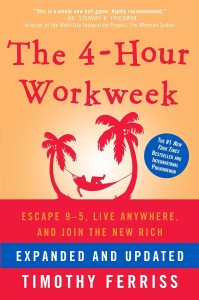
The 4-Hour Workweek: Escape 9-5, Live Anywhere, and Join the New Rich
n four hours of work is almost boring. Let us say, like, twenty hours.
Reduce the work. Next question. Yes. If you had the opportunity to travel back in time, what advice would you give your younger self?
I would say follow your intuition. I feel like I have learned that more and more over the years, to trust yourself and trust your gut over overthinking things. I would have probably done that earlier in life.
Nice. Love that. The next question is, what is the best investment you have ever made?
Over ten years ago, I was living in Medellín, Columbia and I just saw more and more people moving there, etc. Since then, I think the place I bought has quadrupled in value over like eight years. That is a good one on real estate.
Now, what is the worst investment you have ever made, and what lessons did you learn from it?
Around that same time, I met people in the Brazilian tech scene who were all very qualified, but startup investing is really hard. I invested in a couple of startups that went to zero. From there, I have never invested. I have invested in VC funds, but I do not invest in startups because I think it is all about deal flow. You need to be really attuned and plugged in to get a really good deal flow.
The next question is, how much would you need in the bank to retire today? What is your number?
That number is an interesting one. I do not know. I am very happy just as such. I guess I put it at like $10 million, but I am actually somebody that I do not really even fully believe in numeric goals. I let things flow to me. Even if you reach $10 million, it is like, “What are you going to do now?” I try not to even look at goals like that. I look at my intuition about what I am going to do next, etc.
Monetary $10 million, I think, has been the most common answer we have gotten.
Really? Okay.
Next question. If you could have dinner with someone, dead or alive, who would it be?
I would say Winston Churchill. That was such an interesting period in the world during World War II, and Winston Churchill has always been a fascinating figure for me.
He has got cigars named after him, but they are ripping off his statues now, and they are ripping them down because they are saying that he has done some bad things.
Next question. If you were not doing what you are doing today, what would you be doing now? Any hobbies that you loved?
I was going to say I would probably be just some yoga teacher traveling around the world or something like that. Anything that involved traveling and was a very free-flowing thing, like a ski instructor, surf instructor, or something like that.
Nice school.
So much fun. Next question. Book smarts or street smarts?
I am street smart.
From a guy who advised reading as many books as you can. He is on the street.
Book smarts are learned.
Last question, Vincenzo, if you had a million dollars in cash and you had to make one investment today, what would it be?
I always say just invest in yourself. I would start a new company, or I would probably put it in a real estate company. Just because I have been doing that for a long time, but I think that is a big cop out. I would also say yeah, I would just invest in myself and do something
The last thing is just let everybody who is listening know the best way that they can reach you, please.
If anyone has any questions, visit us at OnlineTaxman.com. We obviously do the structuring, but we also do just regular tax return compliance. If anyone has any international tax situation that touches the US, whether you are an American living abroad, a foreigner that is living or investing in the US, or wants to open up one of these tax-free LLCs, hit us up.
Thank you so much, my friend.
Thank you, Vincenzo.
Thank you for having me.