


People hate paying taxes, especially when it cuts into the profits of a successful real estate sale. But for investors focused on building tax free wealth, there’s a decades-old tool in the U.S. tax code that allows you to defer—and potentially eliminate—capital gains taxes on your investment properties.
In this deep dive, we break down the Section 1031 Exchange with qualified intermediary Dave Foster. Discover the surprising mechanics of tax deferral, the strict 45 and 180-day deadlines you must know, and the powerful “Four D’s of 1031 Investing.” Whether you’re a seasoned syndicator, a small-time investor looking to scale, or simply wondering how the world’s wealthiest pass on their real estate empires tax-free (hint: it involves death and a “step-up in basis”), this post is your essential guide to turning taxable gains into generational wealth. Ready to stop writing checks to the government and start reinvesting 100% of your profit? Don’t miss this episode.
Get in touch with Dave Foster:
- Website: https://www.the1031investor.com/
- LinkedIn: https://www.linkedin.com/in/davefoster1031/
- Facebook: https://www.facebook.com/the1031investor/
- Instagram: https://www.instagram.com/davefoster1031
- YouTube: https://www.youtube.com/c/The1031Investor
If you are interested in learning more about passively investing in multifamily and Build-to-Rent properties, click here to schedule a call with the CPI Capital Team or contact us at info@cpicapital.ca. If you like to Co-Syndicate and close on larger deals as a General Partner, click here. You can read more about CPI Capital at https://www.cpicapital.ca.
#avabenesocky #augustbiniaz #cpicapital
—
Watch the episode here
Listen to the podcast here
Important Links
- The 1031 Investor
- Lifetime Tax-Free Wealth: The Real Estate Investor’s Guide to the 1031 Exchange
- Who Not How
- Whatever Happened to Penny Candy?
- The Clipper Ship Strategy
- The 1031 Investor on YouTube
About Dave Foster
 Dave Foster is a Qualified Intermediary (QI) for 1031 exchanges and Founder of The 1031 Investor. As a multi-industry visionary, he has over 25 years of experience working in all phases of real estate investing and brings his clients a fresh perspective and clear vision for strategic development using tools in the tax code such as the 1031 exchange and the Sec 121 Primary residence exclusion.
As an investor himself, he views each investment as a unique opportunity to maximize returns. A degreed accountant with a Master’s in Management, Dave has also just released a best selling book, Lifetime Tax-Free Wealth, The Real Estate Investor’s Guide to the 1031 Exchange.
Tax-Free Wealth: Unlocking The Power Of The 1031 Exchange – Dave Foster
We’re joined by Dave Foster. Dave Foster is a Qualified Intermediary for the 1031 exchanges and the Founder of The 1031 Investor. As a multi-industry visionary, he has over 25 years of experience working in all phases of real estate investing and brings his clients a fresh perspective and clear vision for strategic development using tools in the tax code such as the 1031 exchange and the Section 121 Primary Residence Exclusion.
As an investor himself, he views each investment as a unique opportunity to maximize returns. A degreed Accountant with a Master’s in Management, Dave has also just released a best-selling book called Lifetime Tax-Free Wealth: The Real Estate Investor’s Guide to the 1031 Exchange. Welcome to the show, Dave.
Awesome to be here. Thanks for having me, guys.
Introduction To 1031 Exchange
Dave, let’s start off with please tell us about your background and how you even got into what you’re doing now being Qualified Intermediary for 1031 exchanges.
I would have to say that at this point in time in my life, it was a fortunate accident that was a really bad thing at the time. Many years ago, my wife and I had our first child. That changes life. We threw away the TV and just started watching this little bundle of joy. We knew that one of the things we wanted was more time. That was the commodity that we had to maximize. We said, “Well, how can we do that to spend time with our family?”
Somebody said on a date night, “Let’s just become real estate investors. It’ll be easy.” my other nickname in life is Ready-Fire-Aim-Dave. I went and bought a piece of property in Denver, Colorado, fixed it up, put some renters in it, sold it later, made a great profit and thought we’re off to the races because we had decided that we wanted to sail away and raise our family on a sailboat.
That was great until my accountant, because if you do your own taxes as an accountant, you’ve got a fool for a client. My accountant said, “Dave, you got to write a check for $30,000.” That was not part of the plan. I said, “There’s got to be a better way.” that was just when there was a huge tax court case that had been resolved against the US government in favor of a taxpayer so that now this thing called the Starker Exchange or the 1031 exchange was going to be available to regular investors like you and I.
By the way, August, let’s talk about Canadian investors at the end because they can do 1031. We’ll come back. All of a sudden, the opportunity to sell a piece of real estate, to take all of the profit including the tax you would have had to have paid and go buy new investment real estate using the tax dollars for your benefit. That’s what it afforded us.
We were able to get back on our 10-year goal, move our portfolio using the 1031 exchange and a series of primary residence exemptions from Colorado to Connecticut to Florida, bought a 53-foot sailboat with tax-free dollars and lived off of our vacation rental portfolio just North of you guys in Cape Coral. We raised our kids for ten years on the boat doing that and taking care of my clients. When I looked at what it had done for us, I said “My gosh, what power does this have for anyone?” I paid $30,000 I didn’t have to, but now I’ve been able to sail a lot and help a lot of people along the way.
Sorry, you raised your kids on a sailboat? We have a hard time raising our kids on land.
The greatest thing in the world was timeout. We never had to listen to them because we just put them in the dinghy and towed it off the back of the boat. I said, “You can come back on board when you can behave.”
Obviously they homeschooled, right, on the boat?
We did. We homeschooled them, you bet. We maximized our time. We got to spend so much more time with them than we would have in a traditional setting.
Dave, talk to us about the 1031 exchange. Obviously, first of all, the 1031 is mentioning a part of the tax code, if you can confirm that.
One of my mentors once challenged me to stop thinking about the tax code as a way for the government to get your dollars. He said, “That’s not what this is all about at all. The tax code exists as a behavior incentivizer. The government wants you to do certain things and if you do them, the tax code rewards you.” Here in America, we’re a relatively young country, but the underpinning of our entire country’s wealth is really in real estate, isn’t it?
The tax code exists as a behavioral incentive. The government wants you to do certain things, and if you do them, the tax code rewards you. Share on XA vibrant, active real estate economy is critical for the United States success. How does the IRS incentivize that? By allowing you to invest in real estate, sell and buy, and be able to do it without having to pay the tax. By the way, this is an interesting aside. It was put in the tax code in 1920. This is not something new, because a lot of the farmers coming out into the industrial age were wanting to sell their farms and buy bigger farms but because of the tax burden, didn’t have the money to be able to do that.
Even more importantly, young farmers who wanted to go into farming couldn’t do it because the older farmers weren’t selling their farms. The IRS said, “Let’s put 1031 into the code and now you can sell and buy those farms without paying taxes.” Doesn’t that sound just like real estate now? People that have it need to be able to sell it so that the younger investors can come in and start to buy their entry-level properties. It’s a great stimulant for the economy in real estate.
It aligns with the idea of the United States which is the political model, which is capitalism. That’s great.
Give us a crash course as far as deferring the taxes and how it all works.
Defer sounds like an -ish word, doesn’t it? I get this from retirement planners and accountants all the time, clients, “Why do I want to do this if I’m just going to defer the tax?”
It doesn’t get wiped out completely. It’s just deferred.
Hence the four D’s of 1031 investing. The first D is to defer, get started because you defer that first tax. Now in my case, it would have been $30,000. Yes, as long as you keep it deferred, you make the money off of that. The rule of 72 tells us that if you divide your interest rate by the time, it tells you how long it takes for your investment to double.
If I made 10% on that $30,000 by reinvesting it in real estate, it would double every 7.2 years. Fast forward 35 years, what would that $30,000 be worth right now? A bunch. It still keeps me up at night, I got to tell you, because it’s the one that got away. That’s the whole point, is to start because every day the tax is deferred, you’re making the money on it. It does get better. Now I’m going to feel like the Ronco salesman, but wait, there’s more.
The 1031 allows you to react to wherever the real estate cycle is. We know that the. That real estate is cyclical. It booms and busts in different places at different times and with different asset classes. Typically, it’s single-family homes. You guys are syndicating a lot so you’re going into larger multifamily or commercial projects. Absolutely. Those have their place in time.
With the 1031 exchange, you can sell any type of investment real estate anywhere in the country and go buy any other type anywhere in the country. Even though yes, you’re deferring tax, you’re not locked in so that it’s impacting your strategic decisions. You can still move your portfolio from San Francisco to Austin, from single-family to commercial and keep all of that tax deferred while it’s making money for you.
Mechanics & Rules of 1031 Exchange
Follow up question to that. You buy a piece of property for $1 million, you’ve held it for 10 years, it’s worth $2 million now. Your taxable amount is $1 million. Simple math. Now you want to do a 1031 exchange and we’ll get into the actual mechanics of how that takes place and service providers such as yourself and so on. The idea here is that only that taxable million has to be invested in a new property. The principal doesn’t matter, the other million doesn’t matter.

Yeah. Here’s where the IRS does nasty stuff because they don’t tell you the rest of the story. You’re absolutely correct because if you just sold that piece of property, you would not be taxed on your capital, you would only pay tax on the profit. That’s how the rule is. Here’s the other shoe that drops in a 1031 exchange. In order to defer all tax, you must purchase at least as much real estate as you sell using all of the proceeds.
In our example, you would have to purchase $2 million of real estate. Now here’s how they get away with that. What they say is if you wanted to pull out your original $1 million, you’re not pulling out that $1 million, you’re pulling out $1 million of profit and you’ll be taxed on it. You and I would say, “Well no we’re not. I started with $1 million. I’m taking that out in the sale.” they said “No, when you do a 1031 exchange, this is what we choose to say. You’re taking out profit first.” it’s really a nasty trick.
Following on that logic then, it is more preferential, it is more advantageous to use as much debt as possible if your plan is a continuous 1031 exchange? Is that fair to say?
It absolutely could be, sure.
As long as you’re not putting high octane risky debt on there, if it’s a good debt but better to put debt on it.
Debt in general is one of the components of the internal rate of return. It’s how you make money off of your mortgage amortization and the tenants paying your interest. Yeah, definitely. As long as you use all your cash and you purchase at least as much as you sell, you’re absolutely right, certain amount of debt can be good or at various times it may not be. For instance, in the last couple of years we’ve been in a fairly high-rate environment. People that own their properties free and clear were able to 1031 into more.
However, when debt is cheap, instead of buying one $2 million property, maybe they go and they buy $3 million or $4 million properties and use their cash as leverage into a low interest debt. The 1031 allows you that flexibility as long as you purchase at least as much as you sell and use all of whatever cash is generated.
I know you want to get that question going, but let me just ask couple more. Is there a time limit? Going back on this exercise that we’re doing, you bought a piece of property for $1 million, either bought it cash or you put some debt on it, you owned it for 10 years, it’s worth $2 million, you’re selling it for $2 million, you don’t want to pay taxes on that $1 million so you’ve elected to do an exchange, buy another piece of property.
You understand that you have to use the whole $2 million, not just the $1 million in profit, you have to use the whole thing if you got debt on there then you use whatever proceeds that come from that sale, you have to use that whole thing on your next property. Is there a time limit of when you can do that?
The time limits of the 1031 exchange are that it starts with the closing of the sale of your old property from that day you have 45 more days simply to identify your potential replacement property.
You can identify like three different ones?
You can identify up to three and then it doesn’t matter how much they’re worth. If you are looking to move from a less expensive asset into a more expensive asset, that’s a good limit to stay at is three. You can name as many as you want, but if you name more than three, then here’s the IRS making it complicated just because they can. If you name more than three, then either the entire value of your list can’t be more than 200% of what you sold, or in our example, $4 million, or you have to purchase 95% of the value of the list.
If you sell for $2 million and you want to look in that same or more expensive price range, you can’t name 4 or 5 or 6. You’re going to want to stick to three. If you’re selling that $2 million and maybe it’s the time in the market where the cheaper single-family homes are where the return is, you could name a bunch of those, couldn’t you, and still keep the amount under the 200%? Does that make sense?
Yeah. If you’re doing an exchange and Ava asked, “Can I have these,” to identify the next property I’m going to invest in, I have 45 days to identify, can I go out there and identify 10? You’re like, “No, there’s a restriction on how many you can identify.” when you talk about identify, that means identify and who do we give that to? Do we do we go online and put that in somewhere?
It never reaches the IRS until they want to question you. It’s one of the things that the qualified intermediary has to keep on file.
It stays on your books. You go and identify, you let your intermediary know that I’ve identified ten properties. Your intermediary comes and says, “You’ve identified ten properties, you can’t do that because your 10 properties you’ve identified are worth $20 million, your max amount is 200% of your total amount which is $4 million. You got to reduce and pick your top players.”
Not unless Ava was ready to buy all of them, then it would still qualify. There are some tricks and nuance that’s in there. The recommendations I give people, you want to work as quickly as you can because nothing is keeping you from actually closing on your new properties all during the 45-day period. You can be under contract for them prior to the closing of your sale, you just can’t take title to them until after your sale closes.
I got 45 days to identify the property. You then have identified it and you have to put it under contract within that time? What happens? What’s the next trigger?
Just identification. Once 45 days passes, you can’t alter that.
You’re stuck with what you have. Now you go to the process of purchase and inspections and so on and so forth. How much time do you have, then?
From the day 45, you have an additional 135 days. For the entire process, you have 180 days
What worries me is that 45 days, you have to identify three properties. What if it’s a hot market and all three of those properties are on multiple offers, and they all go to somebody else. What are you left with?
A whole lot of problems. I had this exact same thing happened because he did not get them under contract. Anyways, outfit for all his Parcels of land. Now, the list was the list. My recommendation to him, once he climbed off the ledge was you need to go negotiate with the people that will hit you. That’s what he did and they had the properties ended up costing me more and it wasn’t a happy day but there was still significant tax savings. As much as you can work before that 45-day period. Take advantage of doing a hard thing first. If it’s a hot market, get your new properties under contract then sell your old property.
Ava, to remind you, we wrote an LOI on a build-to-rent built by D.R. Horton. I think 85 single-family homes as a community, beautiful water park in San Antonio, built by one of the top merchant builders in in the US, public-traded company. The property came online, Paul and I underwrote it, we were achieving 16% average annual returns on a brand-new property and we were so excited.
We wrote an offer on it, went into LOI, exchange buyer came and bought it right under our feet, it was gone. That’s where comes this idea of stimulating the economy, the goal that IRS and the US government has is to stimulate the economy, to make these people be more aggressive, making them willing to pay more because they have that ticking time bomb that comes down. Now coming back to this discussion, you buy a property for $1 million, you sold it for $2 million.
You have $2 million of proceeds you have to use into the next property. You can go up to three properties but if you go above 200% of your property value in identified properties, you have to buy all of them, so you want to stay within that range. You can cut this up. You even talked about you can go and buy a bunch of single-family and. That’s totally fine. It doesn’t it doesn’t restrict asset classes. It’s bound-free when it comes to asset classes and business model-free.
What we’ve learned over time being in the world of finance, being in the world that are run by very savvy people, these Ivy League types that. I was listening to JP Morgan’s interview in Davos and I almost fell off my chair. I believe he was in his mid-40s and he had left the job that he had. He actually got fired from his job and he was looking for a new career and he had all these great offers. One of the offers was from Home Depot to become a CEO of Home Depot.
Now he’s currently the CEO of JP Morgan. JP Morgan is the has the largest share in banking in the world, it’s a 16% market share in banking. It’s mind blowing what he’s done. Brilliant guy, half Jewish, half Greek. Going back to my point is that Jamie Dimon having this job offer at Home Depot prior to going to his meeting, when he walked into the meeting, he’s like, “I have a confession to make. I’ve never been to a Home Depot.”
The point I’m trying to make is some of these finance guys, they’re from a different cloth. They’re they might not be human. They might be aliens. The guy is in his mid-40s. I lived half of my life in a Home Depot, for God’s sake. Anyways, what point I’m trying to make is there is always savvy things that finance people do. They make money out of thin air. Has anybody ever come up with a type of evergreen fund or a vehicle that allows investors using the exchange model to invest in that vehicle? Has that ever come up?
Specialized Investment Vehicles (DSTs & REITs)
The limiter to that is that another requirement of the 1031 exchange is that the taxpayer for the old property has to be the same as the taxpayer for the new property. What we mean by that is not the person, but the entity and the tax return that is reporting the activity of that property. In so many of the funds or syndications these days, they’re being set up as limited partnerships and then allowing investors to come in as general partnerships, general partners.
Now, when someone buys a membership interest in that, they are not buying the real estate. The partnership owns the real estate. They are buying a membership interest in an entity that owns the real estate. That does not qualify for a 1031 exchange initially. Should we talk about some ways you can make that work?
That’s our next question. There isn’t any vehicle out there, the finance boys have not figured out a vehicle, a financial instrument, a way to solve this problem. The only way that that problem can be solved somebody go out there and buy a piece of real estate that is not structured in an LP?
The only exception to that structurally from a government entity, meaning the SEC and the IRS, is a product called a Delaware Statutory Trust, in which you own a membership interest in the trust and the trust owns a large asset. Self-storage facility, Amazon distribution center, something like that. That specific vehicle was blessed in 2004 by the IRS as a replacement. Even though you own a trust, you also base they own the underlying real estate.
That’s the one way to do it cleanly. There is a thing called a 721 UPREIT, where you sell your real estate and then you buy a piece of real estate from a REIT and then you contribute that real estate to the REIT in exchange for membership interest. That lets you circumvent the 1031 rules. Now, there’s a limit. There’s a bad limitation in that and it falls under my description of the fourth D of 1031 investing in America.
The greatest motivator to keep doing 1031 exchange, which means going through the trouble of making sure you’re always selling and buying actual real estate, is that when you die, your assets are given what’s called a step up in basis as of the day you die. All of that profit from that series of 1031 exchanges all your life goes to your heirs tax-free. Your estate doesn’t pay it, they don’t pay it. It’s the greatest wealth transfer tax-free.
How does this connect to those two options, the Delaware Trust and the REIT that you talked about? In those cases, they can’t?
With the Delaware Trust, you can. The Delaware Statutory Trust is just like owning the real estate. It will go into your estate. The 721 UPREIT goes into the REIT and you don’t pay the tax at that point, but REITs are designed just like any other security to buy and sell at various times. No matter what happens, when you sell a share of that REIT, you will pay the tax. No more option to 1031.
In that Delaware Statutory Trust, if you bought a piece of property for $1 million, you sold it for $2 million, you couldn’t find a property you wanted, you then went to a guy who’s got a DST and. You invested within the DST. Now, few years passes, you want to take that money and buy another piece of property. Can you pull it out?
That’s the greatest thing about them. They act just like real estate with their own calendar of pro-forma. A DST typically is designed for the sponsor to hold it 3 to 7 years and ultimately sell to a large pension fund, the Minneapolis Firefighters or whoever. When that is sold, it acts like another real estate sale. You can 1031 back out.
Now, think about this as a market cycle. You can’t find property because it’s a crazy market, interest rates are too high, for whatever reason you don’t like it. Go buy a DST. Four years later, they sell that DST. Interest rates have dropped 3%, inventory’s growing, so you can 1031 back into your favorite class of real estate, keeping the tax deferred. It’s an awesome hedge, absolutely.
Yeah, interesting. We can we can have it just another show just on DSTs alone. Next thing, Ava, I want to go and start our own DST. We started a vehicle in Canada called a mutual fund trust, which allows us to raise money from Canadian investors who want to use their retirement accounts. In Canada, just like the US, people can use their retirement accounts to invest in syndication, they have that liberty to do that.
They can invest their RRSPs, TFSAs, RESPs into syndication. However, unlike the US, the syndication itself has to be structured in this vehicle called a mutual fund trust. It’s a cumbersome, costly, and it has to have 150 investors at all times. It’s very difficult to run that vehicle. We finally created the MFT and we’re using it to then the MFT invest in our syndicated deals so it allows us to access the $2 trillion that Canadians have in registered funds.
The Delaware Statutory Trust reminds me of an MFT so it’s very interesting. Let’s keep going down here on our next series of questions. We’re learning lots here. I’m really glad to have our friend Dave on. Just touch on a bit more on the journey. You talked on the passing. The guy buys a piece of real estate for $1 million, sells it for $2 million, takes that $2 million, invests it in other real estate, over his career, he’s turned that $1 million into $50 million of deferred taxable real estate.
Possibly, maybe instead of $50 million, let’s say it’s turned into $200 million. He’s got 66% LTV on the property he has. Let’s just say as far as equity, he has grown that equity to $50 million of equity, $200 million of real estate. Now this fellow is 118 years old, the age that I want to die at. We’ve learned from Who Not How, that you should pick your age and times it by a huge multiple.
Anyways, going back to my point. The guy’s super old, he’s pretty close to his deathbed, he’s 1031 exchanged his whole way. Now he’s got a bunch of kids and grandkids, he wants to leave his estate to all of them. Walk us through that. Walk us as if that guy walked into your office. I’m not sure if you provide services for that person as well. Walk us through what happens there. Do they talk to an estate attorney? Walk us through step by step what happens.
The “Step-Up In Basis” & Estate Planning
Yeah, it’s really not something that the QI is going to have much to do with. It’s really going to lie with your financial planners and your estate planners. The rough sketch of what happens, and the example you gave is on one extreme side, is that whatever is profit goes into their estate and then is stepped up in basis those assets are.
When you defer that first tax, as long as you keep it deferred, you make money off of it. Share on XWhat does that mean? Define stepped up in basis.
Let’s bring it down to I bought for $1 million, I sold for $2 million and I died. I did the 1031 exchange and I bought another. I bought another property in my 1031 exchange for $2 million. I happen to die the next day. What’s that property worth? $2 million. If I was to have sold it the next day, I would have still had to pay taxes on $1 million because there was still that profit.
The basis, which is that starting $1 million carries forward into that property but the profit stays in there. Under inheritance law in the US, that $2 million property, the basis is adjusted up to $2 million. Your heir inherits the property as if they paid $2 million for it on the day you died. Where’s the profit? It goes away. That’s the great gift of the US estate tax code.
I feel like there’s somewhat of a trick that the government is playing here because as soon as the heirs get that property for $2 million, now they have a $2 million asset. At some point, they have to sell that $2 million asset, meaning that at some point they have to pay taxes on it, right or no?
What if they remember this guy named Dave Foster that their dad used to do 1031 exchanges?
If they didn’t go that route and they just wanted the cash because they just wanted to go buy crypto?
They’re going to pay tax on whatever appreciation there was from the $2 million.
If they sold it the next day so if they sold it the next day there was no appreciation, then tax-free? That is unbelievable. That sounds too good to be true, Dave.
What a country. There are limits on the size of the estate. Honestly, I couldn’t even tell you what they are right now but because it fluctuates depending on the year and the Congress. Sometimes it’s $10 million, sometimes it’s $30 million. It’s just at some point, it’s going to fall. Assets above that are not going to get that a step up.
For those amounts, the people you were talking about, the $200 million, those folks have already set up family offices. Instead of giving the property to the heirs, that property remains owned by the trust or by the LLC that is the family office. They die and their heirs simply take over the trust the business itself so there’s no property sale.
You can do it in personal name and corporation name?

Tax Free Wealth: If you’re looking to move from a less expensive asset into a more expensive one, a good limit to stick with is three, even though you can name as many as you want. If you name more than three, the IRS steps in and makes it more complicated.
Yes.
It doesn’t matter, a trust a trust can own the property and then sell the property and the trust will just do an exchange itself.
We do a bunch of these for revocable, irrevocable trusts that exist to benefit the grandchildren or whatever. The manager of that trust, the trustee, will sell and buy and sell and buy doing a 1031 exchange to provide the living income for the beneficiaries.
This is unbelievable. Instead of a person buying a property for $1 million and then selling it for $2 million going all the way up to $50 million let’s say, from day one, it was structured in a trust and the trust heirs were kids and grandkids. Now it got to that big amount got to that big windfall.
Let’s say 40 years goes by.
The main trust trustee passes away so now the trustees get the trust. Is that 100% tax free sitting in there?
If they want to sell the property.
The property’s owned by the trust and so the trust is selling the trust has all of that appreciation that they are going to have to pay tax on. A certain amount of it will become tax free and depending on how the person dies or the original grantor dies. There’s some possibilities there. That’s one of the ways you’re probably not going to skate 100% tax free. Let’s say instead of a trust it was an LLC. The LLC simply keeps functioning. The members or the owners of the LLC might change, but it is the LLC that owns the property that has the profit.
Can an LLC be sold without a tax event, the LLC itself?
Sure, the LLC itself can.
Which owns the underlying property. LLC owns 123 Main Street that has done an exchange for 10 years over and over, owns this new property. Now that LLC’s being sold.
Sure, but here’s the problem. What’s that LLC worth when you’re determining its value to be sold? Isn’t it going to be worth at least the sum total of the value of the assets? If you sell that, are you selling real estate? No, you’re selling an entity. You can’t 1031 and you’re selling it for what the sum total of the assets are so you’ll pay a bunch of tax.
We’re running out of time here. Let’s talk about one last item here before getting to the second segment of the show. We run a real estate fund, we are syndicators, we go out there raise money to buy real estate to allow Canadian investors, US investors to have exposure to multifamily these large institutional properties otherwise they wouldn’t have access to them.
It’s time to simplify life. It’s time to move into more passive opportunities. Share on XWe also do build-to-rent development deals we’re just building a project in San Antonio, Texas, Apollo Oaks, named after our second born son, building 30 duplexes there. Now, at times, investors have come to us yet an investor who had $1 million in 1031 exchange wanted to invest, we had already created our entities. Talk to us about syndications. Let’s not convolute the conversation talk about funds but talk about project specific syndications where you’re raising money in an LLC, or in our case, a limited partnership because it’s more tax efficient for Canadian investors.
How do you allow someone who wants to do an exchange? Now timing has to match perfectly because of those 45 days. It has to be perfect so you should probably a syndicator, a fund manager should probably have a huge database of potential exchange investors in their database so the timing can align with some of them. If you just know one guy, it might not work out. Let’s say that is the case. Now they want to take their principal and the profits they’ve made and invest it into your syndication or at least a portion of it into your syndication. How does that work?
Integrating 1031 Exchange With Syndications
Remember, the difficulty is that the taxpayer has to stay the same. With a typical syndication, I can’t do that because I’m buying a membership interest in the LP. Couple of ways you can tackle that. The first one obviously is take a look at your tax liability and say what’s my potential return versus what I have to pay. I am never the person that says you should always do a 1031 exchange. I’m 99.9% of the time, but there might be that reason why but you’ve got to do a studied pro-forma to see that.
The second way to do it though is if the syndication can create a tenant in common scenario. Your financing’s going to have to allow for it, but what you’re going to do is the 1031 investor’s going to sell that property for $1 million and they’re going to buy $1 million not of your limited partnership, $1 million of the underlying real estate.
Now there are two owners of the real estate. There’s your syndication and there is this individual. Their returns are going to be created, adjusted and managed according to an operating agreement that you have with them. They can mirror what everybody else gets but they’re on title to the real estate and so it qualified for a 1031 exchange. Does that make sense?
Somewhat. It makes sense on the basic side.
It has to be let’s say an LLC and then a TIC for example, a tenant in common. That’s where these tics come in.
Let’s say a limited partnership. We don’t structure our deals in an LLC. We structure our deals in a limited partnership. We’re buying a piece of property that property is we’re buying it for $20 million so we’re getting $15 million of debt putting $5 million of that equity. $4 million is coming from us and our investors, $1 million is coming from the exchange buyer. We go and create a tenants in common. Is tenant in common actual vehicle is just the name of the process of having two owners?
It’s just the way you own real estate. A tenant is 1 person, tenants is 2 or more, joint tenants is 50% each, tenants in common is whatever the percentages are. It’s just how you’re on the deed. Now you would not set it up for everybody. You would set it up only for that one 1031 investor.
You can have multiple 1031s. You can have multiple tics that are branched off from so maybe you can have four owners of particular property.
It takes some extra legal work and takes work on the finance side. Most of our syndicators that will do that require $500,000 or $1 million as an initial to make it worth their while to do it. That can absolutely be done.

Tax Free Wealth: The trust exists to benefit the grandchildren—or whoever the beneficiaries are. The trustee manages the trust, buying and selling assets according to the strategy we want, to provide a comfortable living for the beneficiaries.
Can they add on the additional owner after the fact?
Absolutely. I was going to say that alleviates the timing that August was talking about because if your limited partnership owns the real estate, you could sell a percentage of that real estate to a 1031 investor. You could sell it to them at your basis or cost of acquisition so you’re not generating profit, there’s nothing taxable.
I do like these. There is a third way that I actually like even better and we’ve had a lot of clients have success. Remember the goal typically with a with a 1031 investor is growth over time. Growth in assets, growth in profit and along the way, it’s time to simplify life. It’s time to start moving into more passive opportunities. Let’s say I’ve got that million-dollar property that’s free and clear. I sell it. I don’t want to pay tax on it. Instead, what I do is I go and I take $800,000 and I go buy one asset free and clear.
There’s some leftover $200,000 with $1 million in debt. I take $800,000, I go buy a million-dollar property free and clear. I take the other $200,000 and I go buy another million-dollar property using maximum debt. I’ve done my 1031 exchange. I don’t owe any tax. Sheltered it all. What do I own? I own an asset that’s heavily leveraged but it’s making profit because I don’t buy bad properties.
I also have an asset that’s free and clear. If I want to start to buy into syndications, I will do an immediate cash out refinance on that property, take $750,000 and buy a limited partnership, limited partner position in your syndication. At the end of my transactions, what do I have? An 80% leveraged piece of property generating income. A 75% leveraged property generating income. A cash investment in a syndication generating income. That’s growth.
I love this interview. I could have you on here for another hour, but really appreciate this, Dave. It was probably one of the top experts we’ve ever who really understands their space. He knew everything like back of his hand. Great, thank you so much. Thanks for the advice and wisdom. Let’s get to the second segment of the show.
Incredible. Okay, Dave.
The second segment over show the ten Championship rounds to Financial Freedom. I have ten questions. Are you ready?
Let’s go.
I have a quick question. You’re in the space. You’re in real estate. You’re in 1031 exchange. I have to ask you a quick question. Real estate is cyclical. It goes through recession, recovery expansion, hyper supply, over and over. They usually goes to around 8 to 10 years. It goes through these phases, these cycles, but in the last few years, it has gone through a few of these cycles that usually take ten years.
I don’t want to get your sense where we’re at in the real estate cycle, let’s say 12:00 is top of the market where its mania, people are putting multiple offers. They’re putting non-refundable deposits day one, it’s just absolute mania, absolute frenzy. 6:00 is recession terrible time bottom. The market people are in some cases walking away from their deposits. What time is it now?
It’s pretty close to 6:00 and here’s why. We’re seeing price retreats, we’re seeing days on marketing, please, all the general stuff that happens when people who owned a property just to reality. We’re also see the effects of reduced borrowing. The current administration in Washington are trying to do some things with single family homes in particular to start to stimulate demand.
This is not a 2008 scenario where there’s going to be such a divine cliff. I would say we’re probably pretty close to the bottom, which we’re seeing all the other associated services stagnate out about the same amount. A little bit more interest rate drop, a little bit more reality check. I also noticed because we’ve got rental properties that are projected rents are starting to increase again, which is a reflection of wages. What is that doing a real estate prices? It all just blends together, so 6:30, there we are.
The 10 Questions
Alright, let’s get started on the ten questions here, Dave. First question is who’s been the most influential person in your life?
The absolute most important person I’ve grown up with all my life and I seek to know more and more about but I follow Jesus and his teachings and his words of wisdom found in the Bible have been applicable in every part of my life, business to personal.
Next question Dave, what is the number one book you would recommend?
You guys are going to love this, you got to buy it. It’s called Whatever Happened to Penny Candy? You’ve never heard of it, have you? It is the best primer on the actual impacts, causes of inflation that I’ve ever read. It was written for middle school kids but it brings in concepts that are so far beyond that. We have adjusted our investing strategy specifically around what Uncle Charlie wrote in Whatever Happened to Penny Candy? And his follow-up book The Clipper Ship Strategy.
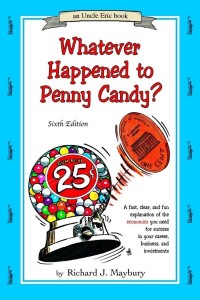
Whatever Happened To Penny Candy?: A Fast, Clear, and Fun Explanation of the Economics You Need for Success in Your Career, Business, and Investments (UNCLE ERIC BOOK)
Thanks, Dave. Next question is if you had the opportunity to travel back in time, what advice would you give your younger self?
I would travel back not all that far about 35 years and I would say, “Get going now. Start now.” the things that we set out to do we’ve done well and we loved them and my only regret is we didn’t do them sooner.
Alright, next question. What’s the best investment you’ve ever made?
The piece of land in North-Central Kansas that I then sold but I carried a note back on and they forfeit on the note so I took it back and then I developed it and sold it again and made 3 or 4 times each time.
Alright, now what’s the worst investment you’ve ever made and what lessons did you learn from it?
The worst investment. I’ve got a rental house right now in Tampa that’s just driving me nuts because I got in a hurry to buy it. I knew what I needed to pay for it but I let myself pay a little more because one of my sons wanted to live in it. It’s not horrible but it drives me nuts because of all the backed up capital improvement costs that take away my profit. Which is why August I loved your story about that brand new home project because those are great for 1031 investors. Sell old assets, go buy and avoid new construction and avoid your capital expense.
Next question. How much would you need in the bank to retire now? What’s your number?
I don’t honestly have a number for a couple of reasons. Number one because I’m never going to retire. I love what I do. I will do it as long as I live and because I can do it well, I’ll always be making money. Even more importantly, another one of my mentors beat me over the head with this when we were developing The 1031 Investor. He said, “The judge of a person’s wealth is not how much money they make. It is how much money they keep.” There’s a lot of not rich people out there that have a lot of money but the back door’s wide open. I love living with a lot less. We don’t have debt. I love living with a lot less so I need a lot less.
Next question. If you could have dinner with someone dead or alive, who would it be?
I want to have dinner with Abraham Lincoln. I have no clue where that just came from. That man somehow navigated one of the craziest, most turbulent times in our history and we know relatively very little about his personal nature other than we do know that he was plagued with depression.
He’s the 16th president of United States of America.
I would just love to spend some time with him to hear how he navigated his mental illness along with being such an influential historical figure.
The Lincoln letters, it’s synonymous with his name, the letters that he wrote then he never sent out because after he sent his initial letter that he sent, one of his generals fired back and he was very upset he paid for it for many years. He learned that he would write these letters and he would just wouldn’t post them. The concept of Lincoln letters really came out. I do that a lot with text actually. I write the text but I don’t send it.
If you weren’t doing what you’re doing today, what would you be doing now?
Any hobbies any dreams in any anything else in the world you would have ever done.
I’d be on a sailboat. We raised our four children on a sailboat for ten years and we went to all of the places and did all of the things that you now watch people doing on TikTok and YouTube and getting paid for it. We were just too early to think about monetizing. Yeah, that’s exactly what I’d do. I’d get back on the sailboat monetize that sucker.
Next question. Book-smarts or street-smarts?
Street-smarts.
Last question. If you had $1 million in cash and you had to make one investment now, what would it be?
There’s nothing I really want to buy now but with $1 million. I would probably go pick out a vacation rental in the Smoky Mountains. They’ve gotten pretty depressed there. Prices are not what they used to be you can buy a lot more for your money and if you’re not having to worry about cashflow, it’s going to pop up again.
Where is that? Is that in Colorado?
In the Smoky Mountains. Gatlinburg, Pigeon Forge, Tennessee or I’d go buy a whole bunch of New Mexico ranch land just because I love it there.
Alright, thank you so much Dave. I really appreciate you and your wisdom.
Thanks, Dave. Just let everybody know what’s the best way that they can reach out to you.
We try to make it easy for folks. Come find us at The1031Investor.com. Everything’s there, YouTube videos, opportunities to talk to us and by the way, let me tease you. Have me back and we’ll talk about how your Canadian folks can use 1031 exchange.
Yes, exactly. We’ll do that. Amazing. Thank you so much, my friend.