

When navigating the complex terrain of real estate private equity, long-term success relies heavily on understanding both sides of the table. Investors often struggle to distinguish between stable, cash-flowing opportunities and high-risk speculative hypes. In this episode, hosts Ava Benesocky and August Biniaz sit down with Paul Shannon, the founder of InvestWise Collective and author of the newly released book, Both Sides of the Table. Paul shares his decade-long journey from capital equipment sales to managing multifamily properties and passive investments. He pulls back the curtain on how syndicators structure fees, the critical truth about floating versus fixed-rate debt, and why genuine investor trust takes years to build but only minutes to ruin.
Get in touch with Paul Shannon:
Website: https://www.investwisecollective.com
LinkedIn: https://www.linkedin.com/in/paul-shannon-68255530
➤Newsletter: Join 10K+ investors reading the CPI Capital Newsletter each week:
https://cpicapital.cpicapital.ca/newsletter
➤Investors: Access CPI Capital exclusive investment opportunities:
https://cpicapital.cpicapital.ca/investor
➤Underwriting: Access to CPI Capital’s proprietary back of the envelope underwriting model:
https://share.hsforms.com/14uV3n5iJStO6Soy2RO6tmQ4rx4j
➤Website: https://cpicapital.com/ (https://cpicapital.ca/)
#avabenesocky #augustbiniaz #cpicapital
—
Watch the episode here
Listen to the podcast here
Important Links
- Paul Shannon on LinkedIn
- InvestWise Collective
- BiggerPockets
- PassivePockets
- Both Sides of the Table
- Devil Take the Hindmost
About Paul Shannon
 Paul Shannon is an experienced residential real estate professional, capital allocator, author, and former co-host of The PassivePockets Podcast.
Paul is an active multifamily investor with a track record of results and integrity – experienced in underwriting, acquisitions, raising capital, property management, project management, asset management, and is a licensed Realtor.
He is also a limited partner, investing in over 40 deals as a passive investor – spanning across multiple real estate asset classes, capital stack positions, and private equity.
Paul is currently the managing principal of InvestWise Collective, helping investors diversify out of traditional markets into passive real estate opportunities. He recently released “Both Sides of the Table” sharing his stories and perspectives as an LP, GP, and fund manager.
The Real Estate Reckoning: How Syndicators Lost Millions & What Comes Next | Paul Shannon
Catching Up On Market Waves And CPI Capital Milestones
Welcome back to the show. I was going to say, “I’m back.”
Isn’t that like a rapper? There’s a rapper out there.
Possibly. I’m not too sure.
It was Diddy or someone before he went to prison for whatever he is in prison for.
I’m excited to be here because I feel like it’s been a while since I’ve been on the show. I wanted to apologize to all of our viewers. They’re probably thinking, “Where has Ava gone?” I’m not dead. I’m just excited. We actually have a couple of live investment opportunities that we launched, and they really do require my full attention as I’m more focused on the equity side of the business here at CPI. I’ve just been talking to investors all day. I launched two deals in conjunction with each other. We’ve never done that before at CPI. One of them is oversubscribed. Congratulations to everybody on that. The other one we’re just currently actively raising for. Yes, you blink your eyes, a week goes by getting my time and energy.
In the middle of all that, we had a quick summer vacation as well. We went up to the Okanagan for two weeks. For our American audiences and viewers, that’s like the Napa Valley of the province of British Columbia that we live in.
That’s right. August and I have some exciting news on the personal level. We’re expecting our third son in December as well. That’s going by really fast, too. Look at the smirk on this guy’s face.
I’m actually smiling. This is the way you’re presenting. It sounds like it’s like a newscast right now that you’re doing. It’s a podcast. It’s not live anymore. Just take it easy. People are always asking. Let’s dive into real estate. Let’s talk about real estate. It’s exciting and crazy right now. There’s a lot happening in the economy over my experience over the last month and a half raising capital for our offerings.
The current fundraising environment has certainly been more challenging than what we’ve experienced in previous years, including last year when we did a capital raise right in the middle of Trump slapping tariffs in the Canadians’ faces. That was a very emotional roller coaster for a lot of investors. We ended up raising $7 million in soft commits on that. Only had to raise $4, but we had about $3 million of equity back out just due to the fact that these tariffs were being slapped in the face.
The majority is Canadian equity, though.
That’s right. The majority is Canadian equity. Right now, yes, I would say there are a lot of investors who are sitting on the sidelines right now. There’s a lot of uncertainty. Many investors, in Canada for sure, have capital tied up in development projects across Canada. Others have really experienced equity losses from the floating-rate debt that was placed on properties, and those are coming to maturity now.
Obviously, there’s ongoing geopolitical uncertainty. There are tariffs again that are being spoken about. Just broader market volatility. There’s a lot going on. The war in Iran. All of this has impacted investor sentiment. It’s something that I love to talk about and what investors love to hear about as well, because we’re all in this together. Our guest here. We’re going to be diving into a little bit of that.
He has his finger on the pulse of what’s taking place with his platform, but he has also been a podcast host himself and interviewed many people. I’m sure he’s going to have his perspective.
We have Paul Shannon as our guest, and he’s a really experienced guy. Welcome to the show, Paul. We’re excited to have you here.
August and Ava, it’s my pleasure. I’m excited to be here as well. Congratulations on the news of your third son coming.
Thank you.
Thank you.
You have three kids as well. I think we were discussing that before the show.
I do. Three kids, two girls, and the youngest is a boy. He’s got to toughen up a little bit. His sisters are always picking on him. We’ve got to get him out there with some other boys and get him tough.
When you start buying properties, you realize you have a finite amount of capital. To continuously grow, you must learn to borrow private money. Share on XI grew up with a house full of women. My two sisters. I was a middle child. It was not easy. That’s why I’m so glad that I got it now. It’s going to begin to get it up on Ava. All of these.
Good thing I’m a strong lion over here. Lioness, I should say.
The Entrepreneur’s Leap: A Journey From Ophthalmology Sales To Multifamily Real Estate
Paul, talk to us because I’ve seen you in the real estate private equity ecosystem. I’ve seen you in this space for a long time. You are someone who’s continuously creating a lot of great content out there, as you have a connection with the BiggerPockets platform, I believe as well. You used to, but talk to us about your journey. How did you end up in real estate, particularly on the investment side of real estate, the private equity side of real estate? Love to hear your background and your starting space.
I was in sales for most of my career, for about fifteen years. I was in capital equipment and medical device sales. I was in the operating room most mornings, very early on, working with nursing staff, working with surgeons to implement difficult technologies in the operating room, namely ophthalmologists. Cataract surgery in the front part of the human eye. It was always a lucrative position. It was fun. I enjoyed it while it lasted. It certainly was a means to an end, but I never really had fulfillment. I was always looking for something that stoked my fire, let’s call it that.
I started to get involved with those side projects here and there and got really excited about real estate. I’d always been interested in real estate. Started buying single-family homes to flip and do the BRRRR strategy, which is basically buy, renovate, rent it out, refinance, and repeat it. I had a finite amount of capital at that point and started to see that I was going to run out of money, and I needed a way to continuously grow. I started borrowing private money from other high-net-worth individuals and continued to grow my business there.
I got into small multifamily properties and scaled from a 4-unit to an 8-unit to a 20-unit to a 40-unit and started to gain more and more perspective in the space. I was also investing as a passive investor. This is going back to about 2016, when I was allocating some capital that I wasn’t putting to use in a different part of my portfolio with other sponsors. I wanted exposure and diversification to different geographical areas of the country, different asset classes like self-storage, mobile home parks, and debt funds. You name it, really any asset class, private equity businesses.
I wanted to diversify away from myself, thinking that if my strategy does not continuously work out into the future in a cyclical type of space, at least I’ve got some exposure to different sponsors, different people that I may make a mistake with at some point, but these people are professionals, so I can work with them as well. I was really looking at it from an allocator’s mindset, not necessarily like spray and pray and just hope everything goes well, but I was trying to be as strategic as I could and made some mistakes along the way for sure, but learned a lot. Now at this point, 10 or 11 years later,
I’ve got a pretty dialed-in portfolio. I got attracted to the investment space because things were going pretty well and we were scaling and growing. I ran into a buzzsaw in 2022, as a lot of us did. For me, it was time to put on the brakes. It was right about the time when we could have scaled to that next level. In the US at that point, the federal funds rate was at zero. You could finance multifamily property for three percent, roughly, give or take. Inflation was at about 9%. Our Federal Reserve chairman at the time, Jerome Powell, was saying initially that inflation was transitory.
It was going to take care of itself and go away. We just flooded about twice as much money into the market during the COVID crisis. He started to back off that commentary and started to make it sound like things were going to be more structural. If you study financial history, which I’m very interested in, you could see that what that implied was that rates could go up drastically and they could go up quickly. In that case, at the time, people were acquiring multifamily property at these crazy high prices.

Real Estate Syndication: If you study financial history, you see that interest rates can go up drastically and they can go up quickly.
We’re counting on rent growth into the future, and they were acquiring them with floating-rate debt, as you both know. That helped them acquire the properties because they could pay closer to what the seller’s expectations were. We were constantly coming in at 80% to 85% of broker guidance. That was because we were underwriting the fixed-rate agency debt before it was a cool thing.
We could not compete, and we kept banging our heads against the wall. In hindsight, we saw the writing on the wall, and we did not want to use that type of debt. We’re grateful that we did not at this point because we’ve been able to maintain the trust of our investor base. We’ve had good outcomes in the deals we have gotten involved in, both our own. We’ve acted as a fund of funds and allocated to other investment opportunities through sponsors that are in my network.
While it’s been frustrating to scale as fast as we’d like to, and I’m conservative by nature and probably will not ever be a scalaholic, as I call it, I avoided a lot of the problems. That’s my journey up to this point. I love the space, am a student of the game, and I love to play the contrarian. I’m definitely looking at it from a long-term point of view because it is a cyclical market, and you have to pick your spots as to when you enter.
Resisting The 2022 Hype: How CPI Capital And InvestWise Avoided The Floating-Rate Debt Trap
I absolutely love everything you just said there. I feel like he’s mirroring our journey and what we went through as well. We did not hit the velocity we wanted to at CPI Capital either. We saw all these other firms and groups making all this money and closing on deals, and it was a big party for them. I remember back in the day, in 2022, I was actually trying to get August to do an investment, and he said, “Absolutely not.” I already had all the investors lined up, excited about the deal. Nobody transferred funds, but we walked away from the deal.
We did not do a deal after that for like 28 months. It was hard having all these investors building up our firm. Obviously, the high expense is to run a real estate private equity firm and everything else like that. We’re so proud of exactly what you said. Maintaining the trust of the investors. We’re so proud that we’re buyers in this market. We’re not sellers, as a lot of people are. These are literally the deals that we’re getting our hands on now. As the two that are one of the ones that we launched, we’re getting like $7 million from basis, what the seller bought it, acquired it for.
We were literally mirroring what we’ve been through. I think it’s going to be an amazing next market cycle for ourselves and our investors, just going on that bull run that we saw everybody go on from 2011 to 2019 when they had their hands on cheap debt, but just going into it at a, I guess, smarter viewpoint with fixed debt. A lot of people are realizing that I think the biggest question for a lot of investors is, “We were trusting these firms back in 22.” How did they not know?
If we’re talking about firms that have done billions of dollars in transactions all over the news, Tides Equities, done billions of dollars of deals, S2 Capital, Western Wealth Capital, all these firms have now lost hundreds of millions of dollars in LP equity, particularly for S2 Capital. I was looking at a report on X, and whatever they had made for their investors starting in 2013, in the over $400 million that they have lost now has been wiped out by the gains they made for their investors. Same thing across the board for all these investors.
When Ava and I get together, we keep thinking about what it was. How did they mess up so badly to have this level of losses? What happens is that it must be some human psychologies is where it’s become so fashionable and so normal to put bridge debt on a multifamily value-add deal when the product is supposed to get you from distress to stabilization, and these people were just putting on a high-octane debt and not even thinking that the prices are going to keep going up. Now, similar things have happened in a lot of bubbles, and people were saying that, but the problem was this.
People were talking about it being a bubble for just too long. Vancouver real estate prices are another thing that has happened here over the last 25 years. Real estate prices have gone up, or actually, just 20 years, I should say. In the last twenty years, real estate prices in Vancouver and Toronto have gone up 500%. The whole time, all the way through, starting from the late ‘90s, I used to hear “Bubbles coming. This is all a bubble. This is unsustainable.” Vancouver medium home price is 1.7 million, and medium income is 90,000. It’s the most unattainable.
It’s the most burdened economic situation for anybody trying to buy a home. They were saying that, through the whole process, coming back to the point I’m trying to make, is that we can just sit back and throw rocks at these guys and what they did. If we possibly were in, I know that you mentioned we sat on the asylum, but we got into the game way later, so we could see what was happening. We weren’t part of that and had made millions of dollars and had bought kitchen homes all over the world, and I was flying private jets on the fees we were collecting on a fund.
I heard Grant Cardone talking about how he’s never lost capital, and he’s been sending distributions. Grant, if you take all the assets you own in any of your funds and you look at the valuation today compared to what the equity is, your valuation today is going to be less than the equity. You never talk about that in the fifteen hours of your deposition. You never talked about that, but valuations change.
Another shocking stats I am going to give you guys is that US multifamily public REITs are trading at $0.70 on the dollar. If you take all the public REITs in the US and you take every asset they own and you look at the current valuation, their stock price is $0.70 for every dollar of what their value is. Some of these REITs are buying the stocks themselves. The point I’m trying to make is that it must have been just being in that environment because it happened across the board to all of these guys. Was it complacency? Was it greed? What was it?
Another point that people do not think about, looking from the outside in, is the overhead that they had to run their company. The talent that they built over the years. It’s like, “I stopped doing deals. I stopped paying my employees. They quit, and I’m stuck here.” That was another aspect. They had to do deals to keep the lights on because they had such high overhead. That’s another little aspect of it as well.
The Anatomy Of Syndication Failures: Distinguishing Greed, Overhead, And Long-Term Ethics
Paul, what have you seen in your experience? We talked a lot here. Talk to us about that.
There’s so much to unpack from what you guys are saying. I have like 5 or 6 points I wanted to make. I’ll try to remember two of them, but I think, Ava, when you started talking, you were mentioning trust. It’s so critical when you’re in our seat to realize that it takes years to build trust. It only takes minutes to have it ruined and all gone down the tubes. You have to take a long-term mindset. August, what you were talking about and why some of these people got involved in some of these deals is multifactorial.
It takes years to build trust, but it only takes minutes to have it ruined and gone down the tubes. You have to take a long-term mindset. Share on XSome of it has to do with a lot of new entrants flooding into the market who did not have any business being in the space, saw easy money, and did not really understand operations. When everything was going up, values, rents, etc., and debt was cheap, all they had to do was acquire. It made it look easy. It’s not easy. Running these operations, running a multifamily property or any commercial property, is not easy. When the tide went out, these people were exposed. Those people are now gone, which is a healthy purge from the industry.
There are still some firms out there, some of the larger ones that you mentioned, that have made headlines, and some that maybe are in the midst of trying to work out their portfolios or have not yet had those cataclysmic points in their portfolios that you mentioned overhead, that had a couple hundred employees that they needed to keep on staff or wanted to keep on staff. You have got to continuously feed the syndication beast to pay those payrolls. You have to continuously earn acquisition fees to cover that overhead. When you think about it, it’s human nature in general.
If you follow the incentive, you can see what the outcome is going to be. The incentives for these folks were to do deals. If you just throw ethics and caution to the wind, you look at these acquisition fees that some of these groups are making, and then the asset management fees that are ongoing, and it’s 50% plus of their total compensation for the deal, and that could be millions of dollars. The other 50% or so is the carry. It’s the promote. It’s what happens on the backend if the deal goes correctly. What’s the incentive for them to get investors into a deal? Let’s advertise an 18% or 20% IRR.
That’s if everything goes perfectly. If it ends up being a 5% IRR or a 10% IRR, we return the principal. Of course, it’s not a very good risk-adjusted return. Are any of our investors going to be upset? Probably not. I mean, they’re going to be disappointed, but nobody’s going to sue us, and we’re going to be okay. Are we still going to get rich? Yes, absolutely. Let me do this deal. That’s the incentive and the mindset a lot of these people took. It takes an individual who has a little bit more of that long-term perspective, a little bit more ethics, to see that.
A lot of LPs got caught up in the hype because that’s just human nature also. These bubbles. You talked about it in August, like this stuff happens in all financial markets. There are run-ups, and people feel like they’re missing out. It’s the fear of missing out. In real estate, there are ways that you can, as an investor, see what’s happening in real time. It’s not necessarily to time the market. It’s just to realize where you are right now on that continuous pendulum that shifts back and forth between euphoria and fear. Back in 2021, it was easy to see that this was a euphoric situation. Now, cap rate spreads were really compressed.
The money was cheap. Everyone was chasing deals. Sponsors are projecting twenty IRRs left and right. That, to me, is when you get defensive as an investor, both as an LP and as a GP. You tilt towards debt that’s more conservative, maybe stabilized assets, lower leverage, hold more cash, deploy less capital, as you guys did. On the other side of the table, in a market trough, cap rate spreads are widening, sentiment is depressed, lending is conservative, and assets have been repriced, falling in value 20% or 30%. That’s when I’m thinking, “Everybody’s going in that direction. I’m going to go the other way and start becoming a buyer.”

Real Estate Syndication: I love this space. I am a student of the game, and I love to play the contrarian. Because it is a cyclical market, you have to pick your spots as to when you enter.
That’s exactly right.
It’s just, you go the other way, as Warren Buffett talks about again, to use him, if I already haven’t, I forgot. I talk about Warren Buffett a lot, but it’s like he says that, and I completely lose my train of thought when he talks.
Fearful when everybody’s greedy.
“Be greedy when others are fearful.” Thank you. That really is a solid mantra to live by as an investor. For me, I guess where I stand today in 2022, I had a really strong thesis that this was not the right time to buy. I was going in the other direction, being really conservative and going to hide basically for a little while. Whereas I’m much more towards the bullish end of things. Last year I was even more so. You’ve got the Iran conflict in the US, you’ve got tariffs, you’ve got the US that’s got $40 trillion in debt.
The bond market is going absolutely berserk right now. The ten-year Treasury has risen 70 basis points over the last two months, and positive leverage seems to be gone in a lot of assets now. While there were hopes that things were getting a little bit more predictable and you could underwrite more with more assumptions that you felt confident in. All this turmoil starts again, and it becomes a little less clear. I’m a little cloudy right now. I’m still bullish.
If you buy right, that means a decent basis with conservative debt, with in-place cashflow, with conservative rent growth numbers, and a good operating team that you can control expenses with. I think you can be successful, but I think LPs need to reframe what their return expectations are. It was twenty IRRs in the past. Today, It’s longer holds and lower returns. You have got to focus on this as a diversification play. This is a tax play, etc. It’s not a get-rich-quick scheme. Absolutely not.
Fee Compounding And The Multi-Billion Dollar Wave Of Impending Commercial Loan Maturities
Talking on as far as GPs, the unscrupulous side of GPs is where they front-load all their fees, and they’re diluting the deal with the fees they charge. Some of the firms that we looked at were just egregious. The fees they would charge everywhere they could possibly put a fee. I learned about some new fees that I did not know existed, looking at some of these groups’ fees, but they could do that because it made their investors great money. They could just put as many fees as they could.
Real Estate Syndication: When everyone is chasing deals, get defensive as an investor. Tilt towards debt that’s more conservative and deploy less capital.
You talked about how they would look at it. I am an unscrupulous one who, if the deal even goes sideways, has our fees upfront. Who cares about the promoter to carry? To compound that further, to even use an analogy of Dave Chappelle and the crackhead that’s there and free-basing this, they actually started their own property management firm and started charging egregious fees on the property management side as well. Now they’re running their own property management firm. They’re doing kickbacks on that front as well.
The deal is getting skinnier and skinnier. That works when you go from starting in 2012 all the way up to 2019, and then with COVID, and then again, the market going on a bull run. It works because rising tides lift all ships. As soon as there’s a bit of distress, you just get wiped out to the tune of billions and possibly even in the trillions, quite possibly as far as the distress that exists. This year alone, have $850 close to billion dollars $850 billion in commercial loans are coming due this year, 2026, and one third of that is multifamily.
It’s a quarter trillion dollars right there. It’s a very interesting time. Yes, I love the perspective of where you are today. That’s what we feel today as well when it comes to our investors is that yes, it has been a mania, and unfortunately, a lot of LPs have heard, “This is the best time to buy.” Just look around the space, look at the deal we have under contract in Dallas. It was purchased in 2022 for $25.5 million. The current seller spent another $3 million on renovation. They’re all-in basis around $28.5 million. We have another contract for 23.
As an investor, that’s what you want to see. You want to see that correction. Now, could the market go down a bit more? Yes, it could. It’s not going to go down another 30% because they did not do that in GFC either. Understanding where you are, real estate is cyclical. You’re going to go through these cycles, and there’s going to be a boom and bust that takes place in real estate and markets. Right now, we have AI, and so much money is going into private credit funding AI. There is a bubble taking place there as well. We know that’s going to come.
We know there’s going to be an AI bubble at some point because of such a fluid situation. As real estate investors, long-term investors, people like us, we burned the ships when we left. I do not want this. We haven’t been on a podcast for a long time, so this whole podcast seems like we’re tooting our own horn here and like just ragging about ourselves. I want to say that when we started CPI, we had very professional, successful careers. Myself as a builder, and Ava was a real estate agent, and we burned the ships.
The cost was high because we did not have any more income coming in from what we were doing. This is all we have. We’re not going to do anything else. This is where we see ourselves. Atlas at Louisville is named after our firstborn. Atlas at Bay Point is named after our son, Apollo Meadows, and Apollo Oaks is named after our second born. I want to say that putting your family’s name on it and calling this a family business allows you to be a bit more cautious because it’s embarrassing.
Of course. To Paul’s point, it takes twenty years to build a reputation and a day to lose it. Investors have been really over the last six years. They’ve been relying on us to time the market, enter at the right time, and hold back at the right time, and everything like that. We feel right now I was doing a presentation to a bunch of investors in Vancouver, and I was trying to let them know that we feel like it’s between 5:00 and 7:00 PM. I’m looking forward to your thoughts on this, Paul, but it’s between 5:00 and 7:00 PM. If you were to look at the real estate market as a clock, what time is it? 12:00 is the top of the market, obviously, 6:00 being the bottom.
12:00 is approximately 2022.
Peak pricing, nonrefundable deposits being placed like mania, multiple offer situations, etc. Right now, what time is it today? That’s a question that people want to know because that’s how they re-enter the market, and they get great opportunities. We feel here at CPI that it’s around 6:00 PM. Between 5:00 and 7:00 is what all the experts are saying, including AI. When we challenged AI a little bit more, it said, “Listen, you’re only going to know it’s 5:00 PM.” It said it’s 5:00 PM. Once at 6:00 PM, you’re only going to find that out in retrospect.
I always like look at it from the perspective of okay if we were to wait even longer to see if the market comes down a little bit more we can get even better pricing at that time maybe a bunch of dry capital that’s sitting on the sideline rushes back in to deploy capital as well now we’re in a multiple offer situation again now prices have just naturally went up.
One more thing. This is different from GFC. Post-GFC ’09 to 2010 is that the debt markets were completely dry. We have a lot of debt available. The agency is chasing us. Everybody’s chasing us to lend us money. It’s not an issue at all. Is equity that’s the problem today? Understandably, of course, they’re gun-shy. Of course, they’re cautious.
I was going to ask Paul, like, what time is it for you if you were to look at the real estate cycle as a clock, in your opinion?
Navigating The Real Estate Clock: Catching Structural Tailwinds Over Market Timing
That’s a really interesting way to frame it. I do not want to disagree with AI because AI is definitely smarter than all of us combined. AI robots probably know more than me, but I would say I’m less interested in actually timing the market than I am in just avoiding major headwinds and capturing tailwinds. To use the clock analogy, I want to be investing when it’s between 2:00 and 5:00, or 1:00 and 5:00, and 7:00 and 11:00. I want to get out before the peak, and I do not necessarily need to get in right at the very bottom.
If I do, maybe I missed the bottom, and I invest at 5:00 instead of 6:00. If 6:00 is the absolute bottom. The good thing about real estate is that it moves really slowly. It’s not like a stock where you can buy it one day and then all of a sudden 10%, 15% is vaporized the next day. You’re like, “Man, I really missed that on the earnings report.” With real estate, if you’re going to go into a deal, and let’s say today, a lot of deals look pretty good with five-year debt on them, maybe even seven years starting to look decent again. Let me just say it’s a seven-year deal.
I bought it, and I miss the bottom, and the next two years are tough. We’ve got maybe rents that are still declining. We’ve got tenants who are maybe living through a recession. We’ve got more bad debt on the books. We’ve got expenses that are a little bit higher. We’ve got NOI that’s just stagnant, not growing, maybe even going backwards, but we’re still able to cover our debt service. Frankly, I do not really care. You know what I mean? It’s like, “I’d like to meet that preferred return. I’d like to be able to get the cashflow going.”
At the end of the day, I know I have seven years, and these things will work themselves out and then catch that upswing. Instead of me catching the absolute bottom and hitting a 17 or 15 IRR, maybe it’s a 12 or 13. It’s more important to look at it from the framework of do I have a lot of tailwinds here? If I’m wrong about those tailwinds, what could go wrong? Where’s my downside protection in my underwriting? I want durable cashflow.
I want positive leverage. I want an area as far as geographically, that is growing, hopefully. If it’s not growing, at least there’s not a lot of supply coming. You can operate in markets that are not growing significantly if there’s no supply at all, because that’s where people are going to live, as long as the population is not shrinking. I look at it more from that angle, I guess, as if, “Can I just protect this capital and not lose principal?” That’s my first goal.
Sensitivity analysis.
That sensitivity analysis, exactly. Where are all the things that go wrong? I actually push my model to where it breaks, where like 3 or 4 things do not go right, and they do not go right in a major way. I look at it, and I’m like, “What’s the probability of that situation happening? What would the world look like if that were to happen?” People would have a lot more issues in their portfolio than just my multifamily deal.
It’s more about just being conservative and honest about where the property is today, how well you can operate it, and how comfortable you are delivering real news to your investors. What’s actually happening here? They’re big boys and girls. They should be able to take the news as long as you deal with it straight. That’s my style. Time heals a lot of wounds in real estate. If you can get in and have as much certainty as you can on certain things like debt, that’s an easy thing to remove, as far as what are we going to do if interest rates rise?
Time heals a lot of wounds in real estate. If you can get in and have certainty on things like fixed debt, you remove a major risk. Share on XIf you’ve got fixed-rate debt, you’re not all that concerned about it. You’re worried about maybe at exit, your cap rate might expand. You have time to prepare for that and figure out how to grow NOI in the meantime. It’s a long-winded way of saying that I’m just more interested in playing in the spaces where I can capture some tailwinds and staying away from the times where I feel like there’s going to be headwinds on the horizon that are going to disrupt my business plan.
Unorthodox Capital Raising: Reaching Sophisticated LPs And Sharing Risk Transparently
A few questions, changing the topic a bit, looking at a couple of questions about your firm and your thesis, your vision, and plans for growth. What we’ve realized is that the process for raising capital has changed and evolved a lot. I know that Ava and I went to a capital-raising summit that this guy used to host, and we flew out to his city and what have you. He was there teaching us how to raise capital, and now, unbeknownst to him, I talked to one of his investor relations guys, and I knew that 90% of his leads were coming through paid ads. I was just waiting for him to tell me, “All I do is throw a bunch of money at paid ads and so on.”
It never came out. He said every strategy possible to raise capital except paid ads. We know now that paid ads are probably the best way. Not anymore today. Obviously is very difficult to compare the cost of the lead to the investor who actually invests with you, and especially when there’s a lot of distress in the space, it makes the process a lot more difficult. When it comes to yourself, coming from the background that you have, being surrounded by those professionals, being in sales so having it in your blood to be able to connect with people and have them like you and trust you in what you do. What has that process been like as far as lead gen for you these days?
I’d say I’m a bit unorthodox in my approach when it comes to that. I’ve never done paid ads. I do not have a Facebook account. I do not have an Instagram account. I do not get on Twitter at all. Never even been on Twitter. I see some stuff that’s been posted on Twitter. Of course, I’ve never been on the web.
Retweet, bro. You’ve got to get a retweet. It’s all real. It’s like all the drama is on there. Every time I’m on some drama, if I do not want to get into arguing with my wife, I just jump on X, man. It gives me so much drama about geopolitics and everything. Real estate. Yes, I just, that’s why I’m scrolling half the day because I’m on X, just going into drama.
Just give me an update on everything that you’ve learned.
I would go insane. It’s better for me to stay away. I do get on LinkedIn, and I’ve understood it has started to turn into more of that type of platform than it was when I was first starting to write my thoughts on it back in 2020 or 2021 or so. I saw that as a professional network. That’s the people that I was trying to piece together and get my brand out to. I went all in on that, and I’ve stayed in that mantra. I’ve also had a tight relationship with the original founders, the left-field investors who were bought by BiggerPockets, which then became and rebranded as PassivePockets. PassivePockets is a community of investors who are LPs looking to deploy capital looking to share an experience.
Both Sides of the Table
There’s a forum on there that people can go on and talk about specific sponsors, ask questions about, “I’m thinking about investing with X, Y, Z sponsor. Have you heard about this person? Has it been a good experience?” It’s surprising that some of the information that you can get through word of mouth and through networking can help you with these decisions and help you really avoid mistakes. I was the host of that podcast for a while, which helped me get my brand and my name out. I’ve done a lot of interviews like this with you guys over the years.
That’s really been my approach. When it comes to actually talking with investors, I’ve found that if I’ve talked to other sponsors, friends of mine in the space, I think a lot of their investors are unsophisticated. Maybe they’re the folks who are coming through the traditional consumer marketing ad-type platforms. For better or worse, I’ve got some pretty sophisticated investors. These are folks who have learned or have battle scars. They’ve been in space for, let’s say, 7 or 8 years. They had a really big upswing. They got rich quickly when the run-up happened before 21.
Some of them got caught up in the mania and stayed involved, kept recycling that capital and reinvesting it, and got crushed when the downturn happened and had their equity wiped out. That’s a difficult group to deal with because I’ve actually been a part of that myself as an LP. I’ve been a victim of fraud in two different deals. I’ve lost capital investing with other sponsors where I’ve been like, “Overall, I think I’ve done deals with bridge debt as an LP in what, two different syndications.” I’ve never originated it myself and then taken an investor in capital along as a GP.
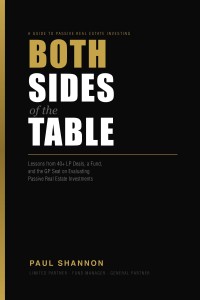
As an LP, I have. To the point at the top of the show, it’s like, “I want to diversify with different sponsors, and this person looks credible, and they’re doing a good job, and they’re using bridge debt.” I do not really have any exposure to it. I’ll take a flyer. Let’s invest. I’ve had trouble with those types of deals. I can relate to these investors on that level, having done about 45 LP positions personally at this point, and then looked at deals at scale as a fund manager, evaluating all different kinds of asset classes. I always try to, and this is what I’ve done in my book too, Both Sides of the Table, which I just launched a couple of months ago, just spell it out how I see it. It’s pretty frank.
This is not an advertisement. This is not a get-rich-quick scheme to use that theme and that phrase again. This is what really goes on in the industry. Here’s how you can be led astray as an LP. Here’s what you should watch out for. Here’s a misnomer that you’ll hear over and over again that you think is the truth. It’s not. It’s a myth. I just lay those things out, and I try to operate with what I feel like is integrity and do things the way that I think is right. The people who have seen that have come along for the ride.
That’s really what I’m trying to build is something that is more legacy-driven that I can be proud of when I’m older and say to my kids, “I’m really excited that I built this thing. It probably was not as big as it could have been.” Do you know what? I stayed out of trouble. I do not. I can look at myself in the mirror, and I always use the phrase, “I want to invest personally as an LP with somebody who would rather break their arm than lose my money.” I’ve invested with people who take the opposite approach.
That’s what the standard I live up to when I take investor capital is like, “Listen, I do not take this lightly. I’ve had investors who feel like they may know me a little bit, as I’m sure you guys probably have. They get to know your personality through your podcast, your writings, or your stuff that you put out on social media, etc. They trust that, and they say, “I want to invest with you. I’ve seen this deal. You like it, I like it, let’s go.”
I remember having a conversation with an investor one time and saying, “I really appreciate that. I’m flattered. I cannot take your capital under that guise. I want you to really look at the documents. I want you to understand the risks. I want you to scrutinize the underwriting. I want you to understand what you are investing your capital in.” If things do not go right, we’re sharing in the reverse together.
You can say, “I knew that was one of the downsides that could potentially happen, and here it is, and we’ll face it. I trust Paul to handle it the best he can,” versus the alternative. Take his capital, her capital. I invest it because they trust me. They do not know much about the deal. It goes south. They point the finger at me, and they blame me and say, “This is your fault. I trusted you. What went wrong? How is this possible?” Investing carries risk. All investing does. I just want to make sure that people understand what that risk is before they allocate their money.
Bootstrapping Deals In Indiana: Underwriting Strategies And Bank Workout Obstacles
Yes, absolutely. I love that. Very well said. Are you currently doing deals right now? What’s your investor sentiment right now from the more sophisticated investors that you’re dealing with?
I’d say it’s cautious optimism. I really would. We have pent-up demand for capital to be placed right now, and we are actively looking for deals. The last deal we did was in January. It’s been a desert lately, which is unfortunate. We had a couple of distressed opportunities that we were fighting red tape and trying to get through to the finish line. For one reason or another, we couldn’t get it under contract. We’re learning how to deal with bank workout rooms, etc. We were just in a best-and-final last week for a property we really liked. We stretched and stretched, and it got a little uncomfortable.
We still got beat by two other groups. They can have it at that point. We’re very actively underwriting. I’ve underwritten 6 or 7 deals this week. It seems like there’s stuff out there. Having a lot of conversations with brokers. We’ve got to look at hundreds of deals, in my opinion, actually. I do not know what the number is. I should probably track that. I always hear the cliche. “We look at a hundred deals to get one.” That might be true. I’d say it’s probably more for us. It’s an interesting time in the market. I do think investors will look to invest if we find something that fits our appetite, though.
An asset class you’re in and the regions you’re in?
As an operator of multifamily, we are specific to Indiana. Center of the USA. We occupy and operate properties pretty much in a straight line across the state, right through the middle. We take the south. We’d like to get into the northern part of the state. There are some interesting opportunities up in Fort Wayne. If you guys know the Chicago Bears, they’re now moving to the northwest suburbs of Indiana. That area is booming. We haven’t broken in up there.
From a capital allocation standpoint, we did quite a bit in the way of debt funds back in 2023 and 2024, and we’re winding down some positions now in 2026. That was fantastic. I was allocating as an OPA into some of these deals, and then I found a couple where I knew some of the people in the sponsor group, and I couldn’t access them. One of them had a million-dollar minimum investment. Even if I had a million dollars sitting around, I probably would not throw it all in like that. That’s pretty concentrated bets. I thought to myself, “I like this as a risk-adjusted play. Let’s bring investors along that we had.”
We had over 50 investors join us in one deal where we earned fifteen percent, two years in a row. The third year was a little lighter, about ten percent, depending on the time one investor got in. That was a great way to keep engagement and investors involved in our ecosystem. Even though we did not have as many deals back then, we did a couple of multifamily deals in 2025 and then one early this year. We’re really getting more bullish towards multifamily, more focused on being operators because from a GP standpoint, I think that’s the fun part. As a middleman, we just cannot influence the business plan as much. We’re excited to operate on the property.
In debt funds, equity, and multifamily value-add, mainly if you do your own deal, it’s going to be in your backyard. If you do it, if you allocate it, you’re agnostic about where the market is and depending on who the sponsor is.
Yes, correct.
Right on.
This has been a great conversation. We hope to have you back on at some point in the next segment of the show.
Championship Rounds Part 1: Mentorship, Financial History Bubbles, And Best/Worst Investments
The 10 championship rounds to financial freedom. We’re going to ask you a series of questions, Paul, just 10. Are you ready? Are you ready to go?
I do not know. I’m not sure yet. Let’s give it a shot.
Let me give it a shot. I love it. First question. Who’s been the most influential person in your life?
That’s easy. It’s my wife. She’s a marathon runner. She pushes me to keep going, and she’s a good influence on me. I love her, and she’s great.
Man, our guests are all scared of their wives.
Terrified of their wives, man. I say my mama every time I go on a show, “My mom.”
I love it. The second question is, what is the number one book you would recommend?
Does it have to be real estate related?
No, anything. Something you’re reading recently, even something that comes to mind, or something you even want to read, or why you want to read it.
I’ve been voraciously reading this year as part of a challenge I’m involved in, and I’ve read a ton of good books, and it’s hard to pick just one. A lot of the books that have shaped me as a real estate investor are not necessarily real estate-related. One that jumps out at me is Devil Take the Hindmost. It’s written by Edward Chancellor.
It’s a history of financial bubbles going back to the tulips of the Netherlands, Amsterdam, Holland, days to the South Sea, China ordeal, and just about every financial crisis across the world over the last 500 years. You can really start to see patterns in how they develop. Going back to what we talked about earlier in the conversation, “I see some headwinds coming.” They’re always different stories, but they rhyme, as Mark Twain says. They all have predictable patterns. Learning from those patterns is really interesting.
I love that. I’ll have to read that one. Next question. If you had the opportunity to travel back in time, what advice would you give your younger self?
What an idiot. I would say believe in yourself a little bit more, honestly. I had the burden of hand in a career that was lucrative and did not fulfill me early on. I realized later on that money’s not really the key to happiness. It’s fulfillment, and it’s doing something that you feel like you’re adding value to the world. It’s connecting with people. I should get that out of what I do today. I just wish I would have taken a chance on myself sooner.
Money is not really the key to happiness. It's fulfillment and doing something where you feel like you're adding value and connecting with people. Share on XOur sons are two and a half and one and a half. We’re having our third one on the way. Paul has young kids, like teenagers, and a seven-year-old as well. We do have the opportunity to travel back in time and teach that to our younger selves, which is our children.
I traveled back in time every time I dyed my beard.
That’s right. Yes, I love that. I just thought of that right now. The next question. What’s the best investment you’ve ever made?
I bought a 40-unit. Multifamily apartment with my own personal capital that was 50% occupied in 2020 and hit the tailwinds and got a lot of rent growth at an underwriter and developed a great relationship with a property manager who’s a partner now and we three extort money. That was a good one.
Are you guys still in that?
No.
That’s awesome.
Smaller deal. It was a very concentrated bet. I 1031 exchanged that into another deal. It’s still rolling.
Amazing. Good for you. Now, what’s the worst investment you’ve ever made, and what lessons did you learn from it?
As I mentioned earlier, I’ve been the victim of fraud a couple of times, and it’s hard to take away a lesson from something like underwriting something because oftentimes the character of a person changes over time. You really know who that person is because you haven’t seen them in a difficult scenario. You just hear them over the phone or on a podcast, or you’re talking to them. Even if you get to know them for years, something unwinds in their personal life, it could change their whole life.
I’ve just learned from that experience that you should not necessarily just trust other people and their experiences. Even if they’ve got a good track record and the person that you trust has had a good outcome with that person, you need to make your own decision. I married up to some people who had already invested with these groups and had success. There were multiple layers to these investments, too, where it was difficult to reach those at the head. You have these differences. I’ll leave it at that. Essentially, character is difficult to measure. You have to be really careful if you invest in it.
Yes. My advice to myself is always to invest with real estate guys. I remember I invested with a guy who came from a different space. The guy was a chiropractor. He came to real estate and did really well. Again, that character completely changed as soon as times got hard.
I wonder if we’re thinking of the same person. We do not have to name names.
Possibly.
I think so.
I think so. The next question is how much would you need in the bank to retire today? What’s your number?
I wouldn’t have one. I used to want to retire early. I was part of the FIRE movement, and it was like, it was almost my wake-up call to get into real estate because I thought that if you reach a certain number and you draw down like four percent of your portfolio, the old Trinity study, where you can live off your principal indefinitely because the market growth will compensate for whatever you spend. I got really uncomfortable with the idea of a sequence of returns risk and spending down my money with no other income coming in.
I thought real estate solved that because it’s like a hybrid bond. It can grow. They have appreciation. You can force that appreciation if you’re a good operator. It pays you a coupon. Pays you rental income, what’s left over after expenses. I thought if I could grow that and live off of that, that would be really appealing to me. I’m having so much fun doing it now that I feel like retirement’s not even on my mind anymore. I’ll do this until it’s no fun anymore. It’s been challenging. I’m still here. I do not think I want to manage other people’s money past 60. I’m 45 right now. That will lighten the load a little bit. I’ll still manage my portfolio.
You’re 45 too. Both of you are 45. Ava is way younger than me.
You guys look younger.
You know what I always think? What the hell would people do when they retire? I’ve had two jobs since I was fourteen. I literally just do not.
Do not get me wrong. I like Mai Tai on the beach too. I like that. I just want to work on my terms.
Championship Rounds Part 2: Street Smarts, LP Profiling, And The Ultimate $1M Debt Fund Play
That’s true. We still make the beach time happen. It’s definitely more challenging when you’re busy, of course, with work. The next question is, if you could have dinner with someone dead or alive, who would it be?
Charlie Munger. Easy.
Cool. Do you want to elaborate on that at all, or does everybody know?
The greatest investor who ever lived.
He’s the man. I would put him and Buffett together, but I think I’d be more interested in Munger. Just, I think he’s super witty and interesting, and it’d be nice to pick his brain.
Of course. Awesome. Love that. Next question. If you weren’t doing what you’re doing today, what would you be doing now?
You guys heard that Luke Combs song? If I wasn’t doing it, I’d still be doing it, or whatever that country music.
No.
What would I be doing if I wasn’t doing this? I do not know. As I said, I’m enjoying what I’m doing. Because I like fundraising. I might do something like a nonprofit and just do something that I really believe in and try to make an impact in that way.
My favorite question. Book smarts or street smarts?
Street smarts, 100%. You can study books all you want, and they’re helpful. No doubt. You’ve got to learn, you’ve got to read, you’ve got to put it into application too. You’ve got to get out there and do it. That’s where you really learn.
It literally blows my mind. I have this conversation with August all the time. It blows my mind how smart some people are. They’re broke. They’re so smart. They’re the smartest people. If you were to talk to them, they would know everything about everything. It’s the way they speak. I’m looking at them being like, “I wish I could speak like you.” You do not have a job, or you make less than 100K a year, for example, or something like that.
Are you saying people who make 100K a year are broke?
No.
Two hundred million Americans.
I did not mean it like that. I’m sorry.
It depends on where you live. If you live in San Francisco, maybe.
I’m just saying, and we live in Vancouver. I’m talking about affording a home. It’s really difficult on 100K a year.
Maybe relative to the way they speak. They do not sound like they make 100,000. They’re selling them.
It is a great income as well. I’m just saying that, or they do not have a job, for example. It just blows my mind. You know what I’m saying?
The way you say it is like, “You speak that well and you’re not accredited?”
That’s what you said.
Doesn’t this business make you profile everyone as accredited or non-accredited? Once in a while, you come to me like, “You know that person?” I’m like, “Yes.” You’re like, “Can you believe that person is not credited?” I’m like, “Really? Like, “They’re not.”
You know, we had our business. It’s just that’s the question we have.
You have to profile the people. Legally, your duty is to profile people before you can even talk to them.
I’m allowed to legally talk to them.
My parents used to always tell me, “You’ve got to hang out with some wealthy and well-educated friends.” My friends were always losers for whatever it was. I just drew in losers for whatever reason it was. When you get into this business, you have to surround yourself with what they do. Otherwise, you cannot survive. You’ve got to be in a weird way. It’s not judgmental.
I did not mean to. Of the 42 million Canadians who live here, only a million are accredited. You know what? A lot of the high net worth, they’re like, “What does accreditation mean?” A lot of them do not even really know what it means anyway.
That’s the good ticket, exactly.
Anyway, getting back to the last question here. Paul, if you had a million dollars in cash and you had to make one investment today, what would it be?
One investment? That’s all that’s got to go to one spot? That’s impossible. I could tell you what I’d do, like four slugs. I do not know about one. By default, right now, I would probably put it into a debt fund because it’s short-term and semi-liquid. I do not have anything that I’m ready to allocate at the moment we’re speaking. If I could put it into a fund where I could potentially have redemption capability and get my money back in two weeks or 90 days, then I could find something.
I go out there and look for another real estate opportunity to invest equity in. The closing wouldn’t be for 60 or 90 days. I could theoretically rotate that money out and put it back into a deal. In the meantime, I’m waiting to earn ten percent or more, depending on what risk level I’m comfortable with. I’d probably roll like that for a while and see how it went.
I was on a podcast. That question was posed to me, and I said that fund.
There you go.
I’ll send you guys a copy of it. It’s time-stamped.
We’ve got to have coffee and talk some other time. Your reference about Ashy Larry makes me know that we’d be friends.
There you go.
The Chappelle reference.
Yes, actually.
Paul, just let everybody know that you’re tuning in. What’s the best way that they can reach you, please?
If you want people to reach you. Maybe you do not want people to reach you.
I do not know. Your audience, I’m not sure. You sound like pretty cool people. I assume your audience is too. I want to thank you guys for having me on the show. It’s been a pleasure and a fun time. First of all, I just wrote Both Sides of the Table. It’s my perspective on syndications as an LP and investing capital with others as a fund-to-fund. Also, as an operator, seeing things from “Both Sides of the Table” gives an investor a blueprint for how to put real estate fundamentals into practice. Can find that on Amazon. My company is InvestWise Collective, InvestWiseCollective.com.
That’s my syndication platform and investing platform. You can check it out there, and you can set up a call with me. In addition to that, I’m in the PassivePockets archives quite a bit with some really interesting guests from periods past. You can check me out there too. We usually get pretty involved with the conference there. Looking forward to that coming up. That’s the best way. I’m on LinkedIn, and I usually have something to say at least once a week.
I’ve been following you for a while.
Incredible. That was Paul Shannon, everybody. That was a fun interview. I enjoyed that conversation, Paul. Thank you so much for being on the show.
Thank you both. It’s been my pleasure.